

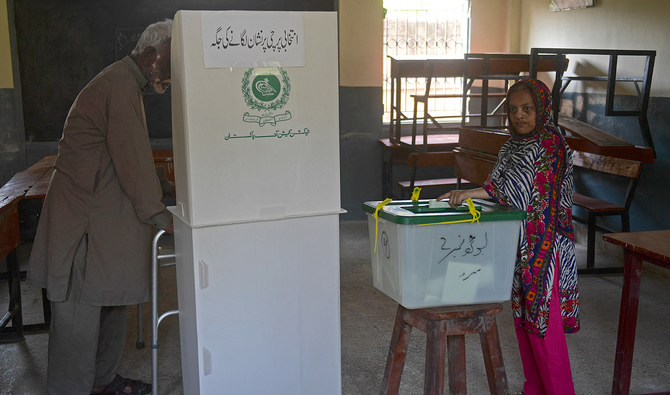

KARACHI: The counting of votes was underway after local government elections in Pakistan's Sindh province after low turnout was witnessed during the first half of the polling day, amid a boycott of polls by Muttahida Qaumi Movement-Pakistan (MQM-P) party in the urban centers of Karachi and Hyderabad.
The Election Commission of Pakistan (ECP) rejected repeated requests of the provincial administration to delay the polls in the two cities due to the concerns raised by the MQM-P over the delimitation of constituencies, saying the elections would be held as per schedule on January 15.
However, the MQM-P, which has a major presence in these urban centers, raised the allegations of “pre-poll rigging” before announcing not to participate in the electoral contest.
Khalid Maqbool Siddiqui, the top party leader, said the delimitation process was solely the responsibility of the election authorities while maintaining it had not managed to fulfil it. He said that his party was withdrawing from the elections and also asked other people to boycott the polls.
“Uncertainty surrounding the polls until last night is one major reason for the low turnout,” Muhammad Aslam, an election official in the Steel Town neighborhood, told Arab News.
“People in Karachi also wake up a little late [on Sundays] and that may also be another reason.”
However, the ECP said people were taking interest in the polls and there were large queues outside the polling stations.
The Sindh police said elections were peacefully taking place despite fears of violence in some areas like Orangi and Korangi towns in the city.
“Elections are being held in a very peaceful environment and there has been no major report of any violent incident,” said a spokesperson.
The ECP also took notice of violations of its code of conduct after a provincial lawmaker, Firdous Shamim Naqvi, visited polling stations in the city. The election authority also took notice of an advertisement by the Sindh administration on various television channels about the local bodies polls.
In Karachi, a bustling megapolis of over 15 million, 10,629 candidates are contesting the polls for 246 union committees of 28 towns across the city. The ECP has set 4,990 polling stations for the elections.
According to the Sindh police, stringent security arrangements have been made at all polling stations, of which 1,496 have been declared “very sensitive.”
Local government elections were scheduled to take place in Karachi and Hyderabad on July 24, 2022. However, last summer’s deadly floods and inadequate security arrangements caused several delays in the election date.
The delays prompted the Pakistan Tehreek-e-Insaf (PTI) and the Jamaat-e-Islami (JI) parties to move the Sindh High Court (SHC) in November last year to ensure the electoral contest was held without further delay.
After a court verdict, the MQM-P said it would quit the federal government, if the center didn’t accommodate its concerns. The Sindh administration issued a notification to cancel the delimitation on Friday, but the election commission turned down its request.
Experts said the MQM-P, once a major political force in Karachi that won the last two mayoral elections, was not likely to emerge as a top party in the local polls.
“It’s going to be a contest between the Pakistan Peoples Party, Jamaat-e-Islami [JI] and the Pakistan Tehreek-e-Insaf [PTI],” said Professor Dr. Tauseef Ahmed Khan, a political analyst, before the MQM-P announced its boycott.
Former prime minister Imran Khan’s PTI party emerged as a major political force in Karachi after the 2018 general elections and won 14 out of 21 National Assembly seats in a major upset to the MQM-P.
The PTI also won the last by-elections in the city to retain its support in Karachi, the largest city and commercial hub of Pakistan.
For Sunday’s polls, the JI has rigorously campaigned for months and fielded Hafiz Naeem-ur-Rehman as its mayoral candidate.
Some experts believe Sindh ruling PPP party strengthened its position by carrying out the delimitation of constituencies in a way that suited its political interests.
“The MQM-P reservations are genuine because of how the delamination process was carried out by the provincial government,” Zia-ur-Rehman, a Karachi-based analyst, said. “A union council in the city comprises up to 60,000 people, but in areas with greater PPP vote bank union councils of up to 20,000 people also exist.”
He believed, however, the MQM-P should have raised these objections “a bit earlier.”
He added he did not expect any party to win 134 seats, the minimum number required for any political faction to install its own mayor.
“No single party may win a clear majority as no one may be able to win 134 of 246 seats,” Zia-ur-Rehman said.


