

Thousands of Indonesian workers protest against president’s job decree

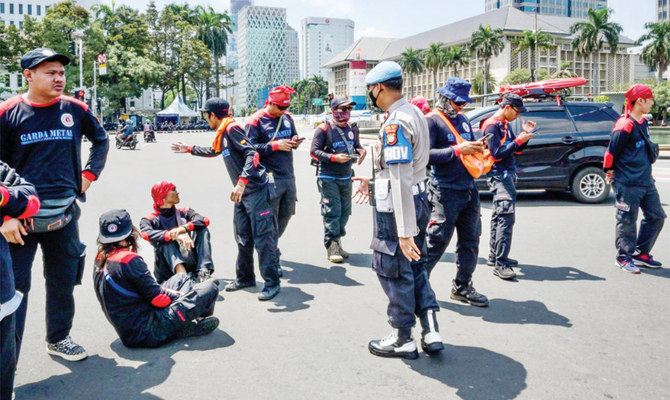
A police officer orders workers to step away from the road during a rally to protest against the job creation bill which they deemed only profits business in Jakarta, Indonesia, on Saturday. (AFP)
Short Url
Updated 14 January 2023
Follow

Thousands of Indonesian workers protest against president’s job decree

  • Protesters held a banner saying “Say no to outsourcing,” while others had signs reading, “Reject job creation emergency decree because there is no emergency situation”

JAKARTA: Thousands of workers held rallies in Indonesia’s capital Jakarta on Saturday, urging parliament to reject a presidential decree that critics say would erode employees’ rights and environmental protections.

President Joko Widodo issued the emergency decree last month, replacing a controversial jobs law in Southeast Asia’s largest economy, a move some legal experts say violated a court ruling.

The Constitutional Court had ruled the 2020 Jobs Creation Law was flawed, saying there had been insufficient public consultation before the law was passed. It ordered lawmakers to complete a renewed process by November.

Protester Damar Panca Mulia, 38, called the decree a government ploy to ensure the implementation of the job law.

“This regulation degrades worker’s welfare, reduces labor protections and causes widespread damage — on agrarian issues, the environment, protection of women,” he said. “Job creation should be in line with workers’ welfare improvement, but this decree runs counter to it. That’s why we oppose it.”

Protesters held a banner saying “Say no to outsourcing,” while others had signs reading, “Reject job creation emergency decree because there is no emergency situation.”

Joko Heriono, 59, said the regulation created uncertainty for workers as they could easily be fired and would get lower severance pay.

Labor party chairman Said Iqbal said outsourcing and minimum wage regulation in the decree were among the issues of concern.

“We don’t want the state to become only an agent for dirty entrepreneurs to weaken workers’ welfare,” Said told reporters.

The Jobs Creation Law, revising more than 70 other laws, had been welcomed by foreign investors for cutting red tape.

Parliament will assess the legal standing of the decree in the current sitting, its deputy speaker said this week. Last week, a group of Indonesians asked the Constitutional Court to carry out a judicial review of the regulation.


Philippines House panel finds bid to impeach Marcos lacks substance

Updated 4 sec ago
Follow

Philippines House panel finds bid to impeach Marcos lacks substance

  • President denies allegations of corruption and constitutional violations
  • Lower chamber is currently dominated by loyalists of the president
MANILA: The Philippine House justice committee on Wednesday said two impeachment complaints against President Ferdinand Marcos Jr., accusing him of corruption, violating the constitution and betraying public trust, were lacking in substance.
On a third day of discussions about the complaints filed separately by a lawyer and activists, the committee overwhelmingly decided both lacked merit. Marcos, who is midway through his term in office, had ‌denied wrongdoing.
The ‌House of Representatives is expected to ‌convene ⁠for a plenary vote ‌where it could either uphold the committee’s findings or override them. The chamber is currently dominated by loyalists of the president.
Gerville Luistro, the head of the justice committee, said they plan to finish the report and submit it to the plenary on Monday next week.
“We intend to transmit right away to the plenary, but ⁠it depends on the plenary as to when the same will be tackled ‌on the floor,” Luistro told a press ‍conference.
For Marcos to be impeached ‍it must be supported by at least one-third of the ‍lower house. If that happens, he would be the second Philippine head of state to be impeached after Joseph Estrada, whose 2001 trial was aborted when some prosecutors walked out. The complaints against Marcos included his decision to allow his predecessor Rodrigo Duterte to be arrested and taken to The Hague to face trial ⁠at the International Criminal Court over thousands of killings during his notorious “war on drugs.”
Marcos, 68, was also accused of abusing his authority in spending public funds that led to a corruption scandal involving flood-control projects. His alleged drug use, which he has denied, also made him unfit to run the country, according to one of the complaints.
If the lower house decides to impeach him, the Senate would be required to convene for trial, where its 24 members serve as jurors.
Five top officials have been impeached in the ‌Philippines and only one of those, a former chief justice, was convicted and removed from office.