After decades, Indonesia’s president acknowledges state’s ‘gross rights violations’

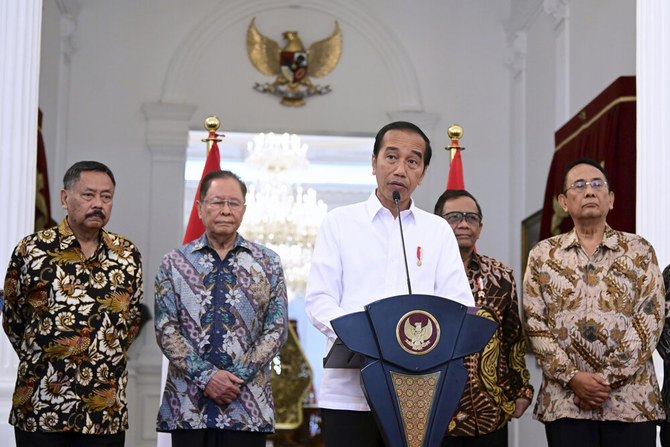
In this photo released by the Press and Media Bureau of the Indonesian Presidential Palace, Indonesian President Joko Widodo, center, delivers a speech at the Merdeka Palace in Jakarta on Jan. 11, 2023. (AP)
Short Url
Updated 11 January 2023
Follow

After decades, Indonesia’s president acknowledges state’s ‘gross rights violations’

  • Jokowi cites 12 incidents, including massacres of 1965-66
  • Activists seek prosecutions, not only acknowledgement

JAKARTA: Indonesia’s President Joko Widodo acknowledged on Wednesday “gross human rights violations” in the country’s past, including the 1960s massacres when up to 1 million people were killed on suspicion of being linked to communists.

One of the darkest periods in Indonesia’s history, the killings of 1965-66 were a series of countrywide political purges targeting members and alleged sympathizers of Partai Komunis Indonesia — at the time the third-largest communist party after China and the Soviet Union.

While an accurate and verified count of the dead is unlikely ever to be known, historians say that a total of 500,000 to 1 million people had been killed. Another 1.5 million had been imprisoned, while their family members still face stigma and discrimination, and many were prevented from holding government jobs up until last year.

“With a clear mind and an earnest heart, I as Indonesia’s head of state admit that gross human rights violations did happen in many instances,” Widodo said on Wednesday after receiving a report from a team formed to help restore the victims’ rights.

“I deeply regret these human rights abuses.”

The president cited 12 incidents of state-sponsored violence between 1965 and 2003, which also included the killing and abduction of activists protesting against the regime of former President Suharto in the 1990s and the military’s violence against indigenous people of the restive Papua province.

Although previous presidents have also acknowledged some of the abuses, including late President Abdurrahman Wahid, who had apologized for the 1965-66 bloodshed, Widodo’s statement is the clearest, most comprehensive admission of the country’s darkest chapters.

“Myself and the government will try to restore the victim’s rights justly and wisely, without negating judicial resolving,” Jokowi said.

But activists say more needs to be done to redress the past violations and injustice faced by the victims and their families for decades.

“A mere acknowledgment without efforts to bring to trial those responsible for past human rights abuses will only add salt to the wounds of victims and their families,” Usman Hamid, executive director of Amnesty International Indonesia, told Arab News.

“This statement is nothing without accountability.”

Widodo “needs to do more than just airing his position,” said Andreas Harsono, Indonesia researcher at Human Rights Watch.

“President Jokowi made the correct statement but he should order his aides to investigate these mass killings, to document mass graves, and to find their families, to match the graves and their families, as well as to set up a commission to decide what to do next,” he told Arab News.

For historian Bonnie Triyana, Widodo’s acknowledgment was, however, a “step forward” for Indonesia to move on from its dark past.

“But we must also ask — what comes next?” he said.

“I hope this isn’t lip service. I hope this comes from the deepest conscience of our head of state and leaders to resolve the issues in our past because of their widespread impact, including the stigmas that are still attached to the victims, especially in relation to the events of 1965.”


Israel says Netanyahu will meet with Trump on Wednesday about Iran talks

Updated 2 sec ago
Follow

Israel says Netanyahu will meet with Trump on Wednesday about Iran talks

  • Israeli Prime Minister Benjamin Netanyahu will meet with US President Donald Trump in Washington on Wednesday about the US talks with Iran
JERUSALEM: Israeli Prime Minister Benjamin Netanyahu will meet with US President Donald Trump in Washington on Wednesday about American talks with Iran, his office said Saturday, while Iran’s foreign minister threatened US military bases in the region a day after the discussions.
“The prime minister believes that all negotiations must include limiting the ballistic missiles, and ending support for the Iranian axis,” Netanyahu’s office said in a brief statement, referring to Tehran’s support for militant groups, including Hezbollah in Lebanon and Hamas in the Palestinian territories. Trump and Netanyahu last met in December.
There was no immediate White House comment.
The US and the Islamic Republic of Iran held indirect talks on Friday in Oman that appeared to return to the starting point on how to approach discussions over Tehran’s nuclear program.
Trump called the talks “very good” and said more were planned for early next week. Washington was represented by Middle East special envoy Steve Witkoff and Jared Kushner, Trump’s son-in-law.
Trump has repeatedly threatened to use force to compel Iran to reach a deal on its nuclear program after sending the aircraft carrier USS Abraham Lincoln and other warships to the region amid Tehran’s crackdown on nationwide protests that killed thousands.
Gulf Arab nations fear an attack could spark a regional war, with memories fresh of the 12-day Israel-Iran war in June.
For the first time in negotiations with Iran, the US on Friday brought its top military commander in the Middle East to the table. US Navy Adm. Brad Cooper, head of the military’s Central Command, then visited the USS Abraham Lincoln on Saturday with Witkoff and Kushner, the command said in a statement.
Iranian Foreign Minister Abbas Araghchi told journalists Friday that “nuclear talks and the resolution of the main issues must take place in a calm atmosphere, without tension and without threats.” He said that diplomats would return to their capitals, signaling that this round of negotiations was over.
On Saturday, Araghchi told the Al Jazeera satellite news network that if the US attacks Iran, his country doesn’t have the ability to strike the US “and therefore has to attack or retaliate against US bases in the region.”
He said there is “very, very deep distrust” after what happened during the previous talks, when the US bombed Iranian nuclear sites during last year’s Israel-Iran war.
Araghchi also said the “missile issue” and other defense matters are “in no way negotiable, neither now nor at any time in the future.”
Tehran has maintained that these talks will be only on its nuclear program.
However, Al Jazeera reported that diplomats from Egypt, Turkiye and Qatar offered Iran a proposal in which Tehran would halt enrichment for three years, send its highly enriched uranium out of the country and pledge to “not initiate the use of ballistic missiles.”
US Secretary of State Marco Rubio said Wednesday that the talks needed to include all those issues.
Israel, a close US ally, believes Iran is pursuing a nuclear weapon and wants its program scrapped, though Iran has insisted that its atomic plans are for peaceful purposes. Israel also wants a halt to Iran’s ballistic missile program and its support for militant groups in the region.
Araghchi, speaking at a forum in Qatar on Saturday, accused Israel of destabilizing the region, saying that it “breaches sovereignties, it assassinates official dignitaries, it conducts terrorist operations, it expands its reach in multiple theaters.” He criticized Israel’s treatment of Palestinians and called for “comprehensive and targeted sanctions against Israel, including an immediate arms embargo.”