

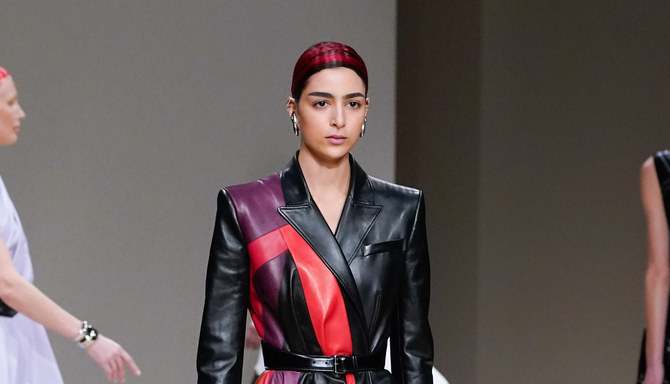
Moroccan British model Nora Attal stars in new Tod’s campaign

The model walked the runway for multiple fashion houses including Alexander Mcqueen. (Getty Images)
Short Url
Updated 14 January 2023
Follow

Moroccan British model Nora Attal stars in new Tod’s campaign

DUBAI: Italian luxury label Tod’s tapped Moroccan British model Nora Attal for their latest campaign, released this week.

Attal took to Instagram to share pictures from the brand’s spring/summer 2023 shoot. In the pictures, Attal wore a large brown woven bag with the brand’s “T” logo in gold placed in the center.

In another shot, the 23-year-old catwalk star posed in a white set that featured straight-leg pants and a blazer that was cinched at the waist. She paired the suit with a white bag and Tod’s “Kate” sneakers.

The campaign, shot by Paris-based photographer Karim Sadli, also stars German model Anna Ewers, Joshua Seth and Paris based model Valentin Caron.

The collection features pale shades and timeless and lightweight materials, according to the brand.


A post shared by Tod's (@tods)

Attal was first discovered by Jonathan Anderson, founder of the JW Anderson label, and shot a campaign for the British fashion house in 2014 before she had even taken her first steps down a catwalk.

She would go on to become a runway fixture. Based in London and signed to Viva Model Management, Attal has worked with a number of renowned designers and stylists. She has walked the runway for major fashion houses, including Tom Ford, Tory Burch, Tiffany & Co., Chanel, Fendi, Burberry and Valentino, to name a few.

Last month, she starred in Chanel’s festive campaign. It was an outer space-themed campaign, in which a bevy of models can be seen jetting off to the Moon in style.


A post shared by Tod's (@tods)

In the short clip, a group of models fly to the Moon on the glittering Eiffel Tower. Once they land, Attal can be seen exploring the lunar landscape while a robot etches the maison’s famous logo onto the surface of the Moon.

Attal also hit the brand’s runway in October at Paris Fashion Week, where she showed off a number of looks as part of the label’s spring/summer 2023 showcase. The ensembles were part of a 71-piece collection designed by the fashion house’s creative director Virginie Viard.

In June, the catwalk star tied the knot with her partner, UK-based photographer Victor Bastidas. The wedding took place against the backdrop of orange and palm trees in the presence of their loved ones in Ibiza, Spain.


Art and the deal: market slump pushes galleries to the Gulf

Updated 47 sec ago
Follow

Art and the deal: market slump pushes galleries to the Gulf

DOHA: With global sales mired in a slump, art dealers have turned to buyers in the oil-rich Gulf, where culture sector spending is on the rise.
Art Basel, which runs elite fairs in Miami, Hong Kong, Paris and Switzerland, held its Gulf debut in Qatar earlier this month.
“The second you land here, you see the ambition. It’s basically the future,” Andisheh Avini, a senior director at New York-based Gagosian Gallery, told AFP at the Doha fair.
“We see a lot of potential in this region and in Qatar,” Avini said, explaining it was “extremely important” for galleries to be exploring new consumer and collector bases.
“That’s why we’re here. And with patience and a long view, I think this is going to be a great hub,” he added.
A 2025 report on the global art market by Art Basel and the Swiss bank UBS showed sales fell across traditional centers in Europe and North America in the previous year.
Economic volatility and geopolitical tensions have weighed on demand, meaning global art market sales reached an estimated $57.5 billion in 2024 — a 12 percent year-on-year decline, the report said.
“The value of sales has ratcheted down for the past two years now, and I do think we’re at a bit of a turning point in terms of confidence and activity in the market,” Art Basel’s chief executive Noah Horowitz told AFP in Doha.

’Time was right’

“Looking at developments in the global art world, we felt the time was right to enter the (Middle East, North Africa and South Asia) region,” he added.
Gulf states have poured billions into museums and cultural development to diversify their economies away from oil and gas and boost tourism.
In 2021, Abu Dhabi, home to the only foreign branch of the Louvre, announced a five-year plan for $6 billion in investments in its culture and creative industries.
Doha has established the National Museum of Qatar and the Museum of Islamic Art. The gas-rich country’s museums authority has in the past reported an annual budget of roughly $1 billion a year to spend on art.
Last year, Saudi Arabia announced that cultural investments in the Kingdom have exceeded $21.6 billion since 2016.
Gagosian had selected early works by Bulgarian artist Christo to feature at Art Basel Qatar.
Best known for large-scale works with his French partner Jeanne-Claude, like the wrapping of Paris’s Arc de Triomphe in 2021, Berlin’s Reichstag in 1995 and Pont Neuf in 1985, the Doha fair exhibited smaller wrapped sculptures.
Avini said the works had sparked curiosity from an “interesting mix” of individuals and potential buyers.
“Of course, you have the Qataris. You’re meeting other dealers, for instance, from Saudi and other parts of the region,” he said.
Among the Christo works were “Wrapped Oil Barrels,” created between 1958-61 shortly after the artist fled communist Bulgaria for Paris.

‘Turn of the cycle’

The barrels — bound tightly with rope, their fabric skins stiffened and darkened with lacquer — inevitably recall the Gulf’s vast hydrocarbon wealth.
But Vladimir Yavachev, Christo’s nephew and now director for the artists’ estate following their deaths, said the barrels were not developed with “any connotation to the oil industry or criticism.”
“He really liked the proportion of this very simple, everyday object,” Yavachev said. “It was really about the aesthetics of the piece,” he added.
Horowitz said there had been an “evolution that we’ve seen through the growth of the market in Asia and here now in the Middle East.”
“With each turn of the cycle in our industry... we’ve seen new audiences come to the table and new content,” he added.
Hazem Harb, a Palestinian artist living between the UAE and Italy, praised Art Basel Qatar for its range of “international artists, so many concepts, so many subjects.”
Among Harb’s works at the fair were piles of old keys reminiscent of those carried during the “Nakba” in 1948, when around 760,000 Palestinians fled or were forced from their homes.
Next to them was a pile of newer keys — 3D-printed replicas of the key to Harb’s own apartment in Gaza, destroyed in the recent war.
In the Gulf and beyond, Harb said he thought there was a “revolution” happening in Arab art “from Cairo to Beirut to Baghdad to Kuwait... there is a new era, about culture, about art.”