
QUETTA: Police in Pakistan’s coastal city of Gwadar have arrested a prominent civil rights leader along with two other persons, an official said on Friday, after weeks of clashes in the town at the heart of a multi-billion economic corridor in the impoverished Balochistan province.
Gwadar is the epicenter of the $64 billion China-Pakistan Economic Corridor (CPEC), a road and infrastructure development plan of Beijing, which aims to ultimately provide the shortest route for Chinese cargo headed for the Middle East, Africa and Central Asia.
But residents of the city say the Chinese investment in the region has done little to improve their lives and many of them complain of water scarcity and lack of employment opportunities, demanding an end to illegal trawling and removal of unnecessary security checkpoints from the area.
Clashes erupted between the protesters and the police in the last week of December after Pakistani authorities arrested 18 members of the 'Give Gwadar its Rights' movement, who were protesting outside the Gwadar port against illegal trawling, border restrictions and unnecessary check-posts in the city.
The clashes resulted in the killing of a police constable in the southwestern coastal town on December 27, after which the police had registered a case against Maulana Hidayat-ur-Rehman, chief of the ‘Give Gwadar its Rights’ movement.
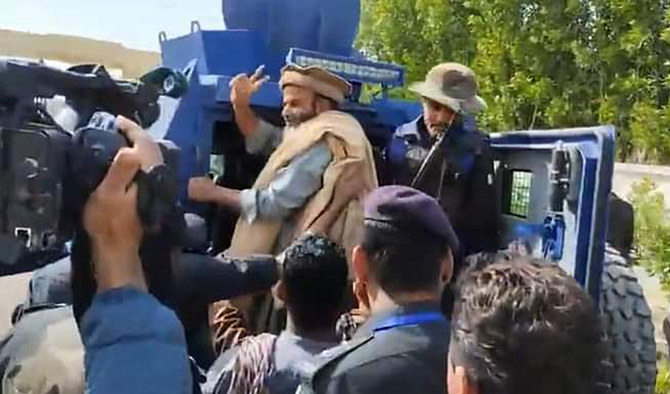
“Maulana Hidayat-ur-Rehman was wanted by the police in the murder of Police Constable Yasir during the clashes and for inciting the people of Gwadar to violence,” Balochistan Information Secretary Hamza Shafqat told Arab News.
"The police arrested Maulana Hidayat-ur-Rehman and two of his accomplices from inside the premises of a court in Gwadar."
Shafqat said the detainees would be tried in courts under the Constitution of Pakistan and dealt with according to the law.
Protests against the lack of basic facilities in Gwadar first erupted in November 2021, but dissipated after the government negotiated with demonstrators and promised to meet their demands. The protests again broke out some two months ago and led to the killing of the police constable, forcing the provincial administration to prohibit large gatherings in the coastal town.
The authorities even suspended mobile and internet services in Gwadar last month, with international rights organizations expressing concerns over the blackouts. The communication services were eventually restored in the first week of January.
Rehman, who faces around 20 cases including one over the murder of the police constable, went into hiding after the killing, but announced last week he was returning to Gwadar to surrender himself.
“Today, we appeared in a court of law to present ourselves for arrest because we trust the judiciary and the Constitution of Pakistan,” the rights leader told reporters outside the Gwadar district court.
"Despite the fake cases registered against me and my supporters and political victimization, we will continue our peaceful struggle for the rights of the people of Gwadar."
He said the authorities had registered 20 cases against him for staging the protest and 13 of his supporters were being tried in Quetta, but they would face the cases.
The Balochistan Bar Council has announced a boycott of all court proceedings on January 14 to protest Rehman's arrest.
“The chief of Give Gwadar its Rights movement appeared to file an interim bail plea, but the police acted against the law and arrested him,” the lawyers' association said in a statement.
The bar council requested the Balochistan chief secretary and the inspector-general of police to take immediate notice of the "illegal act."