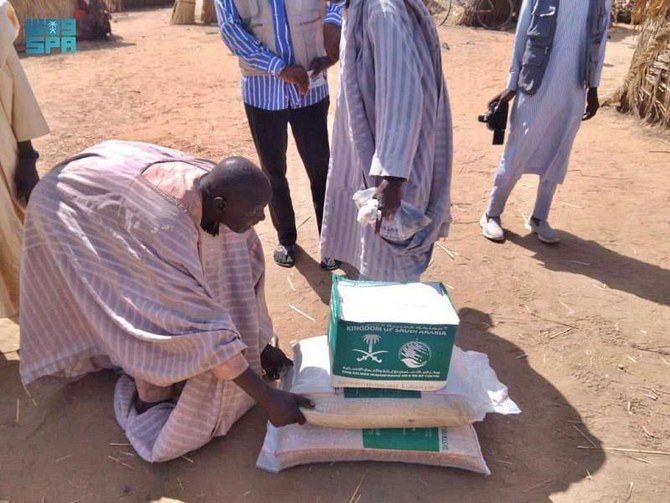
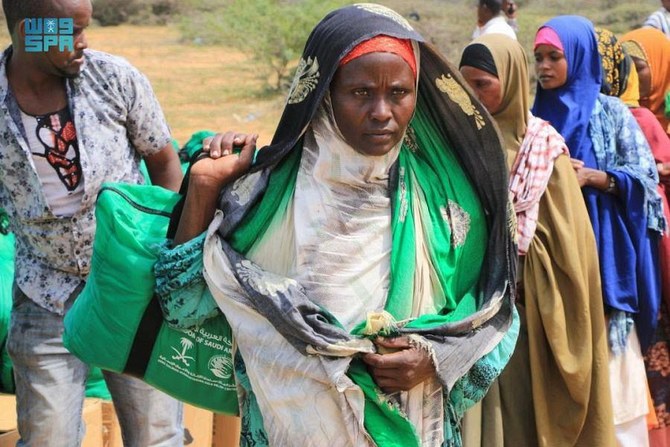
DUBAI: The King Salman Humanitarian Aid and Relief Center (KSRelief) distributed 4,000 winter bags in camps for displaced people in Somalia, benefiting 24,000 people.
In cooperation with the Organization of Islamic Cooperation (OIC), the initiative aims to provide clothing, shelter bags, tents, and necessary supplies to underprivileged people in the drought-stricken African nation, wrote state agency SPA.
KSRelief also distributed food vouchers to refugee families and people in-need on Wednesday as part of its food security project in Jordan.
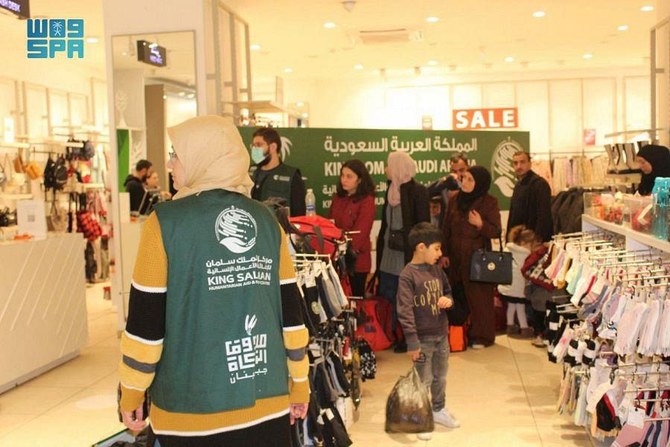
Similarly, 1,318 vouchers were distributed among Syrian and Palestinian refugees, and families in-need from the host community in Lebanon, providing them with winter clothing as part of KSRelief’s Kanaf project.
Meanwhile, 3,120 food baskets were distributed in Nigeria, benefiting 18,720 displaced individuals in the West African country.
The relief efforts come as the Advisor at the Royal Court and Supervisor General of KSRelief, Dr. Abdullah bin Abdulaziz Al Rabeeah, met with Gerd Muller, Director General of the United Nations Industrial Development Organization on Wednesday.
Muller praised KSRelief’s humanitarian efforts as the pair discussed areas of joint cooperation between the two philanthropic organizations.

KSRelief continues aid efforts in 4 countries, praised by UN Industrial Development Organization
https://arab.news/yqsp8
KSRelief continues aid efforts in 4 countries, praised by UN Industrial Development Organization
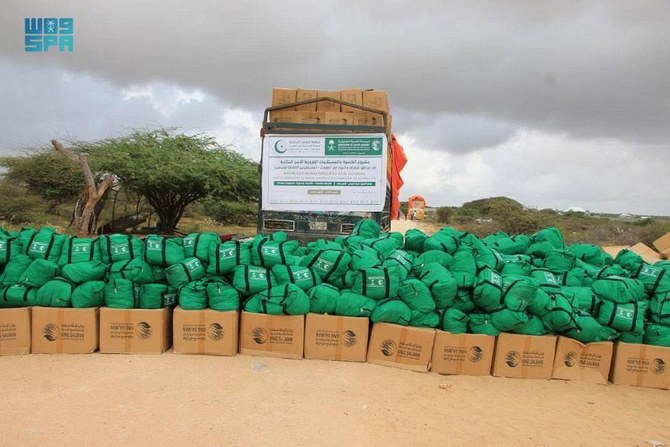
- 3,120 food baskets were distributed in Nigeria, benefiting 18,720 displaced individuals
Saudi wildlife center records rare sighting of critically endangered leatherback turtle in Red Sea
- NCW says the leatherback traveled thousands of kilometers to reach the Red Sea
- The closest known nesting grounds are located in India’s Andaman Islands, some 6,500 km distant
RIYADH: Saudi Arabia's National Center for Wildlife (NCW) has documented a rare sighting of a leatherback sea turtle in the Red Sea, marking a significant biological record for one of the planet's most critically endangered marine species.
The sighting occurred approximately 30 kilometers off the coast of Al-Qunfudhah within the Blue Holes Protected Area, a newly established marine reserve, according to the Saudi Press Agency.
The NCW confirmed that the presence of a leatherback in these waters is an exceptional event. Recognized as the largest turtle species on Earth, the leatherback can weigh up to 900 kilograms. It is easily identified by its unique leathery, black carapace—distinguished by five longitudinal ridges rather than a hard bony shell—and its ability to dive to depths exceeding 1,000 meters.
Noting the species' migratory nature, the center explained that leatherbacks travel thousands of kilometers foraging for jellyfish. The specimen likely navigated through the Bab el-Mandeb Strait in search of food.
This is considered a remarkable journey, the NCW said, noting that the nearest known populations reside in the Indian Ocean, spanning waters from South Africa to Sri Lanka (roughly 7,000 to 8,000 kilometers away). The closest known nesting grounds are located in India’s Andaman Islands, approximately 6,500 kilometers distant. No nesting activity has been recorded in the Red Sea.
According to the IUCN Red List, the leatherback is Critically Endangered in the Indian Ocean. While data for the Red Sea and Arabian Gulf is scarce, recent isolated sightings include a juvenile recorded in Jordan in December 2025 and another off Djibouti in 2019.
The NCW emphasized that these rare appearances highlight the ecological importance of the Kingdom's marine conservation efforts in the Red Sea. The center pointed to the Farasan Islands Marine Protected Area, along with the new Blue Holes and Ras Hatiba reserves, as critical sanctuaries that could support the potential expansion of such endangered species' ranges.