

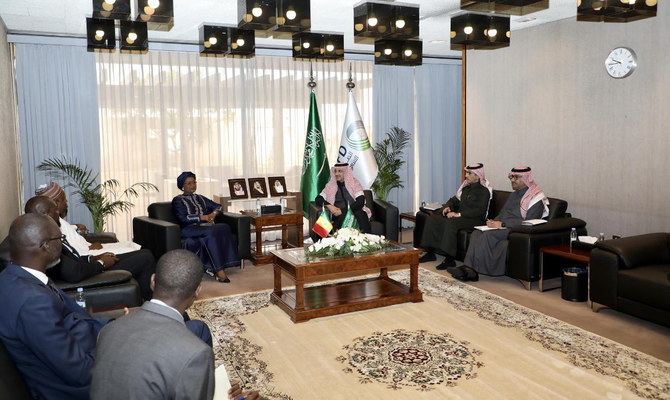
Saudi development fund chief meets Senegalese, Malian officials

Image: SPA
Short Url
Updated 12 January 2023
Follow

Saudi development fund chief meets Senegalese, Malian officials

RIYADH: The Chief Executive Officer of the Saudi Fund for Development Sultan bin Abdulrahman Al-Murshed on Wednesday received Senegal’s Minister of Planning, Economy, and Cooperation Oulimata Sarr and her accompanying delegation at the fund’s headquarters in Riyadh.

During the meeting, they discussed current and future development projects in Senegal, and Sarr thanked the Saudi government for its contribution and support through the SFD toward improving livelihoods, advancing economic development, and achieving sustainable development goals in the west African country.

Since 1978, the SFD has implemented 26 projects and development programs worth around $447 million and administrated four grants provided by the Saudi government through the fund, totalling more than $19 million.

The funding has been used in the sectors of transportation, communications, infrastructure, health, housing, urban development, energy, education, water, and sanitation.

Separately, Al-Murshed met Mali’s Minister of Mines, Energy, and Water Lamine Seydou Traore, and his accompanying delegation, for talks on existing SFD-funded development projects and those under implementation in Mali, and opportunities to enhance development cooperation.

The fund has offered 16 development loans to Mali to finance 15 projects in the agriculture, water, transportation, and infrastructure sectors, in addition to administrating four grants provided by the Saudi government to Mali.

Al-Murshed also met with the CEO of the Islamic Corporation for the Insurance of Investment and Export Credit Osama bin Abdulrahman Al-Qaisi, and his delegation.

Following a briefing on SFD activities, they discussed ongoing development projects and ways to strengthen partnership and cooperation.

Al-Qaisi praised the SFD’s help in providing support for developing countries around the world.


Saudi Arabia launches initiative to reroute Gulf cargo to Red Sea ports

Updated 13 March 2026
Follow

Saudi Arabia launches initiative to reroute Gulf cargo to Red Sea ports

  • The initiative comes as shipping through the Strait of Hormuz has been severely disrupted by the widening conflict in the region
  • Since the US and Israel struck Iran last month, Tehran has moved to restrict passage through the waterway


RIYADH: Saudi Arabia has launched an initiative to redirect shipping from ports in the Arabian Gulf to its Red Sea ports amid the ongoing US-Israel-Iran war.

Transport Minister Saleh Al-Jasser, who also chairs the Saudi Ports Authority (Mawani), launched the Logistics Corridors Initiative alongside Zakat, Tax and Customs Authority Governor Suhail Abanmi, Mawani President Suliman Al-Mazroua, and other officials, the Saudi Press Agency reported.

The initiative will establish dedicated operational corridors to receive containers and cargo redirected from ports in the Kingdom's Eastern Region and other Gulf Cooperation Council states to Jeddah Islamic Port and other Red Sea coast ports.

Al-Jasser said the Kingdom was committed to ensuring supply-chain stability and the smooth flow of goods through global trade routes. Jeddah Islamic Port and other west coast ports, he added, were already playing a key role in accommodating shipments redirected from the east, while also linking Gulf cargo to regional and international markets.

The initiative comes as shipping through the Strait of Hormuz has been severely disrupted by the widening conflict in the region. Iran has long threatened to close the strait — the world's most critical oil and gas chokepoint, through which roughly a fifth of global oil supplies pass — in the event of a war.

Since the US and Israel struck Iran last month, Tehran has moved to restrict passage through the waterway, sending freight rates soaring and forcing shipping companies to seek alternative routes.

Saudi Arabia's Red Sea ports offer a viable bypass, connecting Gulf cargo to global markets without passing through the strait.