

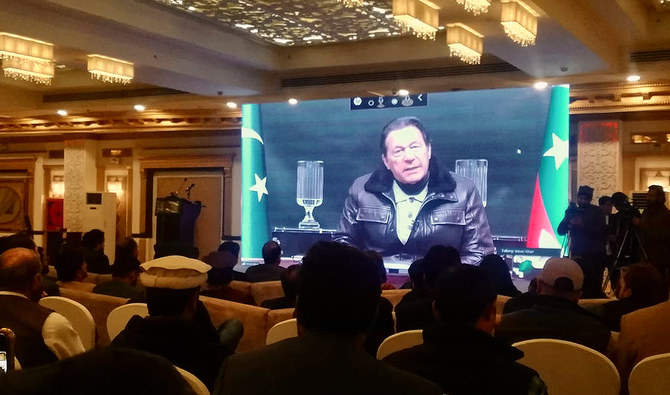

ISLAMABAD: Former prime minister Imran Khan on Tuesday called on the Shehbaz Sharif-led coalition government to engage with the Afghan Taliban, amid a surge in militant attacks in the South Asian country.
Pakistan has witnessed a surge in militancy, particularly after the Pakistani Taliban, or the Tehreek-e-Taliban Pakistan (TTP), ended a cease-fire agreement with the government in November, which has raised fears of a return of militancy and bloodshed in the South Asian country.
The Pakistani Taliban is a separate group but also a close ally of the Afghan Taliban, who seized power in neighboring Afghanistan in August 2021 as US and NATO troops were in the final stages of their pullout from the country after 20 years of war. Many TTP leaders and fighters have found sanctuary and even been living openly in Afghanistan since the Taliban takeover, which has also emboldened the TTP.
In light of the present situation, Pakistan’s top national security body has decided that the country would continue its “war against terrorism,” which will be led by the center and the provincial governments as per the country’s internal security policy.
But Khan on Tuesday criticized the government’s for not engaging with Afghanistan’s Taliban authorities and warned it against deteriorating ties with Kabul.
“Why hasn’t the PDM government talked to the Afghan government? Why Bilawal [Bhutto-Zardari] hasn’t visited Kabul despite going everywhere else in the world,” Khan questioned as he virtually addressed a seminar on the resurgence of militancy in Pakistan.
“Few ministers of the current government are giving very irresponsible statements about attacking the TTP inside Afghanistan and if this new Afghan government stopped cooperation with Pakistan, then this war on terror will expand and will be difficult to control.”
In November last year, Pakistan’s State Minister for Foreign Affairs Hina Rabbani Khar held meetings with the Afghan interim government leadership on a daylong visit to Kabul to discuss a range of issues of common interest, including trade, transit and connectivity between the two countries.
Pakistan has seen innumerable militant attacks in the past two decades but there has been an uptick since November, when the TTP ended the fragile, monthslong cease-fire with the government that was brokered by the Afghan Taliban.
Last month, 33 TTP fighters detained at Bannu’s Counter Terrorism Department seized the compound and took staff hostage. The Pakistani army’s response killed 25 militants.
Pakistan’s national security committee has ruled out negotiations with the militants, saying it will take tough action against them.
“After the departure of the United States, a pro-Pakistan government came in the form of the Taliban in Afghanistan and they were cooperating with my government by putting pressure on the TTP,” Khan said.
“If Pakistan will deteriorate its relations with the Taliban government in Afghanistan, the war on terror will become a curse and punishment.”
Khan, whose party rules the northwestern Khyber Pakhtunkhwa province, said it would suffer the most from this surge in militancy.
“The federal government should sit together with its departments and take a proper input from KP to decide a way of actions to control terrorism,” he said.
Mansoor Ahmad Khan, Pakistan’s former ambassador to Afghanistan, said the TTP and cross-border attacks had been disturbing Pakistan for quite some time, despite multiple diplomatic attempts to persuade successive Afghan governments to control the group.
“We took the issue of TTP safe havens in Afghanistan up with previous Afghan governments as well as the current Taliban regime,” he told Arab News.
“We have asked for their cooperation in eliminating TTP safe havens and also finding a permanent solution to this issue, but could not find a proper solution to these issues.”
There were a few gaps between the concerned institutions and departments of the two countries and bilateral engagement was the “only solution to this problem,” he added.


