

Hurricanes and floods bring $120 billion in insurance losses in 2022

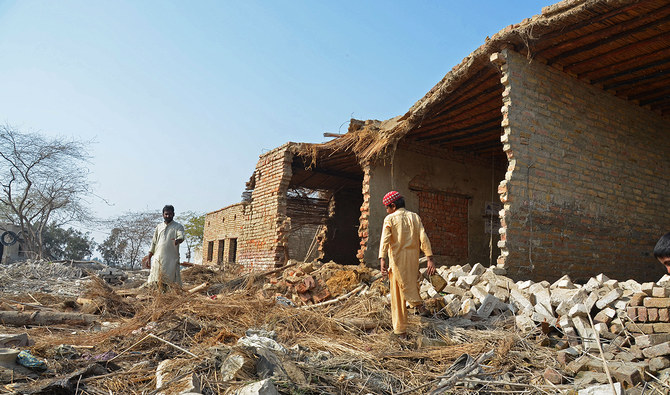
Flood-affected residents collect bricks from the debris of their damaged house in the flood-hit area of Dera Allah Yar in Jaffarabad district of Balochistan province on January 9, 2023. (Photo courtesy: AFP)
Short Url
Updated 10 January 2023
Follow

Hurricanes and floods bring $120 billion in insurance losses in 2022

  • Total losses from natural catastrophes, including those not covered by insurance, were $270 billion
  • Scientists say that events in 2022 were exacerbated by climate change and that there is more to come

FRANKFURT/MUNICH: Hurricane Ian in the United States and floods and Australia helped to make 2022 one of the costliest years on record for natural disasters, Munich Re said on Tuesday, warning that climate change was making storms more intense and frequent.

Losses from natural catastrophes covered by insurance totalled around $120 billion last year, similar to 2021, though short of 2017’s record damages, Munich Re, the world’s largest reinsurer, said.

The annual tally by Munich Re is higher than the average of $97 billion in insured losses over the previous five years and exceeds an initial estimate of $115 billion last month by rival Swiss Re.

“Weather shocks are on the rise,” Ernst Rauch, chief climate scientist at Munich Re, told Reuters. “We can’t directly attribute any single severe weather event to climate change. But climate change has made weather extremes more likely.”

Annual insured losses of $100 billion appear to be “the new normal,” he said.

Total losses from natural catastrophes, including those not covered by insurance, were $270 billion in 2022. That is down from around $320 billion in 2021 and near the average of the previous five years.

The United States once again accounted for a big portion of the losses with Hurricane Ian, which hit Florida in September, causing $60 billion of insured damages and $100 billion in total losses.

Floods in Australia early in the year and again in October resulted in $4.7 billion in insured damages and $8.1 billion overall.

Record monsoon rains and faster melting of glaciers resulted in floods in Pakistan that killed at least 1,700 people and caused $15 billion in damages. Most of the damage was not covered by insurance.

Scientists have said that events in 2022 were exacerbated by climate change and that there is more – and worse – to come as the Earth’s atmosphere continues to warm through the next decade and beyond.

Insurers have in some cases been raising the rates they charge as a result of the increasing likelihood of disasters, and in some places have stopped providing coverage.


Pakistan invites Bangladesh’s new prime minister for official visit in post-election outreach

Updated 7 sec ago
Follow

Pakistan invites Bangladesh’s new prime minister for official visit in post-election outreach

  • Planning minister Ahsan Iqbal attends swearing-in in Dhaka, proposes reviving regional cooperation
  • Islamabad offers scholarships, connectivity and academic exchanges to expand bilateral ties with Dhaka 

ISLAMABAD: Pakistan has formally invited Bangladesh’s newly elected prime minister, Tarique Rahman, to visit Islamabad, its information ministry said on Wednesday after senior minister Ahsan Iqbal met the new premier in Dhaka following the oath-taking ceremony.

The outreach signals a cautious attempt by the two South Asian nations to improve relations decades after the 1971 war that led to Bangladesh’s independence from Pakistan, with diplomatic engagement historically limited and economic links underdeveloped compared with regional potential.

After former Bangladeshi prime minister Sheikh Hasina was ousted during the 2024 political upheaval and fled to India, relations between Dhaka and Islamabad began to normalize after years of near-frozen contact. For over a decade under Hasina’s Awami League government, Bangladesh had aligned closely with India and kept Pakistan at diplomatic arm’s length. 

The political shift in Dhaka — culminating in the 2026 election victory of the Bangladesh Nationalist Party (BNP) led by Tarique Rahman — created space for engagement, including the relaunch of direct flights, high-level political and military exchanges, technical cooperation and business ties. The reset reflects broader regional dynamics: Bangladesh diversifying its diplomacy beyond India, and Pakistan seeking economic partnerships in South Asia amid a geo-economic foreign policy push.

“Planning Minister Ahsan Iqbal conveyed a formal invitation from the Prime Minister of Pakistan to Prime Minister Tarique Rahman to undertake an official visit to Pakistan at a mutually convenient date,” a Pakistani information ministry statement said, quoting Iqbal who represented Islamabad at the oath taking. 

“The two leaders discussed avenues to reinvigorate bilateral relations and enhance regional cooperation.”

The two sides discussed expanding cooperation in education, research and digital governance, including a proposed “Pakistan–Bangladesh Knowledge Corridor” to promote academic partnerships and student exchanges.

Islamabad said it had allocated 500 scholarships for Bangladeshi students, with 75 already traveling to Pakistan for higher education, and proposed closer coordination between national data and statistics institutions in both countries.

Officials also discussed improving direct flight connectivity to boost trade, tourism and business links, as well as cooperation in small and medium-sized industries and technology-enabled services.

The statement added that both sides supported stronger cultural engagement, including joint celebrations next year marking the 150th birth anniversary of philosopher-poet Muhammad Iqbal.

Both countries reaffirmed their commitment to strengthening ties and promoting regional stability and economic cooperation, the statement added.