

Hurricanes and floods bring $120 billion in insurance losses in 2022

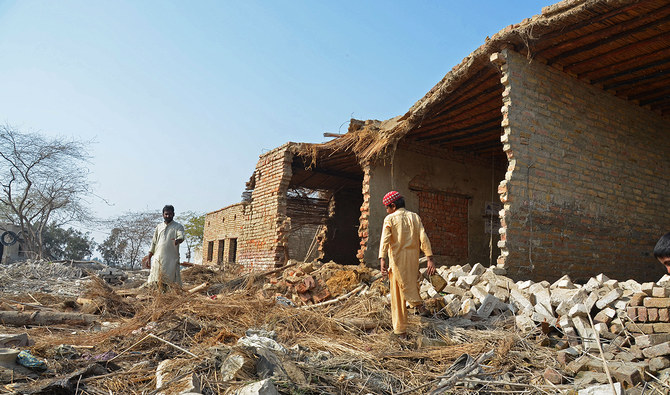
Flood-affected residents collect bricks from the debris of their damaged house in the flood-hit area of Dera Allah Yar in Jaffarabad district of Balochistan province on January 9, 2023. (Photo courtesy: AFP)
Short Url
Updated 10 January 2023
Follow

Hurricanes and floods bring $120 billion in insurance losses in 2022

  • Total losses from natural catastrophes, including those not covered by insurance, were $270 billion
  • Scientists say that events in 2022 were exacerbated by climate change and that there is more to come

FRANKFURT/MUNICH: Hurricane Ian in the United States and floods and Australia helped to make 2022 one of the costliest years on record for natural disasters, Munich Re said on Tuesday, warning that climate change was making storms more intense and frequent.

Losses from natural catastrophes covered by insurance totalled around $120 billion last year, similar to 2021, though short of 2017’s record damages, Munich Re, the world’s largest reinsurer, said.

The annual tally by Munich Re is higher than the average of $97 billion in insured losses over the previous five years and exceeds an initial estimate of $115 billion last month by rival Swiss Re.

“Weather shocks are on the rise,” Ernst Rauch, chief climate scientist at Munich Re, told Reuters. “We can’t directly attribute any single severe weather event to climate change. But climate change has made weather extremes more likely.”

Annual insured losses of $100 billion appear to be “the new normal,” he said.

Total losses from natural catastrophes, including those not covered by insurance, were $270 billion in 2022. That is down from around $320 billion in 2021 and near the average of the previous five years.

The United States once again accounted for a big portion of the losses with Hurricane Ian, which hit Florida in September, causing $60 billion of insured damages and $100 billion in total losses.

Floods in Australia early in the year and again in October resulted in $4.7 billion in insured damages and $8.1 billion overall.

Record monsoon rains and faster melting of glaciers resulted in floods in Pakistan that killed at least 1,700 people and caused $15 billion in damages. Most of the damage was not covered by insurance.

Scientists have said that events in 2022 were exacerbated by climate change and that there is more – and worse – to come as the Earth’s atmosphere continues to warm through the next decade and beyond.

Insurers have in some cases been raising the rates they charge as a result of the increasing likelihood of disasters, and in some places have stopped providing coverage.


Excavations resume at Mohenjo-Daro to study early Harappan city wall

Updated 6 sec ago
Follow

Excavations resume at Mohenjo-Daro to study early Harappan city wall

  • A joint Pakistani-US team probes multi-phase wall dating to around 2800 BC
  • Research remains limited despite Mohenjo-Daro’s archaeological importance

ISLAMABAD: Archaeologists working at the ancient site of Mohenjo-Daro have resumed excavations aimed at better understanding the city’s early development, including the structure and chronology of a massive perimeter wall first identified more than seven decades ago, officials said on Saturday.

The latest excavation season, launched in late December, is part of a joint Pakistani-US research effort approved by the Technical Consultative Committee of the National Fund for Mohenjo-Daro, which met at the site this week to review conservation and research priorities. The work focuses on reassessing the city’s defensive architecture and early occupation layers through controlled excavation and carbon dating.

Jonathan Mark Kenoyer, a senior archaeologist involved in the project, told the committee that the excavation targets a section of the city wall originally uncovered by British archaeologist Mortimer Wheeler in 1950.

“This wall was over seven meters wide and built in multiple phases, reaching a height of approximately seven meters,” Kenoyer said, according to an official statement circulated after the meeting. “The lowest part of the wall appears to have been constructed during the early Harappan period, around 2800 BC.”

Organic material recovered from different excavation levels is being analyzed for carbon dating to establish a clearer timeline of the site’s development, the statement continued, adding that the findings would be published after detailed study.

The committee noted that despite Mohenjo-Daro’s status as one of the world’s earliest and largest urban centers, systematic research at the site has remained limited in recent decades. Its members agreed to expand archaeological studies and invited new research proposals to help formulate a long-term strategy for the site.

The committee also approved the continuation of conservation work on previously excavated material, including dry core drilling data, and reviewed progress on preserving a coin hoard discovered at the site in 2023, the results of which are expected to be published after conservation is completed.

Mohenjo-Daro, a UNESCO World Heritage site in Pakistan’s Sindh province, was a major center of the Indus Valley Civilization, which flourished more than 4,000 years ago.