

DIFC maintains leading position among global financial centers, says CEO 

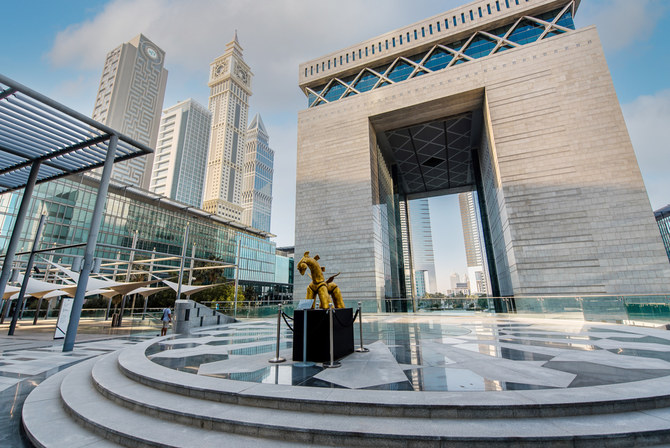
Among the 4,031 companies registered in DIFC, the center hosts 17 of the top 20 banks in the world, and 25 of the 30 most important banks of systemic importance globally. (Shutterstock)
Short Url
Updated 10 January 2023
Follow

DIFC maintains leading position among global financial centers, says CEO 

RIYADH: With more than 250 companies worth over $450 billion, Dubai International Financial Centre has become the largest wealth and asset management center in the world, said the CEO of DIFC Arif Amiri.    

Calling it a major engine for economic growth in Dubai and the UAE, he revealed that the center contributes about 5 percent of the value of the nominal gross domestic product of Dubai. 

Amiri stated that DIFC has maintained its leading position among global financial centers, as Dubai ranked first in the Middle East and among the top 20 globally on the Global Financial Centres Index for 2022.  

In an interview with the Emirates News Agency, WAM, Amiri said that the contribution of financial companies operating from DIFC to the financial services sector in the country exceeds 13 percent of the nominal GDP of Dubai during the year 2021. 

Among the 4,031 companies registered in DIFC, the center hosts 17 of the top 20 banks in the world, and 25 of the 30 most important banks of systemic importance globally. It is also home to five of the top 10 insurance companies, five of the top 10 asset management companies, and many other leading law and consulting companies at the global level.  

He stressed that DIFC enjoys a pioneering operating environment and legal and regulatory frameworks that are in line with the best international standards. 

The center attracted 1,252 related companies specialized in finance and innovation. This comes as the first six months of 2022 witnessed an increase in the number of financial technology companies and innovation companies registered in the center to 599 companies, registering a year-on-year increase of 23 percent.  

Amiri pointed out that the center’s strategic location helps wealth and asset managers access emerging wealth in the fast-growing markets in the Middle East Africa and South Asia region.  

He concluded by saying that the center will continue its leading role in defining the parameters of the sector by launching initiatives that are consistent with its strategy for the year 2030.  


Jordan, Lebanon sign 21 cooperation agreements across various fields

Updated 5 sec ago
Follow

Jordan, Lebanon sign 21 cooperation agreements across various fields

RIYADH: Jordan and Lebanon have sealed 21 cooperation agreements across various fields, including energy, electrical interconnection, and industry.

Jordanian Prime Minister Jafar Hassan and his Lebanese counterpart, Nawaf Salam, witnessed the signing of the deals between the two countries, following their chairing of the eighth session of the Jordanian-Lebanese Joint Higher Committee in Beirut, the Jordan News Agency, or Petra, reported.

Additional areas of cooperation included trade, investment, and tourism, as well as transport and several service sectors.

This reflects the ongoing trade relationship between the two countries. In 2023, Jordan exported $101 million worth of goods to Lebanon, while Lebanon exported $111 million to Jordan, according to data from the Observatory of Economic Complexity.

Petra stated: “In joint press statements after the signing of the agreements, Hassan said that Jordan will continue, as it always has, to support Lebanon and to stand by its security, stability and sovereignty.”

It added: “He stressed that supporting Lebanon is a firm Jordanian position under the continuous guidance of His Majesty King Abdullah II, who tasked him with working intensively to translate the historic relations between the two countries into comprehensive cooperation across all fields.”

The prime minister noted that despite the absence of a shared border between Jordan and Lebanon, the two nations are closely connected through long-standing ties of communication, cooperation, and integration at both official and public levels, extending across economic and cultural spheres.

He further stated that both countries are committed to reinforcing these ties and advancing their relationship, with the next phase expected to see broader institutional cooperation that serves the interests of Jordan and Lebanon.

Hassan underlined that the Joint Jordanian-Lebanese Higher Committee convened again, highlighting the two sides’ commitment to maintaining and regularly holding these meetings in line with the strong fraternal ties.

The prime minister added that both sides agreed to maintain ongoing communication and coordination among ministers, officials, and technical teams to ensure the implementation of the agreed accords and to explore future areas of cooperation in ways that serve the interests of both countries and their peoples.