

Saudi Arabia restores Pakistan’s pre-pandemic Hajj quota of 179,210 pilgrims 

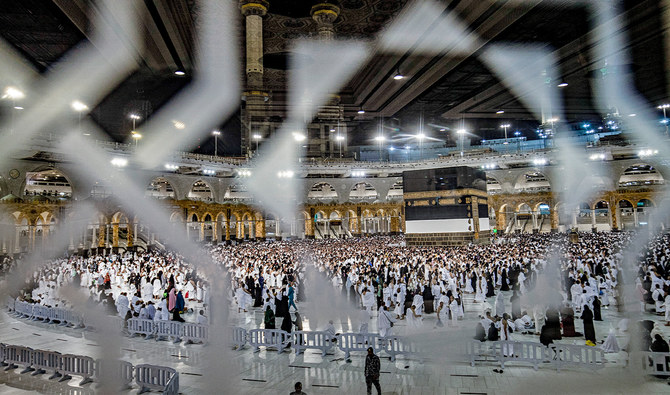
Muslim pilgrims circumambulate around the Kaaba, Islam's holiest shrine, during the annual Hajj pilgrimage at the Grand Mosque in Saudi Arabia's holy city of Makkah on July 6, 2022. (AFP/File)
Short Url
Updated 10 January 2023
Follow

Saudi Arabia restores Pakistan’s pre-pandemic Hajj quota of 179,210 pilgrims 

  • Saudi Arabia lifts pre-pandemic age restriction of 65 years to perform Hajj
  • Pakistan to likely accept Hajj applications from February 2023 onwards

Islamabad: Saudi Arabia restored Pakistan’s pre-coronavirus Hajj quota of 179,210 pilgrims and abolished the upper age limit of 65 years to perform the annual pilgrimage, Pakistan’s religion ministry confirmed on Monday. 

The Hajj is a spiritual journey that every Muslim adult must undertake once in his lifetime, to the holy sites in Makkah and Madinah, if he is financially and physically able to do so. It is one of the important five pillars of the Islamic faith.

At the height of the coronavirus pandemic in 2020, the Hajj was restricted to just 1,000 local residents. In 2021, the kingdom limited the annual pilgrimage to 60,000 domestic participants only, compared with the pre-coronavirus pandemic figure of 2.5 million pilgrims from around the world. 

Last year, the kingdom granted Pakistan a quota of 81,132 pilgrims. Other restrictions imposed on pilgrims from around the world to perform the Hajj included an upper age limit of 65. Pilgrims were also required to be vaccinated with vaccinations approved by the Saudi health authorities. 

Pakistan’s Minister for Religious Affairs and Interfaith Harmony, Mufti Abdul Shakoor, arrived in Jeddah on Monday to attend the annual Hajj Conference. 

“The religious affairs minister received the draft of the annual Hajj agreement according to which Pakistan’s old quota of 179,210 and the age limit of 65 years has been abolished as well,” the ministry wrote on Twitter. 

Pakistan’s religion ministry said Shakoor requested the kingdom’s Hajj authorities to lessen the cost of the pilgrimage so that Pakistani pilgrims who aspire to undertake the journey could do so with ease. “The Saudi minister for Hajj and Umrah assured [Pakistan] of positive efforts in this regard,” the ministry said. 


Pakistan urges concessional finance for developing nations to boost clean energy security

Updated 11 January 2026
Follow

Pakistan urges concessional finance for developing nations to boost clean energy security

  • Pakistan has emerged as one of world’s fastest growing solar markets, with 12GWs of off-grid and 6GWs of net-metered capacity in 2025
  • PM’s aide says Islamabad remains committed to Paris Agreement, looks for continued support in building a resilient and low-carbon future

ISLAMABAD: Pakistan has urged international partners to scale up concessional financing for developing countries, the country’s Press Information Department (PID) said on Sunday, citing an aide to Prime Minister Shehbaz Sharif.

The call was made by Sharif’s coordinator on climate change, Romina Khurshid Alam, while delivering Pakistan’s national statement at the 16th International Renewable Energy Agency (IRENA) Assembly in Abu Dhabi.

Pakistan has emerged as one of the world’s fastest growing solar markets, with 12 gigawatts (GWs) of off-grid and over 6GWs of net-metered solar capacity by the end of 2025. Last fiscal year, renewables accounted for a historic 53 percent of total electricity generation, according to Alam.

The prime minister’s aide stressed that affordable funding for developing nations is critical to accelerating their transition to clean energy and strengthening energy security amid rising climate and economic challenges.

“Alam reaffirmed Pakistan’s target of achieving 60 percent renewables in the power mix by 2030,” the PID said in a statement.

“In her call to action, she urged IRENA and Member States to increase concessional finance for developing nations, treat technologies such as energy storage and green hydrogen as global public goods, and strengthen regional cooperation for shared energy security.”

IRENA is a global intergovernmental agency for energy transformation that serves as the principal platform for international cooperation, supports countries in their energy transition, and provides state of the art data and analyzes on technology, innovation, policy, finance and investment. Its membership comprises 170 countries and the European Union (EU).

The 16th session of the IRENA Assembly is taking place on Jan. 10-12 in Abu Dhabi and focuses on the theme of “Powering Humanity: Renewable Energy for Shared Prosperity.” The session has gathered global leaders and energy decision-makers to discuss strategies and underline necessary actions for the acceleration of renewable energy across countries, regions, and the world, driving economic inclusion, equity, and human well-being.

Alam shared that Pakistan is taking action against energy poverty through initiatives like the Punjab Solar Panel Scheme 2026, which provides free or subsidized systems to low-income households.

She highlighted how distributed solar kits have restored power and livelihoods in flood-affected communities and offer a replicable model for climate-resilient recovery.

“Pakistan remains fully committed to the Paris Agreement and looks to IRENA for continued technical and financial support in building a resilient, inclusive, and low-carbon future,” Alam said.

Adopted in 2015 to combat climate change, the Paris Agreement binds nations to hold “the increase in the global average temperature to well below 2°C above pre-industrial levels” and pursue efforts “to limit the temperature increase to 1.5°C above pre-industrial levels.”