

Pakistani firm says discovered new gas reserves in country’s south

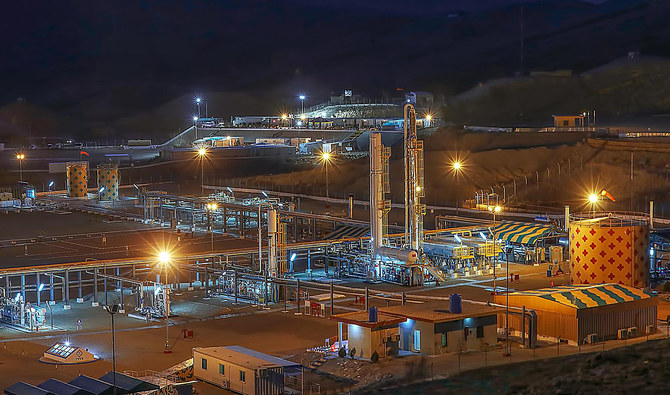
This undated handout photo, available on the Mari Petroleum Company Limited's official website, shows Zarghun South Gas Field in Balochistan. (Photo courtesy: MPCL)
Short Url
Updated 09 January 2023
Follow

Pakistani firm says discovered new gas reserves in country’s south

  • The cash-strapped nation failed to buy gas from the expensive spot market this year
  • Firm says discovery will contribute to mitigating the energy demand and supply gap

ISLAMABAD: An Islamabad-based petroleum exploration and lease company on Monday announced it has discovered gas reserves in the southern Pakistani province of Sindh that will “positively contribute” to mitigating the country’s energy demand and supply gap from indigenous resources.

Oil and gas make up the largest portion of Pakistan’s imports and the cash-strapped South Asian country has been hit with widespread gas blackouts after several failed attempts to buy gas from the expensive international spot market.

Pakistan tried to get a long-term deal at more reasonable prices, but that hasn’t materialized, according to Bloomberg. Local media has also reported that oil supplies remain tenuous owing to difficulties in paying for imports.

In a statement shared with the Pakistan Stock Exchange (PSX) on Monday, the Mari Petroleum Company Limited, an integrated exploration and production company that is operating the country’s second-largest gas reservoir, said it had discovered reserves in Sindh’s Ghotki district as a result of its exploratory efforts.

“Mari Petroleum Company Limited (MPCL), the Operator of Mari Development & Production Lease (Mari D&PL) with 100 percent working interest, is pleased to announce a gas discovery resulting from its exploratory efforts at Mari Ghazij-1 Exploration Well, drilled in Mari D&PL, located in District Ghotki, Sindh Province,” the statement read.

“The said discovery in Mari D&PL shows the commitment of MPCL to exploit the hydrocarbon (HC) potential of the Lease and aggressive exploration strategy. It has opened a new avenue and will positively contribute to mitigating energy demand and supply gap from indigenous resources and will add to the hydrocarbon reserves base of MPCL and the Country.”

Last month, the Oil & Gas Development Company Limited (OGDCL), a leading Pakistani exploration and production firm, announced the discovery of oil and gas reserves in the Sanghar district of Sindh.

Gas shortages always intensify in Pakistan with the arrival of winter. Pakistan needs 4.1 billion cubic feet per day (bcfd) of gas, with winter demand peaking to around 4.5 bcfd against a production of 3.22 bcfd. The shortfall is bridged through LNG imports.

Pakistan began importing LNG seven years ago. However, the price of the commodity in the international spot or short-term market rose from the lows of $2 per million British thermal units (mmBtu) in 2020 to the highs of $57 in August last year after demand in Europe surged, pushing Islamabad out of the market.


Pakistan’s deputy PM speaks with Iran, Türkiye after UN rights vote on Tehran

Updated 8 sec ago
Follow

Pakistan’s deputy PM speaks with Iran, Türkiye after UN rights vote on Tehran

  • Pakistan voted against UN rights council resolution seeking to expand scrutiny of Iran
  • Dar discusses regional issues with Türkiye’s Hakan Fidan after World Economic Forum

ISLAMABAD: Pakistan’s Deputy Prime Minister Ishaq Dar held separate phone calls on Saturday with the foreign ministers of Iran and Türkiye, highlighting Islamabad’s growing diplomatic engagement on regional crises after backing Tehran at the United Nations Human Rights Council and amid wider discussions on Middle East stability.

Dar, who also serves as Pakistan’s foreign minister, spoke with Iran’s Seyed Abbas Araghchi after Islamabad voted against a resolution at the UN rights council in Geneva that sought to expand international scrutiny of Iran following a crackdown on anti-government protests that began last month and continued for several days.

“Foreign Minister Araghchi thanked DPM / FM for his strong support and Pakistan’s position at the United Nations Human Rights Council in Geneva,” the foreign office said in a statement after the phone call.

While the resolution was adopted, Iran rejected it as “politicized” and described the council’s action as interference in its internal affairs.

Dar later spoke by phone with Türkiye’s Foreign Minister Hakan Fidan, with the two leaders reviewing developments following the World Economic Forum in Davos and agreeing to remain in close contact on key regional and international matters, the foreign office said.

Pakistan and Türkiye have increasingly coordinated diplomatic positions on regional issues, including Middle East tensions, as Islamabad positions itself as an active interlocutor in multilateral forums addressing conflict and humanitarian crises.

Iran’s foreign minister also conveyed appreciation to Pakistan’s prime minister, government and people for what he described as Islamabad’s principled stance, the statement added.