

Amid wheat crisis, Quetta residents protest delay in provision of subsidized flour

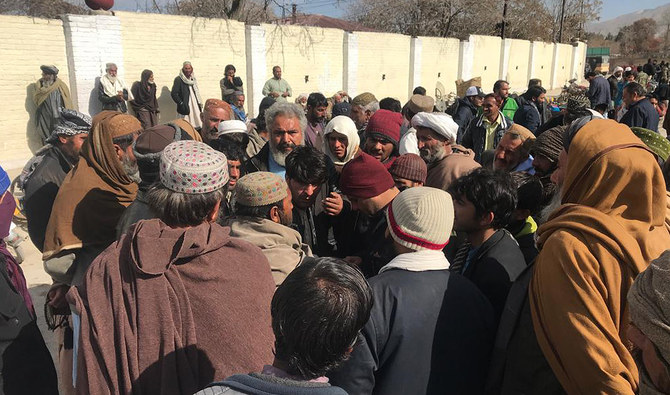
Quetta residents protest against the delay in the provision of subsidized flour in Quetta on January 9, 2023. (AN Photo)
Short Url
Updated 09 January 2023
Follow

Amid wheat crisis, Quetta residents protest delay in provision of subsidized flour

  • Balochistan has been dependent on Punjab, Sindh provinces for its wheat supply post-floods
  • Flour mills association says Sindh, Punjab are unwilling to help Balochistan out of wheat crisis

QUETTA: Residents in the southwestern Pakistani city of Quetta on Monday blocked a key highway as they protested a delay in the provision of subsidized flour, amid a wheat crisis in the impoverished Balochistan province.

Balochistan has demanded immediate assistance from the federal government, Punjab and Sindh provinces to overcome the crisis as the southwestern province has run out of wheat stock for its more than 12 million people.

Quetta residents gathered near the city’s railway station where the provincial food department has been providing subsidized flour for the last two months, but most of them returned home empty handed on Monday as the government didn’t have enough stock to continue provision of subsidized flour.

Having waited for hours, angry residents blocked the nearby Zarghoon Road over non-provision of subsidized flour. The protesters dispersed after a couple of hours, following talks with police officials.

“I reached here at dawn along with my grandson to get a single sack of subsidized flour,” Kulsoom Bibi, 64, told Arab News.

“But waiting for hours in bitter cold, I am returning home without the flour because the government is not sending the subsidized flour stock.”

Abdul Khaliq, who works as a daily wager in Quetta, said he had been searching for subsidized flour for the last four days, but could not find it.

“We can’t purchase flour from the market,” he told Arab News. “There is not even 1 kilogram of flour in my house and my four children are in hunger.”

Last summer’s unprecedented rains and floods damaged large tracts of agricultural land in Naseerabad division and elsewhere in Balochistan, leaving the impoverished province dependent on the Punjab and Sindh provinces to fulfill its demand for wheat.

During the crisis, flour prices have gone up by 100 percent as a 20kg flour bag is being sold for Rs2,850 ($12.69) and the price of a 50kg flour bag has jumped to Rs7,050 ($31.40) in the market.

Jabir Baloch, an additional director at the Baochistan Food Department, also blamed flour mills for the shortage and said the administration had sealed seven mills in Quetta for hoarding the stock.

“The federal government has dispatched 200,000 flour bags for Balochistan, which will be distributed among the poor masses at various points established by the food department,” he told Arab News.

But Badaruddin Kakar, president of the Balochistan Flour Mills Association, said the province needed more than 1 million wheat bags and the 200,000 flour sacks pledged by the federal government were not enough to cover the demand.

“We need 1.2 million wheat bags to meet the regular food demand of the people of Balochistan, but unfortunately Sindh and Punjab provinces were not willing to help us in this wheat crisis despite many requests,” Kakar told Arab News.

“After the 18th amendment of the constitution, all provinces are allowed to utilize their subsidized wheat stock for their own people. However, Sindh and Punjab should assist Balochistan in this crisis.”


Pakistan president meets UAE counterpart, explores trade, investment opportunities

Updated 5 sec ago
Follow

Pakistan president meets UAE counterpart, explores trade, investment opportunities

  • Asif Ali Zardari is in UAE on four-day visit to strengthen bilateral ties, review bilateral cooperation
  • Both sides discuss regional, international developments, reaffirm commitment to promote peace

ISLAMABAD: President Asif Ali Zardari met his UAE counterpart Sheikh Mohammed bin Zayed Al-Nahyan in Abu Dhabi on Tuesday during which both sides explored new opportunities in trade, investment, energy and other sectors, Zardari's office said. 

Zardari arrived in Abu Dhabi on Monday evening with a high-level delegation on a four-day official visit to the UAE to review trade, economic and security cooperation. 

"The leaders discussed ways to further deepen the longstanding and brotherly relations between Pakistan and the UAE," a statement from Zardari's office said about his meeting with the UAE president. 

"They reviewed the full spectrum of bilateral cooperation and explored new opportunities in trade, investment, energy, infrastructure, technology, and people-to-people exchanges, highlighting the significant potential for expanding economic and strategic partnership.

Zardari highlighted the significance of Al-Nayhan's visit to Pakistan last month, the statement said, expressing appreciation for the UAE's continued support for strengthening bilateral ties.

It said both sides also exchanged views on a range of regional and international developments, reaffirming their commitment to promoting peace, stability and sustainable development.

The meeting was also attended by Pakistan's First Lady Aseefa Bhutto-Zardari, the Pakistani president's son Bilawal Bhutto-Zardari, who is also the chairman of the Pakistan Peoples Party, Interior Minister Mohsin Naqvi and Pakistan's ambassador to the UAE. 

ZARDARI MEETS AD PORTS CEO

Zardari earlier met AD Ports Group CEO Captain Mohamed Juma Al-Shamisi to discuss the group's investment initiatives in Karachi. 

"Both sides agreed that the expansion and modernization of port infrastructure would strengthen trade flows and support Pakistan’s broader economic development and country’s seaborne trade," the President's Secretariat said in a statement.

It added that Zardari described the AD Ports Group's long-term investment and expanding role in Pakistan's maritime and logistics sector as a key pillar of Pakistan–UAE economic cooperation.

Pakistan and the UAE maintain close political and economic relations, with Abu Dhabi playing a pivotal role in supporting Islamabad during periods of financial stress through deposits, oil facilities and investment commitments. 

The UAE is Pakistan's third-largest trading partner, after China and the United States, and a key destination for Pakistani exports, particularly food, textiles and construction services.

The Gulf state is also home to more than 1.5 million Pakistani expatriates, one of the largest overseas Pakistani communities in the world, who contribute billions of dollars annually in remittances, a crucial source of foreign exchange for Pakistan’s economy.

Beyond trade and labor ties, Pakistan and the UAE have steadily expanded defense and security cooperation over the years, including military training, joint exercises and collaboration in counter-terrorism and regional security matters.