

Pakistan reaffirms commitment to IMF program after Geneva meeting

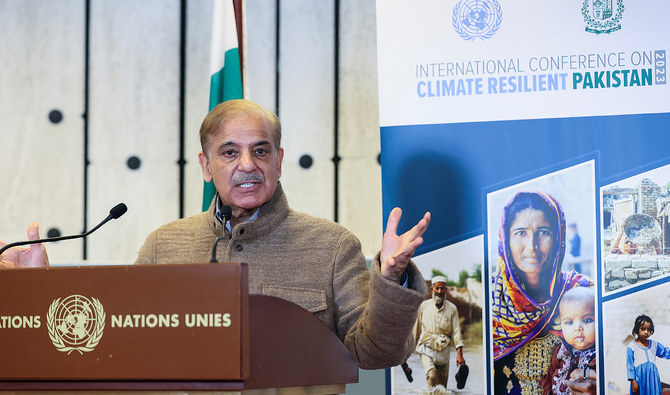
Pakistan's Prime Minister Shehbaz Sharif speaks during a news conference, at the United Nations, in Geneva, Switzerland, January 9, 2023. (Photo courtesy: REUTERS)
Short Url
Updated 09 January 2023
Follow

Pakistan reaffirms commitment to IMF program after Geneva meeting

  • The IMF has yet to approve the release of $1.1 billion originally due to be disbursed in November
  • The delay has left Pakistan with only enough foreign exchange reserves to cover one month’s imports

GENEVA: Pakistan reiterated its commitment to completing a program with the International Monetary Fund in a meeting on the sidelines of a climate conference in Geneva on Monday, the finance ministry said in a statement.

Finance Minister Muhammad Ishaq Dar and IMF officials “discussed challenges to regional economies in the wake of climate change,” according to the statement following the meeting’s conclusion. “(The) finance minister reiterated the commitment to complete the Fund program,” it added.

“It was a good meeting but I do not have any statements to make,” Athanasios Arvanitis, deputy director of the IMF’s Middle East and Central Asia Department, told Reuters immediately after it ended.

The IMF has yet to approve the release of $1.1 billion originally due to be disbursed in November last year, leaving Pakistan with only enough foreign exchange reserves to cover one month’s imports.

French President Emmanuel Macron said at the conference that Paris was ready to support Pakistan in its talks with financial institutions.

UN Secretary General Antonio Guterres earlier called for sweeping reform of the international financial system to allow countries vulnerable to climate calamities to receive adequate funding from richer nations.


Pakistan, seven Muslim nations back Palestinian technocratic body, stress Gaza-West Bank unity

Updated 15 January 2026
Follow

Pakistan, seven Muslim nations back Palestinian technocratic body, stress Gaza-West Bank unity

  • The National Committee for the Administration of the Gaza Strip was announced on January 14
  • Muslim nations call for consolidation of the ceasefire and unimpeded humanitarian aid into Gaza

ISLAMABAD: Pakistan and seven other Muslim-majority countries on Thursday welcomed the formation of a temporary Palestinian technocratic body to administer Gaza, stressing that it must manage daily civilian affairs while preserving the institutional and territorial link between the Gaza Strip and the West Bank amid the ongoing peace efforts.

In a joint statement, the foreign ministers of Pakistan, Egypt, Jordan, Saudi Arabia, Qatar, Türkiye, Indonesia and the United Arab Emirates said the newly announced National Committee for the Administration of the Gaza Strip would play a central role during the second phase of a broader peace plan aimed at ending the war and paving the way for Palestinian self-governance.

“The Ministers emphasize the importance of the National Committee commencing its duties in managing the day-to-day affairs of the people of Gaza, while preserving the institutional and territorial link between the West Bank and the Gaza Strip, ensuring the unity of Gaza, and rejecting any attempts to divide it,” the statement said.

The committee, announced on Jan. 14, is a temporary transitional body established under United Nations Security Council Resolution 2803 and is to operate in coordination with the Palestinian Authority, the ministers said.

The statement said the move forms part of the second phase of US President Donald Trump’s Comprehensive Peace Plan for Gaza, which the ministers said they supported, praising Trump’s efforts to end the war, ensure the withdrawal of Israeli forces and prevent the annexation of the occupied West Bank.

The top leaders of all eight Muslim countries attended a meeting with Trump in New York last September, shortly before he unveiled the Gaza peace plan.

The ministers also called for the consolidation of the ceasefire, unimpeded humanitarian aid into Gaza, early recovery and reconstruction and the eventual return of the Palestinian Authority to administer the territory, leading to a just and sustainable peace based on UN resolutions and a two-state solution on pre-1967 lines with East Jerusalem as the Palestinian capital.