

China says it carried out combat drills around Taiwan again

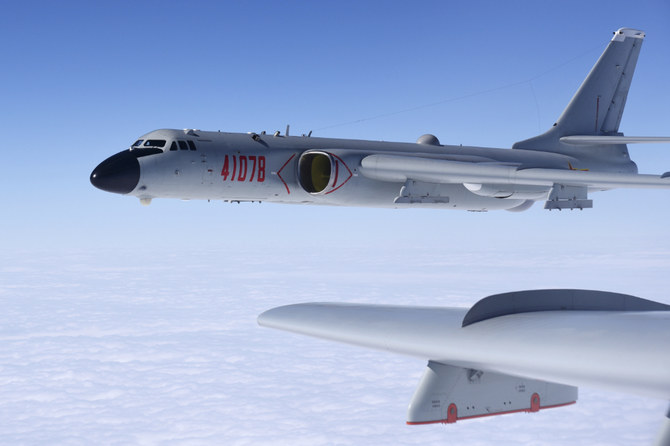
In this photo released by Xinhua News Agency, a Chinese military H-6K bomber is seen conducting training exercises, as the People's Liberation Army (PLA) air force conducted a combat air patrol in the South China Sea on Nov. 23, 2017. (AP)
Short Url
Updated 09 January 2023
Follow

China says it carried out combat drills around Taiwan again

  • China carried out similar exercises late last month, with Taiwan reporting that 43 Chinese aircraft crossed the Taiwan Strait's median line, an unofficial buffer between the two sides

BEIJING: China’s military said it had carried out combat drills around Taiwan on Sunday, the second such exercises in less than a month, with the island’s defense ministry reporting it detected 57 Chinese aircraft.
China views democratically-governed Taiwan as its own territory and has been ramping up military, political and economic pressure to assert those claims.
The People’s Liberation Army’s Eastern Theatre Command said in a statement late on Sunday that its forces had organized “joint combat readiness patrols and actual combat drills” in the sea and airspace around Taiwan, focused on land strikes and sea assaults.
The aim of the exercises was to test joint combat capabilities and “resolutely counter the provocative actions of external forces and Taiwan independence separatist forces,” it added in a brief statement.
Taiwan’s defense ministry said on Monday that over the previous 24 hours it had detected 57 Chinese aircraft and four naval vessels operating around the island, including 28 aircraft which flew into Taiwan’s air defense zone.
Some of those 28 crossed the Taiwan Strait median line, an unofficial buffer between the two sides, including Su-30 and J-16 fighters, while two nuclear-capable H-6 bombers flew to the south of Taiwan, according to a ministry provided map.
China carried out similar exercises late last month, with Taiwan reporting that 43 Chinese aircraft crossed the Taiwan Strait’s median line.
China, which has never renounced the use of force to bring the island under its control, has been carrying out regular military incursions into the waters and air space near Taiwan over the past three years.
China carried out war games around Taiwan last August following a visit to Taipei by the then-US House Speaker Nancy Pelosi.
Taiwan strongly rejects Beijing’s sovereignty claims, saying only the island’s 23 million people can decide their future.
Beijing has been particularly angered by US support for Taiwan, including weapons sales.
The United States, like most countries, has no formal diplomatic ties with Taiwan but is the island’s most important arms supplier and internationally backer.


Faced with Trump, Greenlanders try to reassure their children

Updated 6 sec ago
Follow

Faced with Trump, Greenlanders try to reassure their children

NUUK: In a coffee shop in Greenland’s capital Nuuk, Lykke Lynge looked fondly at her four kids as they sipped their hot chocolate, seemingly oblivious to the world’s convulsions.
Since Donald Trump returned to the White House last year with a renewed ambition to seize Greenland, international politics has intruded into the Arctic island’s households.
Dictated by the more or less threatening pronouncements of the US president, it has been an unsettling experience for some people here — but everyone is trying to reassure their children.
Lynge, a 42-year-old lawyer, relied on her Christian faith.
“There’s a lot of turmoil in the world,” she said. “But even if we love our country, we have even higher values that allow us to sleep soundly and not be afraid,” she said.
As early as January 27, 2025, one week after Donald Trump’s inauguration, the Greenlandic authorities published a guide entitled “How to talk to children in times of uncertainty?“
“When somebody says they will come to take our country or they will bomb us or something, then of course children will get very scared because they cannot navigate for themselves in all this news,” said Tina Dam, chief program officer for Unicef in the Danish territory.

- Unanswerable questions -

This guide — to which the UN agency for children contributed — recommends parents remain calm and open, listen to their children and be sensitive to their feelings, and limit their own news consumption.
As in many parts of the world, social media, particularly TikTok, has become the primary source of information for young people.
Today, children have access to a lot of information not meant for them, said Dam — “and definitely not appropriate for their age,” she added.
“So that’s why we need to be aware of that as adults and be protective about our children and be able to talk with our children about the things they hear — because the rhetoric is quite aggressive.”
But reassuring children is difficult when you do not have the answers to many of the questions yourself.
Arnakkuluk Jo Kleist, a 41-year-old consultant, said she talked a lot with her 13-year-old daughter, Manumina.
The teenager is also immersed in TikTok videos but “doesn’t seem very nervous, luckily, as much as maybe we are,” she added.
“Sometimes there are questions she’s asking — about what if this happens — that I don’t have any answers to” — because no one actually has the answer to such questions, she said.

- ‘Dear Donald Trump’ -

The Arctic territory’s Inuit culture also helped, said Kleist.
“We have a history and we have conditions in our country where sometimes things happen and we are used to being in situations that are out of our control,” said Kleist.
“We try to adapt to it and say, well, what can I do in this situation?“
Some Greenlandic children and teenagers are also using social media to get their message out to the world.
Seven-year-old Marley and his 14-year-old sister Mila were behind a viral video viewed more than two million times on Instagram — the equivalent of 35 times the population of Greenland.
Serious in subject but lighthearted in tone, the boy addresses the American president.
“Dear Donald Trump, I have a message for you: you are making Greenlandic kids scared.”
Accompanied by hard stares, some serious finger-wagging and mostly straight faces, he and his sister go on to tell Trump: “Greenland is not for sale.”
“It’s a way to cope,” his mother, Paninnguaq Heilmann-Sigurdsen, told AFP of the video. “It’s kid-friendly, but also serious.
“I think it’s a balance between this is very serious, but also, this is with kids.”