

Egypt’s women DJs creating inclusive dance floors

Mahraganat relies heavily on computer-generated and synthesized beats and features blunt lyrics that tackle topics including love, power and money. (AFP)
Short Url
Updated 11 January 2023
Follow

Egypt’s women DJs creating inclusive dance floors

  • In Egypt’s patriarchal society, the music industry remains male-dominated, while the conservative country’s cultural establishment marginalizes and even bans electronic music artists

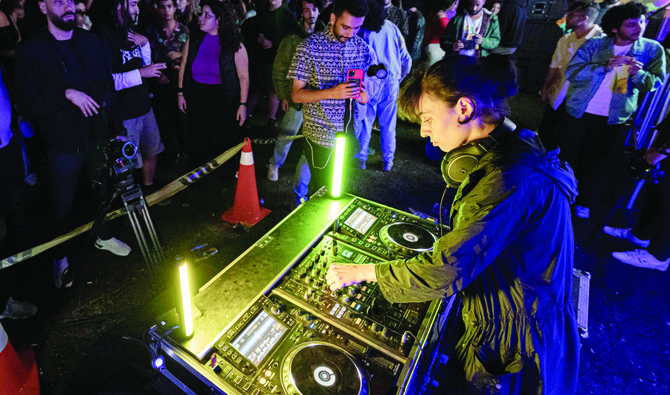
CAIRO: Laser beams illuminate a darkened restaurant-turned-dance hall in Cairo as revelers move to thumping beats from female DJs — part of a generation of women shaking up Egypt’s underground electronic music scene.

“All my life, I’ve seen men behind the decks,” said partygoer Menna Shanab, 26, as psychedelic visuals reflected off the waters at the Nile-side venue.

“It’s good to see the music scene evolving,” said the young Cairo resident, decked out in fashionable streetwear.

In Egypt’s patriarchal society, the music industry remains male-dominated, while the conservative country’s cultural establishment marginalizes and even bans electronic music artists.

Female partygoers for years have complained about harassment on the dance floor, while many revelers find mainstream venues too pricey.

Now, a generation of young women DJs are forging their own path, seeking to create more inclusive spaces for performers and partygoers alike.

A small but vibrant electronic music scene is “booming” in the Egyptian capital, according Yemeni music journalist and occasional DJ Hala K, asking like others AFP interviewed to be identified only by her stage name.

“A lot of female talents feel more confident and empowered to pursue DJing,” the Amsterdam-based Hala K. said by telephone.

Aspiring artists are taking inspiration from female DJs from the region, she added — such as Palestinian Sama Abdulhadi, who has performed from Egypt to France and at premier US festival Coachella.

In Cairo, there are “powerful, talented women at the turntables: They know how to make people dance,” Hala K said.

DJ and promoter A7ba-L-Jelly decided to establish her own collective as part of making the underground electronic dance music scene more inclusive.

“I wanted to organize events where I would feel safe myself, without harassment,” said the 32-year-old.

“I just wanted to go and party in peace.”

More than 90 percent of women in Egypt aged between 18 and 39 said in 2019 that they had experienced some form of sexual harassment, according to the Arab Barometer public opinion research network.

“In some places in Egypt, where they play more commercial music ... you won’t enter because you are single, or because you don’t look rich enough,” A7ba-L-Jelly added.

“I book male and female DJs to create dance floors that are inclusive in terms of music, gender and social class,” she said.

From the Nile-side dance venue, DJ Yas Meen Selectress complained that regardless of gender, “there are no dedicated spaces for us where we can play our music.”

Locations are often gardens or other makeshift sites, organizers said.

“Traditions, society and other factors mean that there are fewer women than men in the scene,” Yas Meen Selectress added. Less than 20 percent of women are officially employed in the country of 104 million.

For the DJ in her late 20s, who lives between Cairo and New York, however, “to be only defined by one’s gender is reductive.”

For others like Dalia Hassan, it is a selling point.

Over the past two decades, she has made a name for herself playing at women-only events from Cairo to the Yemeni capital Sanaa and Riyadh in Saudi Arabia.

Hassan said she DJs at bachelorette parties, gender-segregated weddings and anywhere a female audience wants to “get dressed up and dance as they please.”

Having a woman at the turntables allows other women to let loose — “especially those who are veiled,” she added.

For France-based researcher Hajjer Ben Boubaker, the lack of women DJs runs counter to Egypt’s strong tradition of women performers.

“Female singers have always been well represented in the Arab cultural scene,” she said.

“The symbol par excellence of Egyptian music is still the mythical Umm Kalthoum,” she added, referring to the 20th-century diva revered around the Arab world.

But “women are barely represented in the Egyptian electro scene of mahraganat, which is the most popular music today,” she added.

Mahraganat relies heavily on computer-generated and synthesized beats and features blunt lyrics that tackle topics including love, power and money.

The country’s musicians’ union announced late last year it was abolishing the genre as part of a campaign to “preserve public taste.”

Frederike Berje from Germany’s Goethe-Institut in Cairo noted that Egypt’s “music industry, especially the electronic scene, is heavily dependent on private initiatives and the commitment of individual artists.”


Global gems go under the hammer 

Updated 16 January 2026
Follow

Global gems go under the hammer 

  • International highlights from Sotheby’s ‘Origins II’ auction, which takes place Jan. 31 in Diriyah 

Andy Warhol 

‘Muhammad Ali’ 

Arguably the most famous name in pop art meets arguably the most famous sportsman of the 20th century in this set of four screen prints from 1978, created at the behest of US investment banker Richard Weisman. “I felt putting the series together was natural, in that two of the most popular leisure activities at the time were sports and art, yet to my knowledge they had no direct connection,” Weisman said in 2007. “Therefore I thought that having Andy do the series would inspire people who loved sport to come into galleries, maybe for the first time, and people who liked art would take their first look at a sports superstar.” Warhol travelled to Ali’s training camp to take Polaroids for his research, and was “arrested by the serene focus underlying Ali’s power — his contemplative stillness, his inward discipline,” the auction catalogue states. 

Jean-Michel Basquiat 

‘Untitled’ 

Basquiat “emerged from New York’s downtown scene to become one of the most influential artists of the late 20th century,” Sotheby’s says. The largely self-taught artist’s 1985 work, seen here, “stands as a vivid testament to (his) singular ability to transform drawing into a site of intellectual inquiry, cultural memory, and visceral self-expression.” Basquiat, who was of Caribbean and Puerto Rican heritage, “developed a visual language of extraordinary immediacy and intelligence, in which image and text collide with raw urgency,” the catalogue continues. 

Camille Pissarro 

‘Vue de Zevekote, Knokke’ 

The “Knokke” of the title is Knokke-sur-Mer, a Belgian seaside village, where the hugely influential French-Danish Impressionist stayed in the summer of 1894 and produced 14 paintings, including this one. The village, Sotheby’s says, appealed to Pissarro’s “enduring interest in provincial life.” In this work, “staccato brushstrokes, reminiscent of Pissarro’s paintings of the 1880s, coalesce with the earthy color palette of his later work. The resulting landscape, bathed in a sunlit glow, celebrates the quaint rural environments for which (he) is best known.” 

David Hockney 

‘5 May’ 

This iPad drawing comes from the celebrated English artist’s 2011 series “Arrival of Spring in Woldgate, East Yorkshire in 2011,” which Sotheby’s describes as “one of the artist’s most vibrant and ambitious explorations of landscape, perception, and technological possibility.” Each image in the series documents “subtle shifts in color, light and atmosphere” on the same stretch of the Woldgate, “showing the landscape as something experienced over time rather than frozen in an instant.” The catalogue notes that spring has long been an inspiration for European artists, but says that “no artist has ever observed it so closely, with such fascinated and loving attention, nor recorded it in such detail as an evolving process.” 

Zarina  

‘Morning’ 

Sotheby’s describes Indian artist Zarina Hashmi — known by her first name — as “one of the most compelling figures in post-war international art — an artist whose spare, meditative works distilled the tumult of a peripatetic life into visual form.” She was born in Aligarh, British India, and “the tragedy of the 1947 Partition (shaped) a lifelong meditation on the nature of home as both physical place and spiritual concept.” This piece comes from a series of 36 woodcuts Zarina produced under the title “Home is a Foreign Place.” 

George Condo 

‘Untitled’ 

This 2016 oil-on-linen painting is the perfect example of what the US artist has called “psychological cubism,” which Sotheby’s defines as “a radical reconfiguration of the human figure that fractures identity into simultaneous emotional and perceptual states.” It’s a piece that “distills decades of inquiry into the mechanics of portraiture, drawing upon art-historical precedent while decisively asserting a contemporary idiom that is at once incisive and darkly humorous,” the catalogue notes, adding that the work is “searing with psychological tension and painterly bravura.”