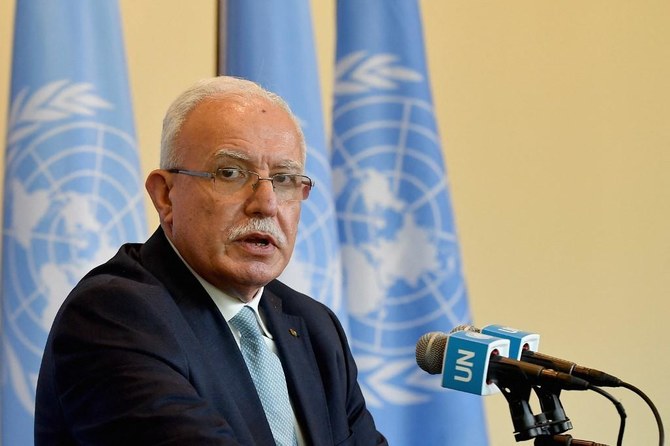
JERUSALEM: Israel suspended on Sunday a pass easing the Palestinian foreign minister’s travel in and around the occupied West Bank, among its responses to a Palestinian bid to involve the International Court of Justice (ICJ) in their decades-old conflict.
Foreign Minister Riyad Al-Maliki’s “VIP” travel card was confiscated by Israeli border staff as he crossed from Jordan into the occupied West Bank, his office said.
A spokesperson for Israel’s Defense Ministry, which administers the West Bank, confirmed the move, calling it part of the implementation of a government decision on Friday.
In televised remarks to the Israeli cabinet on Sunday, Prime Minister Benjamin Netanyahu said the decision entailed, among other measures, “sanctions against senior Palestinian figures.”
“The Palestinian Authority has promoted an extremist anti-Israeli resolution at the United Nations,” Netanyahu said.
The UN General Assembly, responding to an appeal by the Palestinians, on Dec. 30 asked the ICJ for an opinion on the legal consequences of Israel’s occupation of Palestinian territories.
On Saturday, Israel’s Defense Ministry said the VIP cards of three other senior Palestinian officials had been revoked in response to them visiting a member of Israel’s Arab minority who had been imprisoned for killing an Israeli soldier.
Issued under interim accords with Israel from the 1990s, the cards ease travel across the Israeli-controlled West Bank border with Jordan and from Palestinian-ruled territory into Israel.
“The foreign minister will continue his job and his diplomatic activities with or without the card,” Ahmed Al-Deek, an aide to Maliki, told Reuters.
Israel had confiscated Maliki’s VIP card in 2021 after he returned from a meeting of the International Criminal Court. It was not immediately clear when and why the card had been restored.

Israel takes Palestinian minister’s VIP pass in world court flap
Short Url
https://arab.news/wycp2
Israel takes Palestinian minister’s VIP pass in world court flap
- Netanyahu said the decision entailed “sanctions against senior Palestinian figures”
- “The Palestinian Authority has promoted an extremist anti-Israeli resolution at the United Nations,” Israeli PM said
114 killed in week of attacks in Sudan’s Darfur: medical sources
PORT SUDAN: Attacks by Sudan’s army and its paramilitary foes on two towns in the western Darfur region over the past week have killed 114 people, medical sources told AFP Sunday.
Since April 2023, Sudan has been gripped by a war between the army and the paramilitary Rapid Support Forces (RSF), which in October seized the army’s last holdout position in Darfur.
The RSF has since pushed west to the Chadian border and east through the vast Kordofan region, where a drone strike on the North Kordofan capital of El-Obeid on Sunday caused a blackout in the key army-controlled city.
A medical source reported Sunday that 51 people were killed the day before in drone strikes attributed to the army on the North Darfur town of Al-Zuruq, 180 kilometers (112 miles) north of the RSF-overrun state capital El-Fashir.
The strike hit a market and civilian areas, the source said.
Al-Zuruq, under RSF control, is home to family members of RSF commander Mohamed Hamdan Dagalo, the former deputy of his now rival, army chief Abdel Fattah Al-Burhan.
“Two of the Dagalo family were killed, Moussa Saleh Dagalo and Awad Moussa Saleh Dagalo,” an eyewitness to the burial told AFP.
Both the RSF and the army are accused of targeting civilian areas, in what the UN has called a “war of atrocities.”
RSF fighters advancing westward toward the border with Chad last week killed another 63 people in and around the town of Kernoi, a medical source in the local hospital told AFP Sunday.
“Until Friday, 63 were killed and 57 injured... in attacks launched by the RSF around Kernoi,” they said, speaking on condition of anonymity for their safety.
Local sources told AFP that 17 people were still missing.
The entire Darfur region is largely inaccessible to reporters and is under a years-long communications blackout, forcing local volunteers and medics to use satellite Internet to get news to the world.
According to the United Nations, over 7,000 people were displaced in just two days last month from Kernoi and the nearby village of Um Baru.
Many are from the Zaghawa group, which has been targeted by the RSF. Members of the group have fought in the current war alongside the army in a coalition known as the Joint Forces.
‘Attacked by drones’
Since the war began, tens of thousands have been killed and millions displaced.
Much of the worst fighting has been in Darfur, reviving memories of mass ethnic atrocities committed in the 2000s by the Janjaweed, the RSF’s predecessor.
The war’s fiercest violence is currently unfolding in Kordofan, Sudan’s vast oil-rich southern region that links Darfur to the capital Khartoum, which the army recaptured last year.
Drone strikes on North Kordofan capital El-Obeid caused a power outage, the national electricity company said.
“El-Obeid power station ... was attacked by drones, leading to a fire in the machinery building, which led to a halt in the electricity supply,” the company said.
Following its victory in El-Fasher, the RSF has sought to recapture Sudan’s central corridor, tightening its siege with its local allies around several army-held cities.
Hundreds of thousands face mass starvation across the region.
Last year, the army broke a paramilitary siege on El-Obeid, which the RSF has sought to encircle since.
The Joint Forces said last week they had retaken several towns south of El-Obeid, which according to a military source could “open up the road between El-Obeid and Dilling” — one of South Kordofan’s besieged cities.
Since mid-December, some 11,000 people have been displaced from North and South Kordofan states, according to the UN’s International Organization for Migration.
The war has forced more than 11 million people to flee internally and across Sudan’s borders, many of them seeking shelter in underdeveloped areas with a lack of nutrition, medicine and clean water.
Since April 2023, Sudan has been gripped by a war between the army and the paramilitary Rapid Support Forces (RSF), which in October seized the army’s last holdout position in Darfur.
The RSF has since pushed west to the Chadian border and east through the vast Kordofan region, where a drone strike on the North Kordofan capital of El-Obeid on Sunday caused a blackout in the key army-controlled city.
A medical source reported Sunday that 51 people were killed the day before in drone strikes attributed to the army on the North Darfur town of Al-Zuruq, 180 kilometers (112 miles) north of the RSF-overrun state capital El-Fashir.
The strike hit a market and civilian areas, the source said.
Al-Zuruq, under RSF control, is home to family members of RSF commander Mohamed Hamdan Dagalo, the former deputy of his now rival, army chief Abdel Fattah Al-Burhan.
“Two of the Dagalo family were killed, Moussa Saleh Dagalo and Awad Moussa Saleh Dagalo,” an eyewitness to the burial told AFP.
Both the RSF and the army are accused of targeting civilian areas, in what the UN has called a “war of atrocities.”
RSF fighters advancing westward toward the border with Chad last week killed another 63 people in and around the town of Kernoi, a medical source in the local hospital told AFP Sunday.
“Until Friday, 63 were killed and 57 injured... in attacks launched by the RSF around Kernoi,” they said, speaking on condition of anonymity for their safety.
Local sources told AFP that 17 people were still missing.
The entire Darfur region is largely inaccessible to reporters and is under a years-long communications blackout, forcing local volunteers and medics to use satellite Internet to get news to the world.
According to the United Nations, over 7,000 people were displaced in just two days last month from Kernoi and the nearby village of Um Baru.
Many are from the Zaghawa group, which has been targeted by the RSF. Members of the group have fought in the current war alongside the army in a coalition known as the Joint Forces.
‘Attacked by drones’
Since the war began, tens of thousands have been killed and millions displaced.
Much of the worst fighting has been in Darfur, reviving memories of mass ethnic atrocities committed in the 2000s by the Janjaweed, the RSF’s predecessor.
The war’s fiercest violence is currently unfolding in Kordofan, Sudan’s vast oil-rich southern region that links Darfur to the capital Khartoum, which the army recaptured last year.
Drone strikes on North Kordofan capital El-Obeid caused a power outage, the national electricity company said.
“El-Obeid power station ... was attacked by drones, leading to a fire in the machinery building, which led to a halt in the electricity supply,” the company said.
Following its victory in El-Fasher, the RSF has sought to recapture Sudan’s central corridor, tightening its siege with its local allies around several army-held cities.
Hundreds of thousands face mass starvation across the region.
Last year, the army broke a paramilitary siege on El-Obeid, which the RSF has sought to encircle since.
The Joint Forces said last week they had retaken several towns south of El-Obeid, which according to a military source could “open up the road between El-Obeid and Dilling” — one of South Kordofan’s besieged cities.
Since mid-December, some 11,000 people have been displaced from North and South Kordofan states, according to the UN’s International Organization for Migration.
The war has forced more than 11 million people to flee internally and across Sudan’s borders, many of them seeking shelter in underdeveloped areas with a lack of nutrition, medicine and clean water.
© 2026 SAUDI RESEARCH & PUBLISHING COMPANY, All Rights Reserved And subject to Terms of Use Agreement.


