

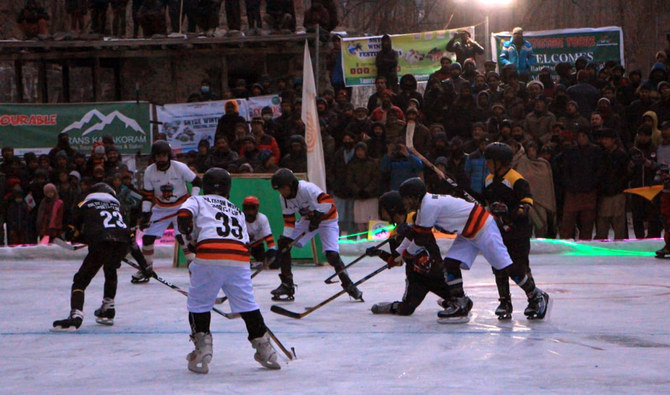
Gilgit Baltistan’s winter festival to become ‘national level’ event from next year — minister

Players participate in an ice hockey at Shyok Winter Festival 2023 in Khaplu Valley of Ghanche district in Pakistan’s Gilgit Baltistan region on January 7, 2023. (Photo courtesy: Social Media)
Short Url
Updated 08 January 2023
Follow

Gilgit Baltistan’s winter festival to become ‘national level’ event from next year — minister

  • The region’s traditional Shyok Winter Festival seeks to increase tourism by arranging Gilgit Baltistan’s cultural games
  • Canadian High Commissioner to Pakistan expresses hope the areas also becomes famous for ice hockey across the world

ISLAMABAD: Gilgit Baltistan’s sports and tourism minister Raja Nasir Ali Khan has promised to turn a traditional winter festival in the region, which kicked off in Ghanche district on Saturday, into a national event from next year by inviting people from other parts of the country.


Canadian High Commissioner Leslie Scanlon watches sports activities at Shyok Winter Festival 2023 along with government officials in the Khaplu Valley of Ghanche district in Pakistan’s Gilgit-Baltistan region on January 7, 2023. (Photo courtesy: Social Media)

The three-day Shyok Winter Festival, named after a river that meanders through the area, has been organized by the district administration in collaboration with the Canadian High Commission and Aga Khan Rural Support Program.

The festivities have attracted hundreds of people who are interested in watching cultural and traditional games of Gilgit Baltistan along with ice hockey which has been introduced in the area for the first time.

“With this festival, a series of winter sports [will continue across] Gilgit Baltistan,” the minister told Arab News over the phone. “Similar festivals are also planned in Ghizer, Hunza, Skardu, Astore and Diamer this year.”

“Next year,” he continued, “we will arrange a national level winter festival to which other provinces will also be invited.”

Known for its picturesque landscapes, Gilgit Baltistan is a mountainous area in Pakistan’s northern region that borders China and Afghanistan. It is among the country’s most popular tourism destinations and was listed by Forbes among ten “coolest places” to visit in 2018.

According to the sports and tourism minister, nearly two million local and international backpackers attended various festivities in the area last year while more than 155 high-altitude climbers summited the world’s second tallest mountain, K2, which is also located in the region.

“We want to see tourists coming to GB in winter as well,” he said. “That’s why we are promoting winter activities here and want to keep the area open for tourists [throughout the year].”


Two ice hockey teams pose for a group photograph at Shyok Winter Festival 2023 in Khaplu Valley of Ghanche district in Pakistan’s Gilgit Baltistan region on January 7, 2023. (Photo courtesy: Social Media)

Addressing the inauguration ceremony of the festival, Canadian High Commissioner to Pakistan Leslie Scanlon highlighted Gilgit Baltistan’s potential to generate more tourism by arranging such activities.

“While I recognize we are in a world-famous region for rock climbing, trekking and mount climbing, I hope that Gilgit Baltistan will also become a world-famous region for ice hockey for boys and girls and men and women,” she said.

Rana Haider Tahir, assistant commissioner in Ghanche district, said the event had a major scope for the development of the area.

“This festival is a celebration of all cultures in Baltistan region, especially the valley situated across the Shyok River,” he told Arab News over the phone.

He informed the authorities were also going to inaugurate a museum along with an information technology park and school for people with disabilities during the three-day event.


Pakistan reviews austerity measures amid Middle East crisis, urges strict nationwide implementation

Updated 11 March 2026
Follow

Pakistan reviews austerity measures amid Middle East crisis, urges strict nationwide implementation

  • Deputy Prime Minister Ishaq Dar chairs review meeting of austerity steps
  • Officials briefed on salary cuts, school closures, four‑day week, petrol conservation

ISLAMABAD: Pakistan’s government on Wednesday assessed progress on a sweeping set of austerity measures introduced to mitigate the country’s economic strain from sharply rising global oil prices and supply disruptions linked to the ongoing war in the Middle East.

Prime Minister Shehbaz Sharif this week announced a series of austerity steps, including a four‑day work week for government offices, requiring 50  percent of staff to work from home, cutting fuel allowances for official vehicles by half, grounding up to 60  percent of the government fleet and closing all schools for two weeks to conserve fuel amid the global oil crisis.

The measures were unveiled in response to global oil market volatility triggered by the conflict involving the United States, Israel and Iran, which has disrupted supply routes such as the Strait of Hormuz and pushed crude prices sharply higher, straining Pakistan’s heavily import‑dependent energy sector.

“The meeting stressed the importance of strict and transparent adherence to the austerity measures, promoting fiscal responsibility and prudent use of public resources,” Deputy Prime Minister and Foreign Minister Senator Mohammad Ishaq Dar said in a statement.

He was chairing a meeting of the Committee for Monitoring and Implementation of Conservation and Additional Austerity Measures, constituted under the directions of the PM, bringing together federal and provincial officials to review execution of the broad cost‑cutting plan. 

Dar emphasized the government’s commitment to enforcing the PM’s austerity steps nationwide. The committee’s review also covered reductions in departmental expenditure, deductions from salaries of senior officials earning over Rs. 300,000 ($1,120), and coordination with provincial administrations to ensure uniform implementation of the plan.

Participants at the meeting reiterated that all ministries and divisions must continue strict monitoring and reporting, with transparent oversight mechanisms, as Pakistan navigates the economic pressures from the prolonged Middle East crisis and its fallout on global energy and trade markets.