

After setting up falafel snack bar in Peshawar, Iraqi man hopes to expand business in Pakistan

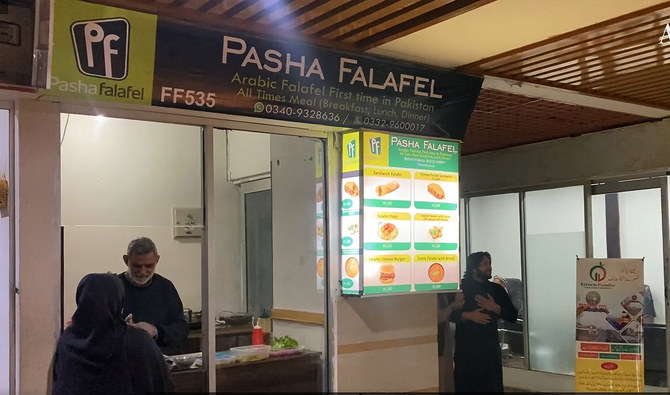
Nawaf Abbasi, owner of Pasha Falafel, interacts with a customer in Peshawar, Pakistan, on January 4, 2023. (AN Photo)
Short Url
Updated 08 January 2023
Follow

After setting up falafel snack bar in Peshawar, Iraqi man hopes to expand business in Pakistan

  • Nawaf Abbasi graduated from Saudi Arabia before moving to Pakistan in 1986 where he married a Pashtun woman
  • After serving as a language teacher for several years, Abbasi started serving Middle East’s ‘popular street food’ in Pakistan

PESHAWAR: A man of Iraqi origin, who decided to settle down in Pakistan more than three decades ago before establishing a snack bar serving falafel last year, plans to benefit from the popularity of Arabic cuisine in the country by expanding his business to other cities.

Nawaf Abbasi, 61, graduated from Saudi Arabia before moving to Pakistan in 1986 where he married a Pashtun woman and got new nationality. He remained associated with various education institutes in Khyber Pakhtunkhwa as a language teacher for 15 years. However, he ultimately decided to set up his small café, Pasha Falafel, to sell the “popular street food” that is consumed by millions across the Middle Eastern countries.

“I have been working in [the field of] education,” he told Arab News on Wednesday. “Now, I have started my own [falafel] business. My plan is to extend [it across] Pakistan. I am negotiating with two parties, one in Karachi and another in Lahore [to expand this initiative to other places].”

Abbasi said he made falafel by mixing chickpeas, broad beans and patty-shaped fritter, adding the cuisine was becoming popular with growing number of people.

His outlet serves the food as sandwich and burger along with an assortment of vegetables and sauces.

“When I heard about Pasha Falafel restaurant, I was too excited because I love and like Arabic foods,” said Mahnoor Khan, a female customer at the facility. “I tried sandwich and falafel cheese burger. The taste was very delicious and spicy and the prices were quite low.”

Asked if he still visited his country of origin, Abbasi said that lost his parents several years ago, though he continued to see his relatives in Iraq.

However, he said he was now permanently based in Pakistan where he lived with his wife and four children.

Responding to a question about his future plans apart from taking his business to other cities, he said: “I am going to introduce frozen falafel that will be available in super markets.”

Pakistan to showcase BYD, Samsung, Google assembly push at ITCN Asia expo

Updated 15 January 2026
Follow

Pakistan to showcase BYD, Samsung, Google assembly push at ITCN Asia expo

  • STZA pavilion backed by SIFC highlights shift from tech services to manufacturing
  • Electric vehicles, electronics and data centers featured at Lahore exhibition

KARACHI: Pakistan will showcase electric vehicle and electronics assembly by global brands including BYD, Samsung and Google at ITCN Asia 2026, its largest tech expo, as the government seeks to signal a shift from technology consumption toward local manufacturing under its investment-led growth strategy.

The display will take place through a flagship national pavilion led by the Special Technology Zones Authority (STZA) at the three-day ITCN Asia exhibition beginning Jan. 17 at the Lahore Expo Center, with facilitation from the Special Investment Facilitation Council (SIFC), according to a statement issued on Thursday by the cabinet division. 

The move comes as Pakistan pushes to deepen industrial capacity and attract long-term foreign investment amid pressure to boost exports and reduce reliance on external financing. While Pakistan has traditionally positioned itself as a provider of IT services and outsourcing, officials have increasingly emphasized localized production in sectors such as electric vehicles, electronics, cloud infrastructure and data centers.

According to the statement, the STZA pavilion will be organized around three themes: “Manufactured in Pakistan,” “Powered by Pakistan,” and “Pakistan as a Tech Destination,” highlighting the country’s effort to integrate technology with manufacturing and physical infrastructure.

“Manufactured in Pakistan [is] a clear demonstration of Pakistan’s shift from technology consumption to localized production, featuring global brands manufacturing and assembling within STZA-notified zones for domestic and international Markets,” the press release by STZA said. 

“Exhibits include BYD Electric Vehicles, Google Chromebook Assembly through NRTC, and Samsung Electronics through Sapphire Group, underscoring Pakistan’s growing role in global manufacturing value chains.”

The digital infrastructure segment will showcase investments in data centers and computing capacity, with participation from firms including Multinet, a Pakistani telecom and data services provider, and Sky47, a local data center and cloud infrastructure operator, focusing on cloud services, connectivity and enterprise-grade digital platforms.

A third segment will highlight investment-ready technology zones, including Tech7 STZ and Winston STZ, privately developed Special Technology Zones that are building large-scale facilities such as offices, data centers and industrial space to support technology firms seeking to expand domestically and internationally.

STZA said it has notified 32 Special Technology Zones nationwide since its inception, hosting more than 250 technology enterprises and around 27,000 professionals across sectors including artificial intelligence, fintech, cloud computing, agritech, business process outsourcing and high-tech manufacturing such as drones, electronics and electric vehicles.

Under existing policy, technology firms operating within notified zones are eligible for income tax, customs duty and foreign exchange incentives until June 30, 2035, the statement said.

ITCN Asia is one of Pakistan’s largest annual technology exhibitions, drawing local and foreign investors, industry leaders and policymakers, and is being used this year to project Pakistan’s readiness for technology-driven manufacturing and infrastructure development.