Prince Harry set to deliver more broadsides at UK royals in TV interviews

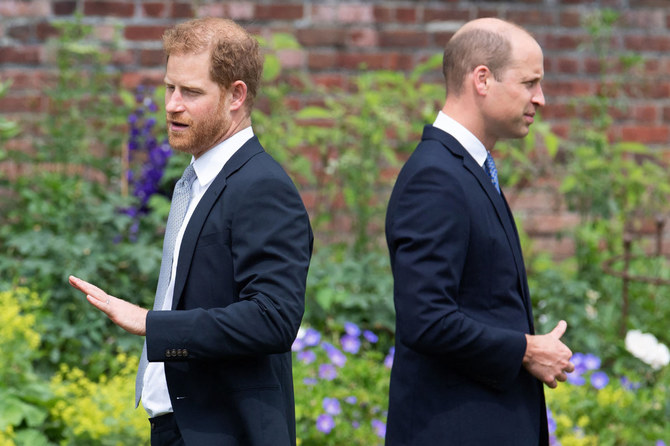
Britain's Prince Harry and Prince William at the unveiling of a statue of their mother, Princess Diana, at Kensington Palace, London, on July 01, 2021. (AFP / Pool)
Short Url
Updated 08 January 2023
Follow

Prince Harry set to deliver more broadsides at UK royals in TV interviews

  • Harry’s book “Spare” chronicles not only hugely personal details, such as how he lost his virginity and took drugs, but also discloses more intimate private instances of family disharmony

LONDON: Days after Prince Harry’s memoir accidentally went on sale early with new allegations of discord and conflict within the British royal family, a series of TV interviews with him will start airing on Sunday with the prospect of yet more damaging attacks on the monarchy.
Harry’s book “Spare,” which went on sale in Spain on Thursday five days before its official release, chronicles not only hugely personal details, such as how he lost his virginity and took drugs, but also discloses more intimate private instances of family disharmony.
His elder brother, heir to the throne Prince William, knocked him over in a brawl, and both siblings begged their father King Charles not to marry his second wife, Camilla, now the Queen Consort, the book says.
Commentators say it has plunged the monarchy into its biggest crisis since the days of the royal soap opera in the 1990s around the break-up of Charles’ marriage to his late first wife Princess Diana, William and Harry’s mother.
All this comes just four months after Queen Elizabeth died and Charles acceded to the throne.
“So here’s Charles trying to establish himself as the new king and now Harry’s thrown this hand grenade and it’s all coming kind of crashing around him,” royal biographer Tina Brown said.
Since Harry and Meghan left royal duties and moved to California in 2020, they have railed at their treatment by the royals and the palace institution.
From their interview with Oprah Winfrey in 2021 to their six-part Netflix documentary series last month and now Harry’s book, the couple’s message has been the same: that the royals and their aides not only failed to protect them from a hostile and sometimes racist press, but actively leaked negative stories about them.
So far, there has been no comment from Buckingham Palace or anyone who speaks for the royal family, a stance that has been lauded by much of the British media as a dignified silence.
No point in 'staying silent'
On Sunday, Harry’s public thoughts will keep coming, with three more TV interviews due to air. They had been timed for broadcast ahead of the official launch of Harry’s book on Tuesday, and excerpts released ahead of time have shown Harry saying he wanted to give his side of the story.
“I don’t know how staying silent is ever going to make things better,” Harry says in his interview with Britain’s ITV, which will be the first to be shown.
Polls suggest many Britons are becoming bored of the whole royal melodrama, and further revelations are unlikely to shake their views, whether sympathy for Harry and Meghan, or for those they criticize. However Harry’s book was No. 1 on Amazon UK’s bestselling books list on Saturday, available for pre-order ahead of its release. 
Royal commentator Emily Andrews said that given Britain’s current cost of living crisis, there could be limited support for the complaints of a privileged prince residing in a mansion in California.
“They are polarizing, Harry and Megan, and I think that this new book by Harry probably won’t change many people’s opinions,” Andrews told Reuters.
“I think this is overkill, it becomes saturation point and people think ‘I don’t want to hear anymore: shut up, go away’.” 


In southeast Pakistan, Ramadan brings Hindus and Muslims closer

Updated 10 March 2026
Follow

In southeast Pakistan, Ramadan brings Hindus and Muslims closer

MITHI: Partab Shivani, a Hindu in Muslim-majority Pakistan, has fasted on and off during Ramadan for years, but this time is different as he practices abstinence for the entire holy month.
Every year, he and his friends in the southeastern city of Mithi arrange iftar, when Muslims break their daily fast, to foster peace and solidarity between the two religions.
“I believe we need to promote interfaith harmony. First, we are humans — religions came later,” Shivani, a 48-year-old social activist, told AFP, adding that he also reads the teachings of the Buddha.
“His message is about peace and ending war. Peace can spread through solidarity and by standing with one another. Distance only widens the gap between people,” he added.
Ninety-six percent of Pakistan’s 240 million people are Muslim. Just two percent are Hindu, most of them living in rural areas of Sindh province where Mithi is located.
In Mithi itself, most of the 60,000 inhabitants are Hindu.
Many of the city’s Hindus also observe Ramadan and iftar has become a social gathering where people from both faiths happily participate.
“This has been a wonderful tradition of ours for a very long time,” said Mir Muhammad Buledi, a 51-year-old Muslim friend who attended Shivani’s iftar gathering.
“It is a beautiful example of harmony between the two communities.”
Like brothers
Discrimination against minorities runs deep in Pakistan.
Following the end of British rule in South Asia in 1947, the subcontinent was partitioned into mainly Hindu India and Muslim-majority Pakistan.
That triggered widespread religious bloodshed in which hundreds of thousands were killed and millions displaced.
According to the Human Rights Commission of Pakistan, freedom of religion or belief is under constant threat, with religiously motivated violence and discrimination increasing yearly.
State authorities, often using religious unrest for political gain, have failed to address the crisis, the independent non-profit says.
But such tensions are absent in Mithi.
“I am a Hindu but I keep all the fasts during this month,” said Sushil Malani, a local politician. “I feel happy standing with my Muslim brothers.
“We celebrate Eid together as well. This tradition in the region is very old.”
Restaurants and tea stalls are closed across Pakistan during Ramadan.
Ramesh Kumar, a 52-year-old Hindu man who sells sweets and savoury items outside a Muslim shrine, keeps his push cart covered and closed until iftar.
“There is no discrimination among us if someone is Muslim or Hindu. I have been seeing this since my childhood that we all live together like brothers,” he said.
Muslim shrine, Hindu caretaker
Locals say Mithi’s peaceful religious coexistence can be traced to its remote location, emerging from the sand dunes of the Tharparkar desert, which borders the modern Indian state of Rajasthan.
Cows — considered sacred in Hinduism — roam freely in Mithi city, as they do in neighboring India.
At two Sufi Muslim shrines in the middle of the city, Hindu families arrange meals, bringing fruit, meals and juices for their Muslim neighbors to break their fasts.
“We respect Muslims,” said Mohan Lal Malhi, a Hindu caretaker of one of the shrines.
Mohan said his parents and elders taught him to respect people regardless of religion or color, and the traditions pass from one generation to the next.
Local residents said both communities consider their social relationships more important than their religious identity.
“You will see a (Sikh) gurdwara, a mosque, and a shrine standing side by side here,” Mohan said. “The atmosphere of this area teaches humanity.”