Pakistan’s mountainous regions to experience rain, snowfall from Friday – Met Office

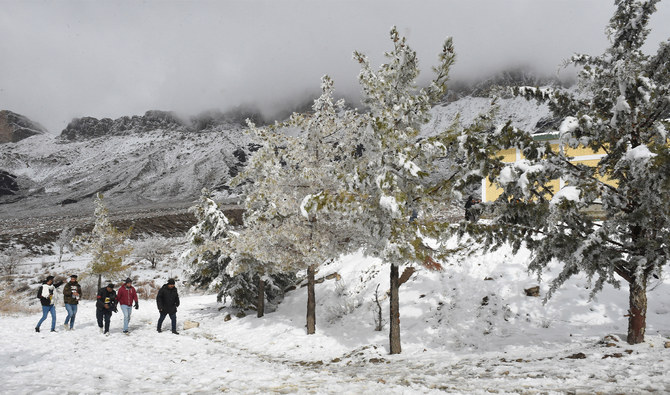
Local tourists vist the snow covered area in Ziarat, around 70 Kilometres from Quetta in Balochistan province on January 8, 2022. (AFP/File)
Short Url
Updated 06 January 2023
Follow

Pakistan’s mountainous regions to experience rain, snowfall from Friday – Met Office

  • The meteorological department asks relevant government departments to take precautionary measures
  • Last year, more than 20 snow tourists died in freezing temperatures after their vehicles got stuck in Murree

ISLAMABAD: Pakistan’s meteorological department warned of changing weather intensity while predicting rains and snowfall on Thursday, asking all relevant government departments to take necessary measures to deal with the situation and urging travelers and tourists in mountainous regions to ensure their safety.

Pakistan witnessed unprecedented monsoon rains last year that triggered flash floods which washed away crops, houses and public infrastructure in the southern region of the country. According to senior United Nations officials, the country needs around $16.3 billion for climate-resilient recovery and reconstruction.

The international community has widely recognized the recent floods were caused by changing weather patterns that necessitated collective action. This is despite the fact that Pakistan is responsible for only 0.8 percent of global greenhouse emissions, though it is also counted among the most vulnerable countries to extreme weather caused by climate change.

As the country continues to deal with the devastation caused by the recent floods, the meteorological department informed in a notification that a westerly wave was expected to enter northern Balochistan late Friday that would lead to moderate rain and snowfall on hills in areas like Quetta, Zhob, Ziarat and Chaman.

A similar forecast was also made for Murree, Gulliyat, Kashmir, Gilgit-Baltistan, Dir, Chitral, Swat and Abbottabad.

Pakistan’s federal capital, Islamabad, and some areas in the Pothohar region are also likely to experience light rain over the weekend.

The meteorological department said the weather forecast was from 6th to 9th January while asking the relevant departments to “prepare general and area/region specific awareness campaign and ensure widespread propagation of likely threats/hazards.”

“Medical resources, paramedics, equipment and medicine [should] be deployed as per the vulnerability/risks identified in different regions to meet respective regional requirements,” the notification added. “Ensure that tourist/visitors/travelers in at-risk/affected areas [are] apprised/forewarned about forecasted weather and road conditions.”

It also asked the authorities to “ensure availability of emergency services personnel during the forecasted period.”

The meteorological department asked people to maintain a decent stock of basic commodities in regions that usually get cut off from the rest of the country during snowfall.

More than 20 snow tourists, including nine children, died in freezing temperatures after their vehicles were stuck in the Pakistani hill station of Murree last year.

The families of the victims blamed the government for not responding on time despite getting an advance warning of heavy snowfall.


IMF hails Pakistan privatization drive, calls PIA sale a ‘milestone’

Updated 10 January 2026
Follow

IMF hails Pakistan privatization drive, calls PIA sale a ‘milestone’

  • Fund backs sale of national airline as key step in divesting loss-making state firms
  • IMF has long urged Islamabad to reduce fiscal burden posed by state-owned entities

KARACHI: The International Monetary Fund (IMF) on Saturday welcomed Pakistan’s privatization efforts, describing the sale of the country’s national airline to a private consortium last month as a milestone that could help advance the divestment of loss-making state-owned enterprises (SOEs).

The comments follow the government’s sale of a 75 percent stake in Pakistan International Airlines (PIA) to a consortium led by the Arif Habib Group for Rs 135 billion ($486 million) after several rounds of bidding in a competitive process, marking Islamabad’s second attempt to privatize the carrier after a failed effort a year earlier.

Between the two privatization attempts, PIA resumed flight operations to several international destinations after aviation authorities in the European Union and Britain lifted restrictions nearly five years after the airline was grounded following a deadly Airbus A320 crash in Karachi in 2020 that killed 97 people.

“We welcome the authorities’ privatization efforts and the completion of the PIA privatization process, which was a commitment under the EFF,” Mahir Binici, the IMF’s resident representative in Pakistan, said in response to an Arab News query, referring to the $7 billion Extended Fund Facility.

“This privatization represents a milestone within the authorities’ reform agenda, aimed at decreasing governmental involvement in commercial sectors and attracting investments to promote economic growth in Pakistan,” he added.

The IMF has long urged Islamabad to reduce the fiscal burden posed by loss-making state firms, which have weighed public finances for years and required repeated government bailouts. Beyond PIA, the government has signaled plans to restructure or sell stakes in additional SOEs as part of broader reforms under the IMF program.

Privatization also remains politically sensitive in Pakistan, with critics warning of job losses and concerns over national assets, while supporters argue private sector management could improve efficiency and service delivery in chronically underperforming entities.

Pakistan’s Cabinet Committee on State-Owned Enterprises said on Friday that SOEs recorded a net loss of Rs 122.9 billion ($442 million) in the 2024–25 fiscal year, compared with a net loss of Rs 30.6 billion ($110 million) in the previous year.