

New UAE-based online marketplace to help Middle East artists sell work year-round

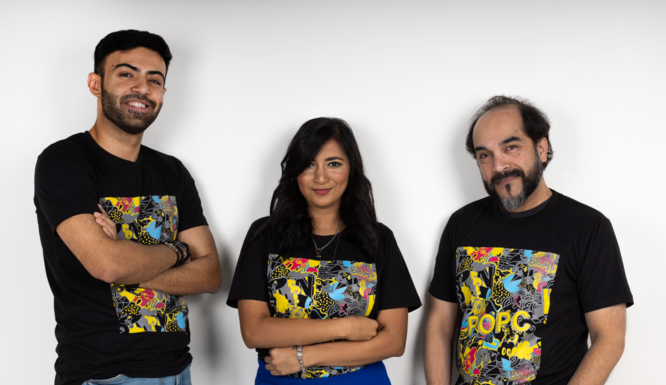
The UAE-based POC founders Haroon Tahir, Amna Aijaz and Arafat Ali Khan. (Supplied)
Short Url
Updated 06 January 2023
Follow

New UAE-based online marketplace to help Middle East artists sell work year-round

DUBAI: A new UAE-based online marketplace has been launched with the aim of disrupting the artist economy in the Middle East.

With a passion for pop culture and a goal to empower the region’s artists to fairly sell their art across a wide range of merchandise, POPC is the brainchild of Amna Aijaz, Haroon Tahir, and Arafaat Ali Khan.


A post shared by POPC (@popcofficial)

Between them they have more than 40 years of experience in e-commerce, marketing, design, pop culture, and customer experience.

For Aijaz, the company’s chief art officer, the seeds for the startup were planted in her imagination during the coronavirus pandemic, when she realized that regional artists similar to herself did not have a year-round platform to showcase and sell their work.

While annual pop culture events such as the Middle East Film and Comic Con — first brought to the UAE by POPC co-founder Ali Khan — help, they usually only run over a few days a year, leaving artists to fend for themselves for the rest of the year.


A post shared by POPC (@popcofficial)

Aijaz told Arab News: “The artwork that we have on the website right now, as it stands, it is very much one of a kind because we are reaching out to artists that don’t have that platform to exhibit or sell their artwork on. They either have those three-day events, or POPC.”

On the POPC website, shoppers and pop culture fans can find merchandise specially designed by creators and artists from the Middle East, who earn a fixed commission on the sale of each product.

Creators are empowered to sell their products through their own individual storefronts within the marketplace at no joining cost, with production and shipping handled entirely by the platform.


A post shared by POPC (@popcofficial)

Marketing and communications professional, Tahir, said several factors put POPC ahead of the game when it came to online artist marketplaces, including that artist commissions were generally higher than average.

“The problem with international marketplaces that we saw were that you needed a US, or UK, or global bank account and a global shipping address to be able to sell and that was a huge detriment to all the artists that we were speaking to.

“Compared to regional competitors, we’re always focused on art that’s fun, relatable, and quirky. We don’t take ourselves too seriously,” Tahir added.


A post shared by POPC (@popcofficial)

The company’s top priority for this year is to cater for the entire Middle East region by the end of the first quarter.

Tahir said: “Another thing we’re also working on is an Arabic comic book reader, one of the first Arabic readers in the region, which will be home to some really cool titles, including some manga studios, that I can’t quite disclose yet.”


The difference between European and Gulf weddings — from a photographer’s point of view

Updated 21 January 2026
Follow

The difference between European and Gulf weddings — from a photographer’s point of view

DUBAI: From her early career in northeast France to working across the Gulf and Europe, wedding photographer Maddy Christina has observed many contrasts between such events in different parts of the world.

Her early years as a photographer were defined by variety; she worked across fashion, family portraits and weddings simultaneously before recognizing how wedding photography brings multiple genres together in a single day. 

Christina said weddings in the region required a shift in both perspective and technique. (Supplied)

“I actually fell into weddings by accident,” Christina told Arab News. “It blends every discipline at once — fashion for the couple session, sports for the reception, documentary work throughout the day, still life with details and jewelry.”

Christina’s connection to the Middle East began through Parisian clients who invited her to Dubai for a post-wedding session: “I instantly connected with the energy of the city,” she said.

Christina’s connection to the Middle East began through Parisian clients who invited her to Dubai for a post-wedding session. (Supplied)

A few years later, a wedding in Kuwait marked the start of her long-term relationship with the region.

Now working extensively across the Gulf Cooperation Council, Christina said weddings in the region required a shift in both perspective and technique.

For Christina, the most meaningful aspect extends beyond the wedding day itself. (Supplied)

“Working across the GCC has opened my mind in ways I didn’t expect,” she said, adding it felt like “resetting everything I thought I knew about weddings” — particularly compared to her experience in Europe.

She said there were clear distinctions between the two regions. “European weddings tend to be more demonstrative and expressive, while brides in the Gulf often place a deeper emphasis on tradition, family bonds and a sense of ceremony,” she said. “The emotional language is different, yet equally beautiful.”

From a technical standpoint, the contrast is just as pronounced: “In the south of France, I was used to shooting outdoors at sunset with couples already comfortable in front of the camera. Here, I often find myself in much smaller spaces, with no windows, artificial light and couples who may be more reserved.”

Christina is drawn to candid moments. (Supplied)

She added that adapting to these conditions pushed her to explore new ways of shaping light and expanded her creative approach.

While Christina is drawn to candid moments, like “guests laughing together, old friends reconnecting, a fleeting emotion passing across someone’s face,” posed pictures remain central to her work.

For Christina, the most meaningful aspect extends beyond the wedding day itself.

“It’s not the decor that makes a wedding unforgettable for me,” she said. “It’s the connection I build with the bride. That long-term bond is what feels truly magical.”