

Dubai announces plan to ‘double’ economy in next decade

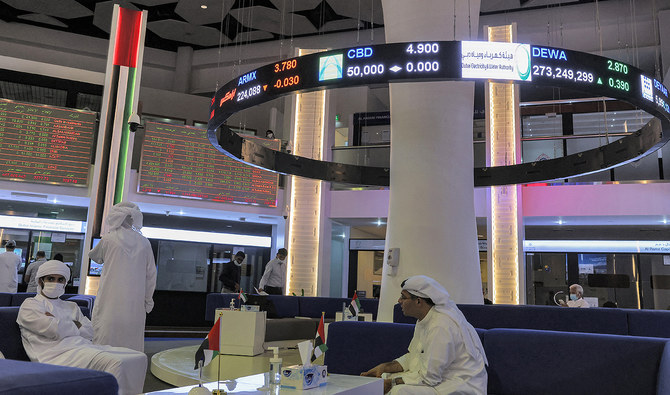
People sit under a display showing the values of different stocks at the Dubai Financial Market stock exchange in the Gulf emirate on April 12, 2022. (Photo courtesy: AFP/File)
Short Url
Updated 04 January 2023
Follow

Dubai announces plan to ‘double’ economy in next decade

  • The new economic agenda will increase foreign trade by 44 percent to 25.6 trillion dirhams
  • The ambitious plan comes as much of the world reels from doom-laden financial forecasts

DUBAI: Dubai announced Wednesday a bold plan aiming to boost foreign trade and investment in the United Arab Emirates’ financial hub and “double the size” of its economy by 2033.

The Gulf emirate’s ruler, Sheikh Mohammed bin Rashid Al-Maktoum, unveiled in a series of tweets the Dubai Economic Agenda, dubbed “D33,” with targets totaling 32 trillion dirhams ($8.7 trillion).

The plan would “double the size of Dubai’s economy in the next decade and consolidate its position among the top three global cities,” Sheikh Mohammed said in a post that was accompanied by a marketing video.

The objectives would be achieved through “100 transformative projects,” he said in Twitter posts using infographics.

The new economic agenda would also add 400 cities to Dubai’s list of trading partners, increasing foreign trade in the coming decade by 44 percent to 25.6 trillion dirhams.

It would also see foreign direct investment in Dubai exceed 650 billion dirhams within 10 years, according to Sheikh Mohammed.

The ambitious plan comes as much of the world reels from doom-laden financial forecasts.

On Monday, the head of the International Monetary Fund (IMF) warned a third of the world’s economy would slip into recession in 2023 amid slowing growth in the United States, the European Union and China.

But visiting IMF officials in November predicted “robust” economic growth in the UAE, with projected GDP growth of six percent in 2022.

Dubai’s GDP stood at 307.5 billion dirhams during the first nine months of 2022, according to the government, representing a 4.6-percent increase year-on-year from 2021.


Syria transition ‘fragile’, one year on: UN investigators

Updated 56 min ago
Follow

Syria transition ‘fragile’, one year on: UN investigators

  • The commission said moving beyond the legacy of war and destruction would take “great strength, patience and support”

GENEVA: Syria’s transition is fragile, one year on from the overthrow of ruler Bashar Assad, and the country’s cycles of vengeance and reprisal need to end, United Nations investigators said Sunday.
Syrians have been marking the first anniversary since Islamist-led forces pressed a lightning offensive to topple Assad on December 8, 2024 after nearly 14 years of war.
The UN Independent International Commission of Inquiry on Syria investigates and records all international human rights law violations since March 2011 in the country.
The panel congratulated Syria on the steps it has taken so far to address the crimes and abuses inflicted during previous decades.
But it said violent events since Assad’s downfall had caused renewed displacement and polarization, “raising worries about the future direction of the country.”
The commission said the “horrific catalogue” of abuse inflicted by Assad’s regime “amounted to industrial criminal violence” against Syria’s people.
“The cycles of vengeance and reprisal must be brought to an end, so that Syria can continue to move toward a future as a state that guarantees full respect for the human rights of all its people, with equality, the rule of law, peace and security for all in name and in deed,” the commission said.
“Syria’s transition is fragile. While many across the country will celebrate this anniversary, others are fearing for their present security, and many will sleep in tents again this winter. The unknown fate of many thousands who were forcibly disappeared remains an open wound.”
The commission said moving beyond the legacy of war and destruction would take “great strength, patience and support.”
“The Syrian people deserve to live in peace, with full respect for rights long denied, and we have no doubt they are up to the task,” it said.
The three-person commission is tasked with establishing facts with a view to ensuring that the perpetrators of violations are ultimately held accountable.
The UN Human Rights Council extended its mandate for a further year in April.