Ukraine says Russia plans new mobilization to ‘turn tide of war’

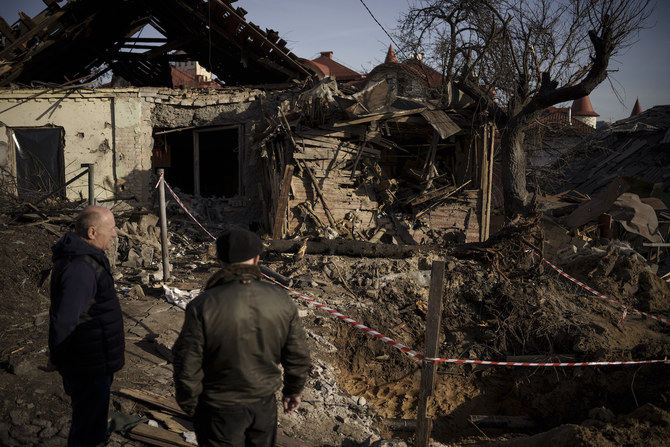
People stand next to the site of a Russian attack in Kyiv, Ukraine, Monday, Jan. 2, 2023. (AP)
Short Url
Updated 04 January 2023
Follow

Ukraine says Russia plans new mobilization to ‘turn tide of war’

  • If Russia is planning a new mobilization, the deaths of scores of conscripts on New Year’s Eve could undermine morale
  • Macron told Zelensky France would send light AMX-10 RC armored combat vehicles to help in the war

KYIV: Ukraine’s President Volodymyr Zelensky said Russia was planning to call up more troops for a major new offensive, even as Moscow was facing some of its biggest internal criticism of the war over a strike that killed scores of fresh conscripts.
Kyiv has been saying for weeks that Russian President Vladimir Putin plans to order another mass conscription drive and shut his borders to prevent men from escaping the draft.
“We have no doubt that the current masters of Russia will throw everything they have left and everyone they can round up to try to turn the tide of the war and at least delay their defeat,” Zelensky said in his nightly video address on Tuesday.
“We have to disrupt this Russian scenario. We are preparing for this. The terrorists must lose. Any attempt at their new offensive must fail.”
Russia’s defense ministry on Wednesday blamed mobile phone use by its soldiers for a Ukrainian strike on New Year’s Eve it said had killed 89 servicemen, the deadliest incident Moscow has acknowledged for its troops since the start of the war.
If Russia is planning a new mobilization, the deaths of scores of conscripts on New Year’s Eve could undermine morale. Hundreds of thousands of men fled Russia when Putin ordered the first call-up of reservists since World War Two in September after military setbacks.
Putin said last month there was no need for further mobilization. But in a sign the Kremlin may now be considering one, a little known group claiming to represent widows of Russian soldiers released a call on Tuesday for Putin to order a large-scale mobilization of millions of men. The Kremlin has not commented on that appeal.
Russian anger
Russia has effectively shut down all direct opposition to the war, with open criticism banned by severe media rules. But it has given comparatively free rein to pro-war bloggers, some with hundreds of thousands of followers on social media.
Many are increasingly vocal about what they consider a half-hearted and incompetently led campaign, and have expressed anger this week over the strike that killed Russian troops housed in a vocational school in Donetsk province on New Year’s Eve.
Criticism has been directed at military commanders rather than at Putin, who has not commented publicly on the attack.
Russia’s Defense Ministry, which raised the official death toll in the attack to 89 from 63, blamed soldiers for illegally using mobile phones, which it said led Ukraine to locate the base in Makiivka, twin city of regional capital Donetsk.
Semyon Pegov, a war correspondent decorated by Putin, said on Telegram the mobile phone explanation “looks like an outright attempt to smear the blame,” and there were other ways Ukraine could have spotted the base.
Other pro-Russian bloggers have said the strike was worsened because ammunition was stored at the site. Moscow has not confirmed this.
Rob Lee, a senior fellow at the Foreign Policy Research Institute think-tank, said Moscow had a problem safely housing freshly mobilized troops near the front in winter.
“It is more difficult to disperse them because of a lack of small unit leadership, and they will do worse in the cold than trained soldiers,” he tweeted. But housing them near ammunition “is simply a leadership failure,” he added.
Armored vehicles
French President Emmanuel Macron told Zelensky France would send light AMX-10 RC armored combat vehicles to help in the war, a French official said after a phone call between the two men, adding this would be the first time Western-made armored vehicles are being delivered in support of the Ukrainian army.
An official from the Ukrainian defense ministry’s intelligence section, Andriy Cherniak, said in comments to the RBC-Ukraine media outlet that Kyiv expected no let-up in Russia’s offensive this year despite the heavy human toll.
“According to Ukrainian military intelligence’s estimates, in the next four-five months the Russian army may lose up to 70,000 people. And the occupying country’s (Russia’s) leadership is ready for such losses,” Cherniak said.
Russian leaders “understand they will lose but they do not plan to end the war,” he said.
In a signal to the West that Russia will not back down over Ukraine, Putin sent a frigate on Wednesday to the Atlantic Ocean armed with new generation hypersonic cruise missiles, which can travel at more than five times the speed of sound.
Ukraine’s military General Staff said in its daily update that Russia had launched seven missile strikes, 18 air strikes and more than 85 attacks from multiple-launch rocket systems in the past 24 hours on civilian infrastructure in the cities of Kramatorsk, Zaporizhzhia and Kherson.
“There are casualties among the civilian population,” it said. Russia denies deliberately attacking civilians.
The battlefield reports could not be independently verified by Reuters.
Ukraine’s General Staff also said Russian forces continued to concentrate on advancing near the Donetsk province city of Bakhmut, where both sides are believed to have lost thousands of troops in weeks of intense trench warfare.
Putin plans to talk to Turkish President Tayyip Erdogan on Wednesday, Kremlin spokesman Dmitry Peskov told Interfax. Turkiye acted as mediator alongside the United Nations to establish a deal allowing grain exports from Ukrainian ports.
Russia launched what it calls a “special military operation” in Ukraine on Feb. 24, citing threats to its own security and a need to protect Russian speakers. Ukraine and its allies accuse Moscow of an unprovoked war to seize territory.


Sri Lanka takes custody of an Iranian vessel off its coast after US sank an Iranian warship

Updated 1 sec ago
Follow

Sri Lanka takes custody of an Iranian vessel off its coast after US sank an Iranian warship

  • Sri Lankan President Anura Kumara Dissanayake said the country took control of the vessel after it reported an engine failure and that the decision followed talks with Iranian officials and the ship’s
COLOMBO: Sri Lanka began transferring more than 200 sailors from an Iranian vessel to shore Friday after the ship sought assistance while anchored outside the country’s waters, as tensions mounted in the Indian Ocean following the sinking of an Iranian warship by a US submarine.
Sri Lankan navy spokesperson Cmdr. Buddhika Sampath said 204 sailors of the IRIS Bushehr were brought to the Welisara Naval Base near the capital, Colombo. They underwent border control procedures and medical tests, but none were found to have health issues.
About 15 others have been left aboard the ship with Sri Lankan naval personnel for assistance because they had reported a fault with the ship.
The Iranian sailors are interpreting operational instructions, manuals and logs for their Sri Lankan counterparts because the ship will be in Sri Lankan custody until further notice, Sampath said.
The ship will be taken to the port of Trincomalee in eastern Sri Lanka, Sampath said.
Iranian ship was taking part in naval exercises
The Sri Lankan government took custody of the Bushehr after the US sank an Iranian warship, the IRIS Dena, off Sri Lanka’s coast Wednesday. The strike marked one of the rare instances since World War II in which a submarine sank a surface warship, and highlighted the expanding scope of the US-Israeli military campaign against Iran.
The Dena had participated in naval exercises hosted by India before heading into international waters on its way home. At least 74 countries had joined the events, according to India’s Defense Ministry, including the US Navy, which conducted reconnaissance aircraft and maritime patrol drills.
The Indian navy received a distress signal from the Dena but by the time it launched a search and rescue operation, the Sri Lankan navy had already begun its own rescue efforts, the ministry said.
The Sri Lankan navy rescued 32 sailors and recovered 87 bodies.
Iran’s Foreign Minister Abbas Araghchi said the Dena had been carrying “almost 130” crew. The normal crew size for a warship of that class is 140.
Araghchi called the sinking an “atrocity at sea” and said the US would “bitterly regret” the attack.
Sri Lanka says it acted under international law
Sri Lankan President Anura Kumara Dissanayake said late Thursday that authorities decided to take control of the IRIS Bushehr after discussions with Iranian officials and the ship’s captain, after one of its engines failed.
“We have to understand that this is not an ordinary situation. It’s a request by a ship belonging to one party to enter into our port. We have to consider that according to the international treaties and conventions,” he told journalists Thursday night.
Separately on Friday, he wrote on X: “No civilian should die in wars. Our approach is that every single life is as precious as our own.”
The IRIS Bushehr had been described in previous Iranian media reports as a navy logistics ship equipped with a helicopter pad.
Dissanayake said Sri Lanka was guided by neutrality while seeking to uphold humanitarian principles.
“We have followed a very clear stance. We will not be biased to any state nor we will be submissive to any state,” he said.
Sri Lanka’s neutrality is tested
The broadening Middle East conflict is putting strategically located Sri Lanka in a delicate position as it tries to balance humanitarian obligations, international maritime law and its longstanding policy of non-alignment.
H.M.G.S. Palihakkara, Sri Lanka’s retired former foreign secretary who also served as its permanent representative to the United Nations, said the country had acted responsibly and impartially.
“There has been a distress call from the ship. So naturally Sri Lanka, as a party to the Law of Sea and The Hague Convention, had no option but to do what it did by mounting a humanitarian operation to provide assistance to save lives and provide medical care to the affected,” he said.
Palihakkara said parties to the conflict would understand that Sri Lanka was not taking sides.
“You could not have ignored the distress call. Even the attacking powers cannot leave shipwrecked sailors dying. That is the law,” Palihakkara said.
Katsuya Yamamoto, director of the Strategy and Deterrence Program at the Sasakawa Peace Foundation in Tokyo, said Sri Lanka, which is not at war with either the US or Iran, is considered a neutral state. As such, the Bushehr can enter a Sri Lankan port if granted permission by the government, he said.
Yamamoto said that once the vessel is docked, it falls under Iranian jurisdiction, leaving Sri Lankan authorities without legal grounds to inspect it unless Colombo decides to side with the US
Australians aboard submarine
Australia’s government confirmed on Friday that three Australians were aboard the submarine that sank the IRIS Dena. The Australians were there as part of the trilateral US, Australian and British training program under the AUKUS security pact.
The Australian government has maintained it was not warned that the USand Israel planned to attack Iran. Australia has not commented on the legality of the attack, but supports the objective of preventing Iran from gaining nuclear weapons.
Neil James, executive director of the Australian Defense Association policy think tank, said it is “reasonably rare” for Australians embedded with another nation’s military to go to war against a country such as Iran that Australia wasn’t at war with.
He said an Australian would not have fired the torpedo that sank the Iranian ship
“The Australians wouldn’t have a job where they had to push the button on the torpedo because the captain of the boat gives the order and someone else, perhaps the weapons officer, presses the button but they’re not going to be Australian,” James said.