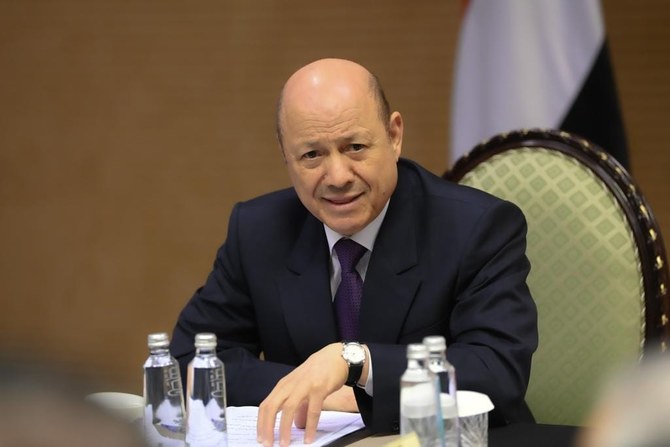

AL-MUKALLA: Yemen’s leader has promised to liberate his country from the Houthis, pay public wages and restore deteriorating public services in his new year message.
“Your armed and security forces, popular resistance, and patriotic alignment will remain our exemplar for restoring the state, putting a stop to the coup, and defending the republican system,” said Rashad Al-Alimi, the chairman of Yemen’s Presidential Leadership Council, in a message on Twitter.
He said that the council, with the assistance of the Arab coalition headed by Saudi Arabia and the UAE, will prioritize promoting harmony and collaboration between diverse Yemeni forces to restore peace to Yemen.
Al-Alimi went back on a previous statement that his government would be unable to pay government salaries due to Houthi assaults on oil infrastructure, and reassured the public that the council would attempt to secure regular salary payments.
“We reiterate our resolve to continue our efforts to relieve the suffering caused by the terrorist Houthi militia supported by Iran, including the regular payment of wages to civil and military personnel, diplomatic missions, and state-funded students in compliance with comprehensive government reforms.”
The eight-member presidential council came to power in April when former President Abed Rabbo Mansour Hadi stepped down.
Yemenis say that previous guarantees by the Yemeni government and the presidential council have not resulted in any changes on the ground in the freed provinces, as they continue to complain about rising costs, a depreciating currency, and severe and worsening power cuts.
The Yemeni riyal began the new year falling further against the dollar, extending a week of declines against other currencies for the first time in many months.
Traders said on Sunday that the Yemeni riyal was trading at 1,230 per dollar, down from 1,200 last week, following an official announcement on a full stop to oil shipments, the country’s principal source of income.
Unlike past years during winter, Al-Mukalla, Aden, and other government-controlled cities have experienced long periods without power.
Public workers say that their wages have not increased since 2011 and have lost 200 percent of their worth owing to the fast depreciation of the riyal and rising inflation.
Meanwhile, on the first day of the new year, fighting subsided in Taiz, Hodeidah, Marib and other provinces.
The calm came almost two days after fierce fighting between government forces and the Houthis in the southern province of Dhale left scores of combatants dead or injured on one of the worst days since the breakdown of the UN-brokered truce in October.
Separately, a Houthi-run court in Sanaa condemned three teachers from the province of Mahwet to death on espionage accusations on Saturday, the latest in a series of death sentences against hundreds of people.
Abdul Majeed Sabra, a Yemeni defense lawyer based in Sanaa, told Arab News on Sunday that his clients who were abducted in 2015 from their home province Mahwet for allegedly collaborating with the Yemeni government and the Coalition to Restore Legitimacy in Yemen.
They were sentenced in the capital’s Specialized Criminal Court.
Last month, a Houthi court sentenced 16 Yemenis to death for collaborating with the Coalition to Restore Legitimacy in Yemen and the militia’s Yemeni adversaries.
The escalation in death sentences has been seen by Yemeni observers as a means of intimidating the population in Houthi-controlled areas, where discontent is rising due to the militia’s failure to pay public employees and its savage crackdown on the media and dissidents.