

Pakistani leaders express condolences over Pope Benedict XVI’s death

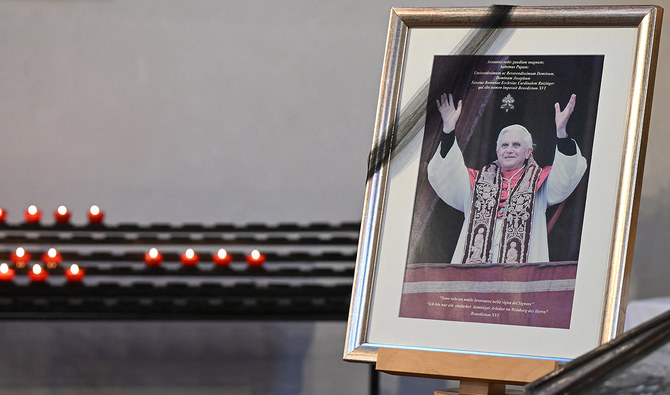
Candles are seen near a picture of late former Pope Emeritus Benedict XVI in the Catholic St Oswald church in his birth place Marktl, southern Germany, on December 31, 2022. (Photo courtesy: AFP)
Short Url
Updated 01 January 2023
Follow

Pakistani leaders express condolences over Pope Benedict XVI’s death

  • Benedict died on Saturday at age of 95 following rapid decline in his health over Christmas
  • Pakistan’s PM and foreign minister express solidarity with the country’s Christian community

ISLAMABAD: Pakistani leaders expressed condolences over the death Pope Benedict XVI late Saturday night while assuring the country’s Christian community that the government stood with them and shared their grief.
Benedict, who was the first pontiff in 600 years to resign his position, used the title of Pope emeritus during the last decade of his life. His death of Saturday brought to an end an extraordinary period in which two men wearing white lived in the Vatican.
The first German pope in a thousand years, Benedict experienced a rapid decline in his health over Christmas before his death at the age of 95.
Leaders from across the world, including Pakistan, reacted to the tragic development while offering condolences and praying for the departed soul.
“Deeply saddened to learn about the passing of Pope Emeritus Benedict XVI,” PM Shehbaz wrote in a Twitter post. “He would be mourned by millions around the world, including in Pakistan. May his soul rest in eternal peace.”

 
Foreign Minister Bilawal Bhutto-Zardari also expressed grief over Benedict’s death.
“We are saddened to learn about the passing away of Pope Benedict XVI,” he wrote on Twitter. “May he rest in peace. We join our Christian compatriots and Catholics around the world in prayers for His Holiness at this time of mourning.”

 
The Vatican said Benedict’s body would remain in St. Peter’s Basilica from Monday until Pope Francis led his funeral on Thursday morning.
The Vatican has painstakingly elaborated rituals for what happens after a reigning pope dies, though no publicly known ones for a former pope.
The authorities in Vatican said official government delegations at the funeral would be limited to those from Germany and Italy.
Other dignitaries would attend in a private capacity.


At Islamabad conference, Pakistan pitches agriculture as next frontier for Chinese investment

Updated 6 sec ago
Follow

At Islamabad conference, Pakistan pitches agriculture as next frontier for Chinese investment

  • Hundreds of Chinese and Pakistani firms attended the event focusing on fertilizers, seeds, smart farming and irrigation techniques
  • PM Sharif urges Pakistani farmers, businesses and universities to engage with Chinese institutions and experts to modernize agriculture

ISLAMABAD: Prime Minister Shehbaz Sharif on Monday pitched Pakistan’s agriculture sector as the next major frontier for Chinese investment, highlighting opportunities in agri-business, food processing and farming technologies.

The prime minister said this while addressing the Pakistan-China Agriculture Investment Conference, which brought together Chinese and Pakistani agriculturists, entrepreneurs, experts, academicians and government officials.

Hundreds of Chinese and Pakistani firms attended the event that focused on fertilizers, seed varieties, machinery, precision farming and smart irrigation systems, according to the organizers.

Sharif said China had never shied away from providing Pakistan with best possible expertise and technologies, and both sides had signed several memorandums of understanding (MoUs) at similar summits in Shandong and Beijing in last two years.

“I was very happy to express my satisfaction over the progress we are making in terms of converting these MOUs into agreements,” he said. “Today’s conference is a clear indication that Chinese business houses are more than willing to shake hands with Pakistani business houses.”

The conference was billed by Pakistan’s Ministry of National Food Security and Research as a platform for deepening bilateral agricultural ties and supporting broader economic engagement between the two countries.

Sharif called on Pakistani farmers, agribusinesses and universities to actively engage with Chinese institutions and experts to modernize the agriculture sector, which accounts for 24 percent of Pakistan’s GDP and employs over 37 percent of its labor force.

“Chinese experts are there to assist us and support us all the way to achieve this wonderful target [of becoming a surplus agricultural economy],” he said. “Now it’s up to us to generate this trade surplus through higher yields, comparative cost and, of course, highest quality.”

Pakistan and China have been expanding cooperation in agriculture under the China-Pakistan Economic Corridor framework, with a focus on mechanization, high-yield seeds, livestock development and value-added food processing.

Officials say stronger agricultural ties could help Pakistan boost exports, ensure food security and create jobs, while offering Chinese companies access to a large farming market and new investment opportunities.

The prime minister noted that Pakistan’s policy rate was down to 10.5 percent down from 22 percent two years ago, exports were gradually increasing and macroeconomic indicators were stable.

“Now we have to move toward growth,” he said. “But then it requires solid, hard work, untiring efforts, blood and sweat. Without that, you will not be able to achieve your targets.”

The Pakistan-China Agriculture Investment Conference focused on technology transfer and joint ventures in farming, food processing and agricultural research.

“I would urge upon Pakistani farmers, Pakistani agri-houses, experts, professors, technicians, that please come forward and show your best to your [Chinese] brothers and sisters,” Sharif said.

“China is ready, ladies and gentlemen, to support Pakistan like always in the past. Let us make use of this opportunity. Let us stand up and accept this challenge and make Pakistan great through untiring efforts, through hard work.”