

2022 ‘worst year in terms of number of Palestinians killed by Israel’ — government

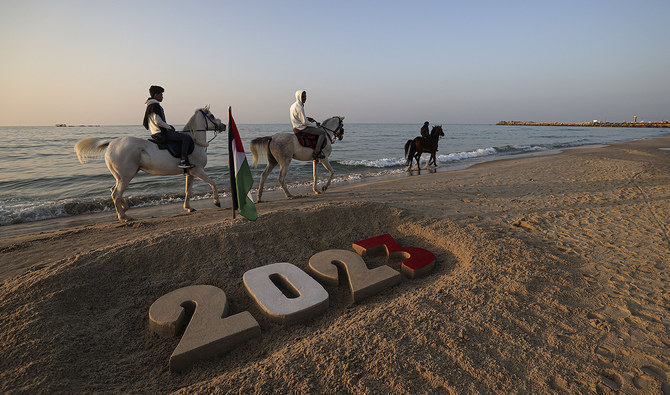
Palestinians ride their horses past a sand creation which reads "2023" on a beach, in Gaza City, on December 31, 2022, during the last sunset of 2022. (Photo courtesy: AFP)
Short Url
Updated 01 January 2023
Follow

2022 ‘worst year in terms of number of Palestinians killed by Israel’ — government

  • Further deterioration in security situation in West Bank feared in coming weeks
  • The people of Palestine welcome UN vote on Israel’s occupation as ‘a victory’

RAMALLAH: Most Palestinians will remember 2022 as a painful year in terms of the scale of human loss, the increase in Israeli aggression, and the election of an extreme right-wing Israeli government that will further deny them their rights.

Ibrahim Melhem, spokesman for the Palestinian government, told Arab News that 2022 was “the worst year in terms of the high number of Palestinians killed by the Israeli army.”

According to official figures, 225 people were killed in the West Bank and the Gaza Strip over the past 12 months.

However, Melhem believes there is cause for optimism thanks to Arab and international solidarity with the Palestinian cause, which was most publicly displayed at the FIFA World Cup in Qatar.

He also said that international organizations had demonstrated a better understanding of the demands and rights of the Palestinian people.

Ahmed Ghuneim, the leader of the Fatah movement in Jerusalem, told Arab News that the most positive occurrence in 2022 was the emergence of a new generation of Palestinian resistance fighters represented by the Lions’ Den group in Nablus and similar brigades in Jenin, Balata, and other areas.

Palestinians claim that the Israel Defense Forces have changed their rules of engagement in recent months, making it acceptable to open fire when they feel threatened and shoot to kill, even if they could easily just injure the attacker.

Sixty percent of the Israeli armed forces currently operate in the West Bank, where 26 combat and 86 reserve battalions are deployed. “There is a soldier to guard every settler,” Palestinians comment sarcastically.

Israeli officials expect a further deterioration in the security situation in the West Bank in coming weeks and an increase in the number of attacks on Israeli army forces and settlers, which will likely mean a rise in the killing of Palestinians.

On a happier note, Palestinians welcomed a vote by the United Nations General Assembly requesting that the International Court of Justice provide an opinion on the legal consequences of Israel’s occupation of the Palestinian territories including Jerusalem. At the assembly, 87 states voted in favor of the resolution, 26 opposed it, and 53 abstained, a result widely considered by Palestinians to be a victory for Palestinian diplomacy.

Presidential spokesman Nabil Abu Rudeineh said the vote was “evidence of the whole world’s support for our people and their inalienable historical rights.”

He said in a statement that President Mahmoud Abbas thanked all countries “that stood by Palestinian rights and all parties that worked to make this decision a success.”

Abu Rudeineh said the time has come for Israel to be held accountable for its ongoing crimes.

“The world must shoulder its responsibilities and implement the resolutions of international legitimacy, and everyone must stop the double standards,” he said.

He stressed that the Palestinian leadership would take all available opportunities to protect the Palestinian people, and that “resorting to international institutions is a Palestinian right, and we will continue to join international bodies and institutions.”

He added: “We strongly believe that justice based on international resolutions and the absence of impunity is the only way to achieve lasting peace in Palestine, Israel, and the entire region.”

“This means there are no negotiations on whether this is occupied land,” Palestinian government spokesperson Melhem told Arab News.

“No conditions will be imposed on Palestinians in exchange for Israeli withdrawal,” he added.


2025: The most successful year in Syrian history since 1970

Updated 6 sec ago
Follow

2025: The most successful year in Syrian history since 1970

  • First year without Bashar Assad brought sweeping diplomatic gains and sanctions relief
  • War-torn nation re-entered global forums, saw sanctions lifted even as scars persisted

LONDON: One year after the fall of Bashar Assad, Syrians are holding fast to hope as 2025 emerges as the country’s most diplomatically successful year in about five decades, marked by renewed international engagement and regional reintegration, even as the legacy of repression and war remains deeply etched into daily life.

The scale of that change is best understood against the longevity of the rule that preceded it. Modern Syria was shaped by more than five decades of Assad family dominance, beginning when Hafez Assad, then defense minister, seized power in a military coup on Nov. 16, 1970.

He formally became president in March 1971, inaugurating an era of centralized authority and political repression that would persist through his son’s presidency.

Over the following decades, Syria drifted deeper into rigid Cold War alignments, recurrent confrontations with its neighbors and, eventually, entrenched international isolation. That trajectory hardened under both Hafez and Bashar Assad, leaving little room for political reform and laying the groundwork for the uprising that erupted in 2011.

But today, post-Assad optimism was on display earlier this month, when thousands gathered in cities including Damascus, Homs, and Aleppo to mark the anniversary of Assad’s downfall.

In Damascus’s Umayyad Square, crowds danced to an Arabic song repeating the chorus, “Raise your head up high, you’re a free Syrian,” reflecting aspirations shaped by nearly 14 years of civil war.

Behind the public celebrations, analysts say Assad’s removal opened a rare historical window.

“Syria has opened a new chapter that many once thought impossible,” Nanar Hawach, a senior Syria analyst at the International Crisis Group, told Arab News. “Diplomatic ties are rebuilding, investment is returning, and the country is beginning to shake off years of isolation.”

Even so, he added, the country’s future hinges on developments at home. “To maintain this momentum, the government needs to focus internally: prioritizing day-to-day security and building trust with all communities.

“External support remains vital, but lasting peace will depend on Syrians feeling safe, included, and represented in the new order they are working to build.”

That view is shared by Comfort Ero, the ICG’s president and CEO. “Syria has made incredible strides forward on the international stage in the past year — forging partnerships, attracting funding and securing the easing of some of its most crippling sanctions,” she told Arab News. “But its future now depends on what happens at home.”

Indeed, the past year brought a wave of diplomatic normalization. Syria restored regional and international ties, saw US and European sanctions lifted or suspended, and rejoined major global forums.

The war-weary country reappeared at high-profile gatherings including the Arab League Summit in Baghdad, the Russian-Arab Summit, the World Economic Forum in Davos, and the Doha Forum.

That momentum culminated in November with interim President Ahmad Al-Sharaa’s visit to the White House, the first such visit by a Syrian leader since independence from France in 1946.

During the trip, Syria formally joined the US-led Global Coalition Against Daesh, days after the US Treasury removed Al-Sharaa, a former Al-Qaeda supporter who once had a $10 million bounty for his capture, from its Specially Designated Global Terrorist sanctions list.

Similarly, the UN Security Council adopted on Nov. 6 a US-backed resolution delisting Al-Sharaa and Interior Minister Anas Hasan Khattab, a move widely seen as a powerful signal of international recognition of Syria’s political transition.

These diplomatic gains followed the dramatic moment on Dec. 8, 2024, when Assad fled to Moscow as a coalition of rebel groups, led by Al-Sharaa, then-commander of the armed group Hayat Tahrir Al-Sham, seized Damascus in a lightning offensive.

Within two months, the new military command named Al-Sharaa transitional president, repealed the 2012 constitution, and dissolved the regime’s parliament, army, and security agencies.

In March, he signed a draft constitutional declaration establishing a five-year transitional period and announced a transitional cabinet.

Economic relief soon followed. The EU suspended major sanctions; the UK lifted asset freezes and most sanctions; and the US ended its comprehensive sanctions program and twice suspended the Caesar Act before permanently repealing it on Dec. 17 — a move many believe will facilitate foreign investment and speed reconstruction.

The Caesar Act had long blocked Syrian banks from accessing the global financial system, restricting external transfers and limiting correspondent banking relationships. Its repeal marked the culmination of a sustained diplomatic push led by Riyadh.

In May, during a high-level visit to Saudi Arabia, US President Donald Trump announced from Riyadh the lifting of sanctions on Syria and met the following day with Al-Sharaa. Around the same time, Saudi Arabia and Qatar paid off Syria’s $15.5 million World Bank debt.

Investment activity soon accelerated. In July and August, Syria had signed 47 investment agreements worth more than $6.4 billion with Saudi companies and secured $14 billion in deals with companies from Qatar, the UAE, Italy, and Turkiye, targeting transport, infrastructure, and real estate.

Opinion

This section contains relevant reference points, placed in (Opinion field)

Diplomatic engagement continued into the fall. In September, Al-Sharaa addressed the UN General Assembly — the first Syrian head of state to do so since 1967. He pledged accountability and national rebuilding.

While in New York, he held meetings across diplomatic and policy circles, including a highly symbolic discussion with former CIA director David Petraeus.

Assad’s fall and early signs of recovery have also encouraged many displaced people to return to their original towns and villages.

According to the UN Refugee Agency, more than 1.2 million Syrians have voluntarily returned from neighboring countries since December 2024, alongside nearly 1.9 million internally displaced people who have gone back to their home areas.

At the same time, Syrians with the means to do so are reopening small businesses and rebuilding homes, even without reliable public services and amid widespread destruction.

Marking the anniversary of Assad’s fall on Dec. 7, UN Secretary-General Antonio Guterres urged the international community to “stand firmly behind this Syrian-led, Syrian-owned transition,” stressing the need for sustained humanitarian support, fewer barriers to reconstruction, and backing for economic recovery.

“On this anniversary,” he said, “we stand united in purpose — to build a foundation of peace and prosperity and renew our pledge to a free, sovereign, united, and inclusive Syria.”