

Syria records lowest annual death toll since war began

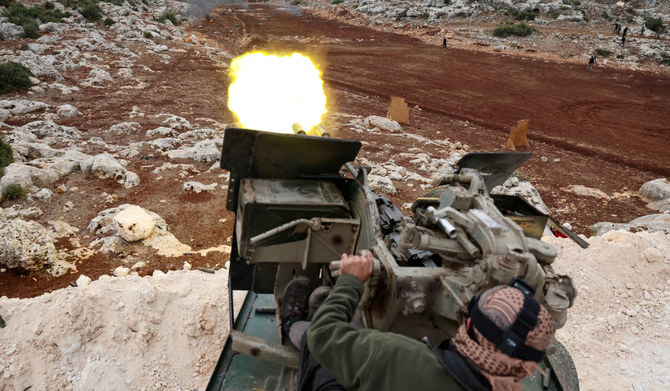
A fighter affiliated with Syria's 'Hayat Tahrir al-Sham' (HTS) rebel-group, takes part in a military excercise with live ammunition, on the outskirts of the northwestern province of Idlib, on November 8, 2022. (AFP)
Short Url
Updated 01 January 2023
Follow

Syria records lowest annual death toll since war began

  • Ceasefire sees major drop in fighting outside Marib, Taiz, elsewhere
  • Fuel tankers trickle into Hodeidah port

BEIRUT: At least 3,825 people have died in Syria’s war in 2022, the lowest yearly toll since the start of the conflict more than a decade ago, a war monitor said on Saturday.
The Britain-based Syrian Observatory for Human Rights had put the death toll at 3,746 throughout 2021, before revising it up to 3,882.
After years of deadly battle and bombardments following the brutal suppression of 2011 anti-regime protests, the conflict has largely abated in the last three years.
Sporadic fighting at times breaks out and jihadist attacks continue, mainly in the east of the country.
Among those killed in 2022 were 1,627 civilians, including 321 children, according to the figures from the Observatory, which relies on a wide network of sources on the ground in Syria.
Of the civilians killed, 209 people — about half of them children — were killed by mines or other explosive devices.
In addition, 627 government security force personnel were killed along with 217 other fighters loyal to the regime of Bashar Assad, the Observatory said.
Some 387 members of the Kurdish-led Syrian Democratic Forces and their allies were also among the dead, as well as more than 500 terrorists
The director of the Observatory, Rami Abdel Rahman, said a large number of the deaths occurred due to security chaos, dozens of strikes launched by Israel, and attacks by Daesh in the Syrian desert.
The war has killed nearly half a million people since it broke out over a decade ago, displacing almost half of Syria’s pre-war population.
Assad has retaken most of the territory initially lost to rebel groups, though the SDF — which the regime maintains a degree of cooperation with — continues to control areas in the north and northeast.
Turkey, a key player in the war, has repeatedly threatened to launch a ground offensive against the Syrian Kurds in recent months, having already pursued three such offensives previously.
In addition, about half of the northwestern province of Idlib and areas bordering the neighboring provinces of Hama, Aleppo and Latakia are dominated by the jihadist group Hayat Tahrir Al-Sham and other rebel factions.


‘No good actors’ in Sudan war, says Trump’s Middle East adviser

Updated 5 sec ago
Follow

‘No good actors’ in Sudan war, says Trump’s Middle East adviser

  • Resolving conflict a ‘deeply felt concern’ of US president, Massad Boulos tells UN Security Council
  • ‘Today, Sudan faces the biggest and gravest humanitarian catastrophe in the world’

LONDON: A senior adviser to US President Donald Trump on Thursday criticized Sudan’s warring factions as he warned that no military solution could resolve the civil war.

Massad Boulos, Trump’s senior adviser on African, Arab and Middle Eastern affairs, was speaking at a ministerial-level UN Security Council briefing on Sudan.

A UN fact-finding mission has determined that the paramilitary Rapid Support Forces’ siege of the city of El-Fasher likely constituted genocide.

Resolving the almost three-year-long war in Sudan is a “deeply felt concern” of Trump, Boulos told the briefing, which was chaired by UK Foreign Secretary Yvette Cooper.

“Under President Trump and Secretary (of State Marco) Rubio’s leadership and close direction, I am helping to spearhead US efforts to achieve peace in Sudan,” he said.

“Today, Sudan faces the biggest and gravest humanitarian catastrophe in the world. After more than 1,000 days of needless conflict between the Sudanese Armed Forces and the Rapid Support Forces, the toll is staggering.”

In the eyes of the US, “there are no good actors in this conflict,” Boulos said, criticizing both factions for carrying out “serious human rights violations and abuses.”

He highlighted apparent efforts by coordinated Islamist networks to regain political influence in the fractured Sudanese state.

“Let me be clear: Efforts by Islamist networks or any extremist political movement to manipulate this conflict, derail a civilian transition, or reassert authoritarian control will not be tolerated by the US,” Boulos said.

“We will use the tools at our disposal — including sanctions and other measures — to hold accountable those who enable violence, undermine democratic governance, or threaten regional stability.”

His remarks came as the US announced fresh sanctions on RSF commanders, citing their record of “human rights violations, including ethnic killings, torture, starvation tactics and sexual violence.”

The paramilitary figures are now “subject to asset freezes, arms embargoes and travel bans,” Boulos said, adding: “We are working closely with partners in this room — including the United Kingdom, Egypt, Saudi Arabia and the UAE, and several others — to press for an immediate humanitarian truce, and without preconditions.

“Such a truce must guarantee sustained, unhindered humanitarian access across conflict lines and borders.”

He urged the international community to support five pillars of engagement to resolve the crisis: achieving an immediate humanitarian truce; coordinated efforts to ensure sustained humanitarian access; a phased approach for negotiating a permanent ceasefire; a structured political process that leads to a civilian-led transitional government and democratic elections; and a robust reconstruction and recovery effort.

“The US remains committed to working with all of you to end this tragic conflict and to support a peaceful, civilian future for Sudan,” Boulos said.