

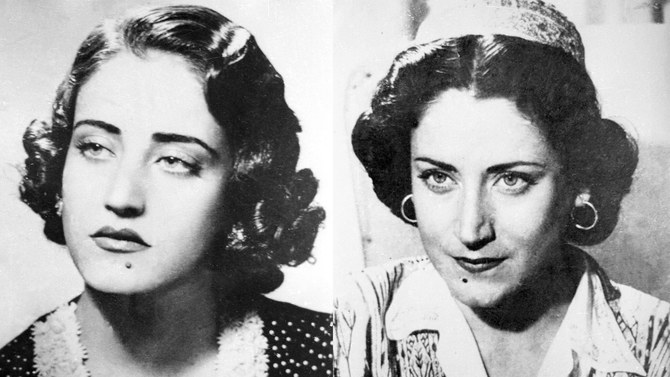

DUBAI: On the morning of July 14, 1944, the singer and actress Amal Al-Atrash took a break from filming in Cairo and headed to the seaside resort of Ras El-Bar. Accompanied by her friend and sometime secretary, Marie Qelada, she wore a yellow dress and carried with her a partly-read French novel. Both were seated in the back of a two-door sedan.
At around midday, and with a suddenness that would shock the Arab world, the car in which Al-Atrash and Qelada were travelling careered into a canal near the city of Mansoura, trapping both women inside. They both drowned. The driver — an acquaintance of Al-Atrash’s third husband, Ahmed Salem — escaped unharmed and mysteriously disappeared.
The untimely death of Al-Atrash — better known by her stage name of Asmahan — would cement her status as a cultural icon. A powerful, independent woman, provocative and divisive, Asmahan was a “glorious voice, a wanton woman, a daredevil, the mistress of many, and a self-destructive force,” wrote Sherifa Zuhur in “Asmahan’s Secrets.” Her tragic death only compounded her already controversial reputation, with conspiracy theories multiplying as the days and weeks turned into years.
In the immediate aftermath of her death, Asmahan left behind an unfinished film — director Youssef Wahbi’s “Gharam Wa Intiqam” (Love and Revenge) — and a multitude of unanswered questions, most of which related to her work for British intelligence during the Second World War. Had she been murdered? Who had killed her? Had she been operating as a double agent? The altering of the ending of “Love and Revenge” to mirror the star’s passing, as well as the use of a stunt double, only added to the intrigue that surrounded her.
“Asmahan’s life is so rocambolesque and romantic that the most daring of scriptwriters would not venture to invent it,” says the Moroccan film director Yasmine Benkiran, who is currently writing a film centered on an investigation into Asmahan’s mysterious death. “A Syrian princess with a golden voice, an actress with many escapades, husbands and lovers, an adventurer, a spy for the British (she helped the Allied troops against the Nazis). Envied by the queen and — some would say — by Umm Kulthum herself, she died in a mysterious car accident. Who killed her? Until today, no one knows. This life already makes her an icon.”
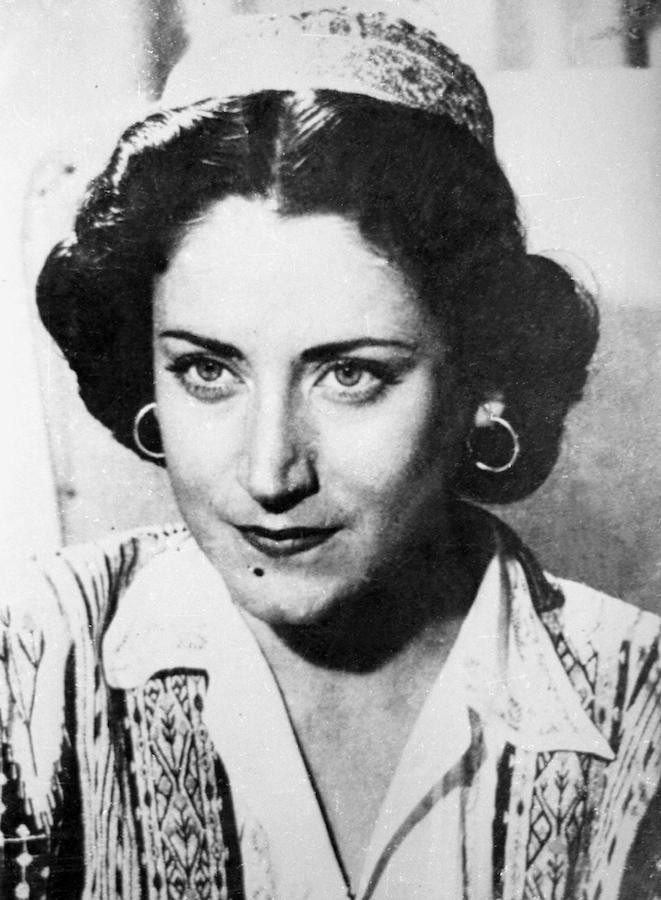
A photograph of Asmahan from the 1940s. (AFP)
Yet much of her life remains a mystery. Even her age is uncertain, with estimates of the year of her birth ranging from 1912 to 1918. In contrast, her legacy endures. She is revered as a cultural icon more than ever before, with her representation in the arts manifesting itself in all forms of expression. Her vocal range, her formidable character, her glamour, her alleged espionage, and her on-screen persona resonate as loudly today as they ever did.
Born into the al-Atrash clan of southern Syria in the early years of the 20th century, Asmahan had been expected to conform to cultural tradition. That meant a life of dedication to a Druze husband and the raising of children, not the sinful life of a singer and entertainer. This pressure to conform was compounded by her family’s prominent role in the fight against French occupation, which meant Asmahan was born into a life of patriotic struggle. That struggle would lead to her relocation to Cairo with her mother and siblings following the French shelling of their Syrian home in 1922.
Yet both she and her brother — the singer, composer and virtuoso oud player Farid Al-Atrash — showed exceptional talent from an early age. Discovered by the Egyptian composer Dawood Hosni during a visit to their family home in Cairo, Asmahan ultimately rejected the life that had been allotted her.
Asmahan’s voice was powerful, extraordinary even, and she was blessed with exceptional range. She epitomized the melancholy and drama of the tarab tradition, yet was simultaneously fragile — something you can hear quite clearly in her voice. As Benkiran says, it was about “the ecstasy of the music, the transport of the soul, a place where melancholy and pleasure meet to become one.” She was also equally at ease with both Arab and Western musical traditions, which meant she was in the vanguard of cultural change.
“Her voice was incredible,” says Lebanese artist and author Zena El-Khalil. “Her vocal depth and breadth were phenomenal and that would have continued to develop had she lived longer. She would’ve had the same kind of stature as Umm Kulthum and the only reason she doesn’t is because she didn’t get to live as long.”
The effect of her appearance on those she encountered was striking. She often appeared on screen bathed in a white glow and embraced her sexuality rather than deny it. Edward Spears, the British High Commissioner in Lebanon, believed “she was, and always will be, one of the most beautiful women I have ever seen,” and she left an indelible impression on all she met. Her untimely death also bestowed eternal youth upon her.
It is her image as a strong and rebellious woman, however, that resonates the most. She lived boldly and freely, regardless of the expectations placed upon her by her family and the wider community. Although she was supported by her brother and mother, she was viewed with shame and horror by conservative Druze society and came under intense pressure. Sometimes she gave into that pressure, marrying her cousin Prince Hassan al-Atrash twice and living in Syria for six years, but she eventually returned to Cairo, where she rekindled her career and entered the world of cinema.
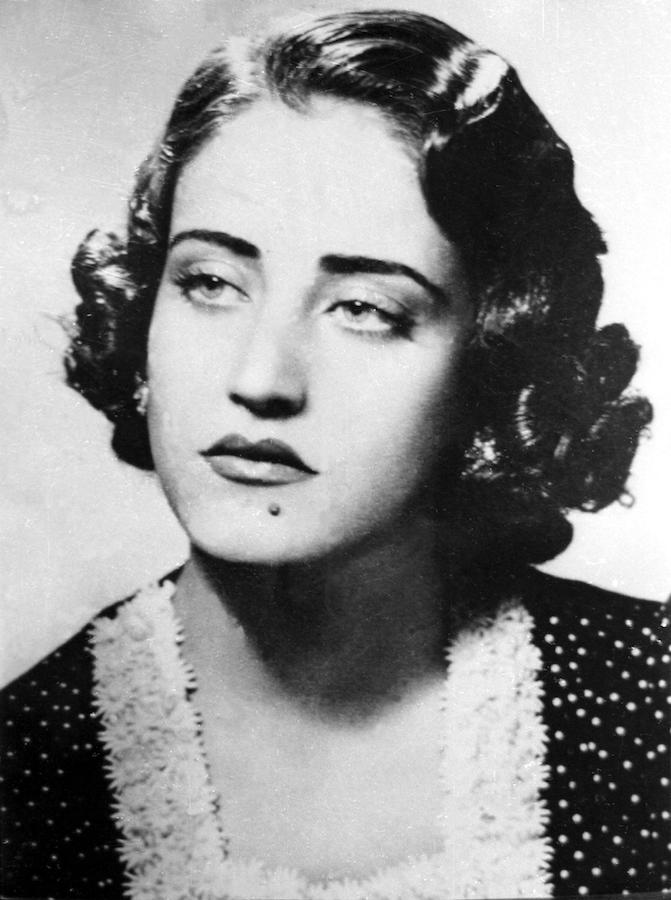
Asmahan pictured in the 1930s. (AFP)
“When I first heard that Asmahan was young and Druze, she really felt like the closest thing I could have to a role model,” says El-Khalil, who is distantly related to Asmahan through her paternal grandmother. “I really felt a kinship with the desire to express yourself fully as an artist, but also having to hold back because of social pressure. She did a really good job of breaking out of that mold. We come from very similar family backgrounds and there’s a part of me that felt that, not only could I relate, but I looked up to her. When I needed strength, I would think of her. If Asmahan could do this 80 years ago, so could I (today).”
Asmahan features prominently in El-Khalil’s book, “Beirut, I Love You,” and she sees parallels in her own life as an artist. “When Asmahan didn’t sing, she got sick. When I don’t paint, I get sick. Sometimes you cannot not be what consciousness is desiring to express through you. And there is something very courageous in the way we both had to break through social norms to not just be artists, but women who express themselves, women who are seen, women who are heard, women who are in the public eye. In Druze culture, women are not allowed to do that. Your job is to follow the orders, follow the patriarchy, and birth children and be a good mother and a good member of society.”
Of all the icons featured in this series, Asmahan is arguably the most complex. This complexity has led to a level of devotion that is often absent in relation to other stars of the Arab world. The filmmaker Azza El-Hassan once told me two stories about her. One was of an Iraqi man who shot himself outside a cinema after watching “Love and Revenge.” The other was of a woman who died whilst trying to catch a glimpse of the Druze princess and is forever known as ‘The Martyr of Asmahan.’
“What is so meaningful about Asmahan — and what makes her so different from the others — is that she is not perfect,” said El-Hassan, whose documentary “The Unbearable Presence of Asmahan” was released in 2014. “She is a star, but also an alcoholic. She is a princess and a concubine. She is simply a bundle of contradictions, which makes her just like you and I. Someone who is far from being perfect. Her imperfection makes it easy to relate to her and to sympathize with her downfalls.”


