


LEBANON: Lebanese celebrating New Year’s Eve are looking back on a period that deepened the political and economic crisis in the country, with 2022 being described as a year of missed opportunities.
In January, former Prime Minister Saad Hariri retreated, along with the Future Movement, from political life.
“There is no room for any positive opportunity in Lebanon in light of Iranian influence, international confusion and national division,” Hariri had said.
One of the repercussions of Hariri’s move was a gap in the Sunni representation in Parliament, resulting in a minimal role for the branch within national politics.
At the end of January, the Cabinet headed by Najib Mikati regained its ability to convene. This came after Hezbollah and the Amal movement returned to join the government once they ensured that their powerful street movement had succeeded in paralyzing the work of the judicial investigator in the Beirut port explosion.
BACKGROUND
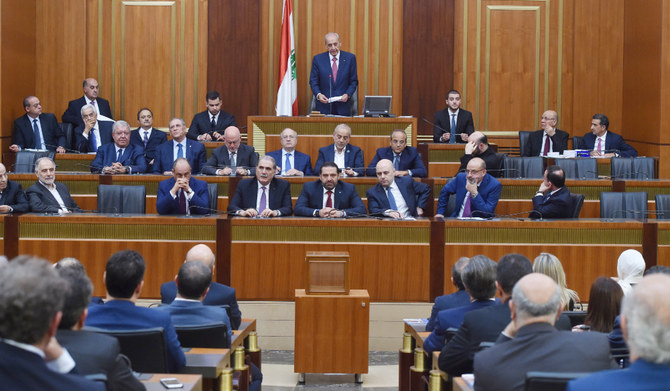
The term of former president Michel Aoun ended on Oct. 30 after six years of disputes. Parliament has since failed to elect a new president despite holding 10 voting sessions.
The government failed to seize the opportunity to implement a recovery plan agreed upon with the International Monetary Fund, despite having the authority and ability to execute decrees and draft laws.
Most of the required reforms, especially those related to resolving the financial crisis, have yet to be enacted.
The Cabinet had to approve the bank restructuring strategy, amend the laws on banking secrecy, detect and investigate financial crimes, recover assets and conduct a special audit into the foreign assets of the Banque du Liban.
However, Parliament only approved the amended 2022 budget and the BDL initiated procedures to unify exchange rates.
The Mikati government’s sole achievement was holding parliamentary elections in May.
Many counted on the elections to end the hegemony of Hezbollah and its allies through a surge in votes from expatriates.
The elections did carry a glimmer of hope for change through the arrival of 13 new independent MPs from the 2019 protest movement.
However, the Change bloc quickly stumbled and its MPs were left divided.
Parliament later failed to elect a new president.
The smuggling of goods, fuel, medicine and wheat across the border with Syria surged in 2022, as well as illegal human trafficking to Europe on what became known as the “death boats.”
The biggest such tragedy of the year came on April 23 when a boat capsized, leading to 22 deaths, including children.
Mikati was designated to form a new government following the parliamentary elections, but was unable to reach a breakthrough following political differences between Hezbollah and its opponents.
Amid all of these failures, Lebanon signed a maritime border demarcation agreement with Israel on Oct. 27 through US mediator Amos Hochstein. Lebanon and Israel divided the disputed areas with Hezbollah’s approval.
In August, a wave of bank raids began. Employees and clients were taken hostage by depositors, whose savings were seized three years ago.
Among those who raided banks was a female MP in Lebanese Parliament, a young woman an elderly woman and several serving soldiers. They demanded their savings in order to pay hospital bills, educate their children or treat relatives suffering from cancer.
The worsening financial crisis forced the military and security services to wait for aid from allied countries.
The judiciary went on strike for the very first time to protest the decline in judge salaries.
The strike continued until the end of the year and led to the paralysis of the Public Prosecution Office and the inability of security services to make arrests. It represented a new stage in the collapse of state institutions.
Armed conflicts broke out in Hezbollah-dominated areas, with the party rebuffed from its attempts to use Christian lands in the southern border town of Rmeish to set up party facilities.
Public criticism of Hezbollah grew, especially following the death of an Irish peacekeeper after his UNIFIL vehicle was shot at in the southern town of Al-Aqabiya.
The party announced that the suspect in the shooting had been handed over to security services, although it denied ordering the attack.
New taxes were imposed on telephone and Internet services, and on state electricity, which had been completely cut off.
People took to the streets to protest declining wages as a result of inflation. The black market exchange rate was 25,000 Lebanese pounds/USD in January but now stands at 50,000.
Corruption files were opened in official sectors, including the BDL, Land Registry and Car Registration Authority, leading to dozens of arrests.
The term of former president Michel Aoun ended on Oct. 30 after six years of disputes.
Parliament has since failed to elect a new president despite holding 10 voting sessions.
Hezbollah and its allies cast blank votes or disrupted activities because officials did not approve of the available candidates.
In December, a political row erupted between two allies, the Free Patriotic Movement and Hezbollah, after ministers took part in a Cabinet session that the FPM deemed illegal.
The repercussions of the dispute are ongoing and could affect Hezbollah’s choice of presidential candidate.
The probe into the Beirut port explosion is still suspended, obstruction of justice is ongoing, and more than 1 million Syrian refugees remain in Lebanon.
The country succeeded in attracting more than 1 million tourists in 2022, mainly during the summer season.
The Lebanese public rejoiced at dance group The Mayyas being crowned winners of US talent show “America’s Got Talent.” The win gave people in the country a much-needed dose of patriotism at a time when many remain skeptical of Lebanon’s future.


