



ISLAMABAD: Pakistan witnessed a sharp increase in militant attacks and related deaths in 2022, reveal data compiled by local research organizations, as radical outfits intensified their activities in the remote regions of Balochistan and Khyber Pakhtunkhwa provinces.
A proscribed militant network, Tehreek-e-Taliban Pakistan (TTP), stepped up attacks in different parts of the country after calling off a cease-fire with the government in November. The armed conglomerate suffered battlefield losses while fighting the country’s security forces in previous years. Analysts believe, however, that it managed to reorganize itself in the tribal districts bordering Afghanistan after the Afghan Taliban ceased control of Kabul in August last year.
Statistics reveal the initial months of the outgoing year were dominated by separatist groups in Balochistan before the TTP amplified its activities. These groups primarily targeted security personnel and Chinese nationals working on the China-Pakistan Economic Corridor (CPEC) along with civilians in different cities, including the provincial capital of Quetta.
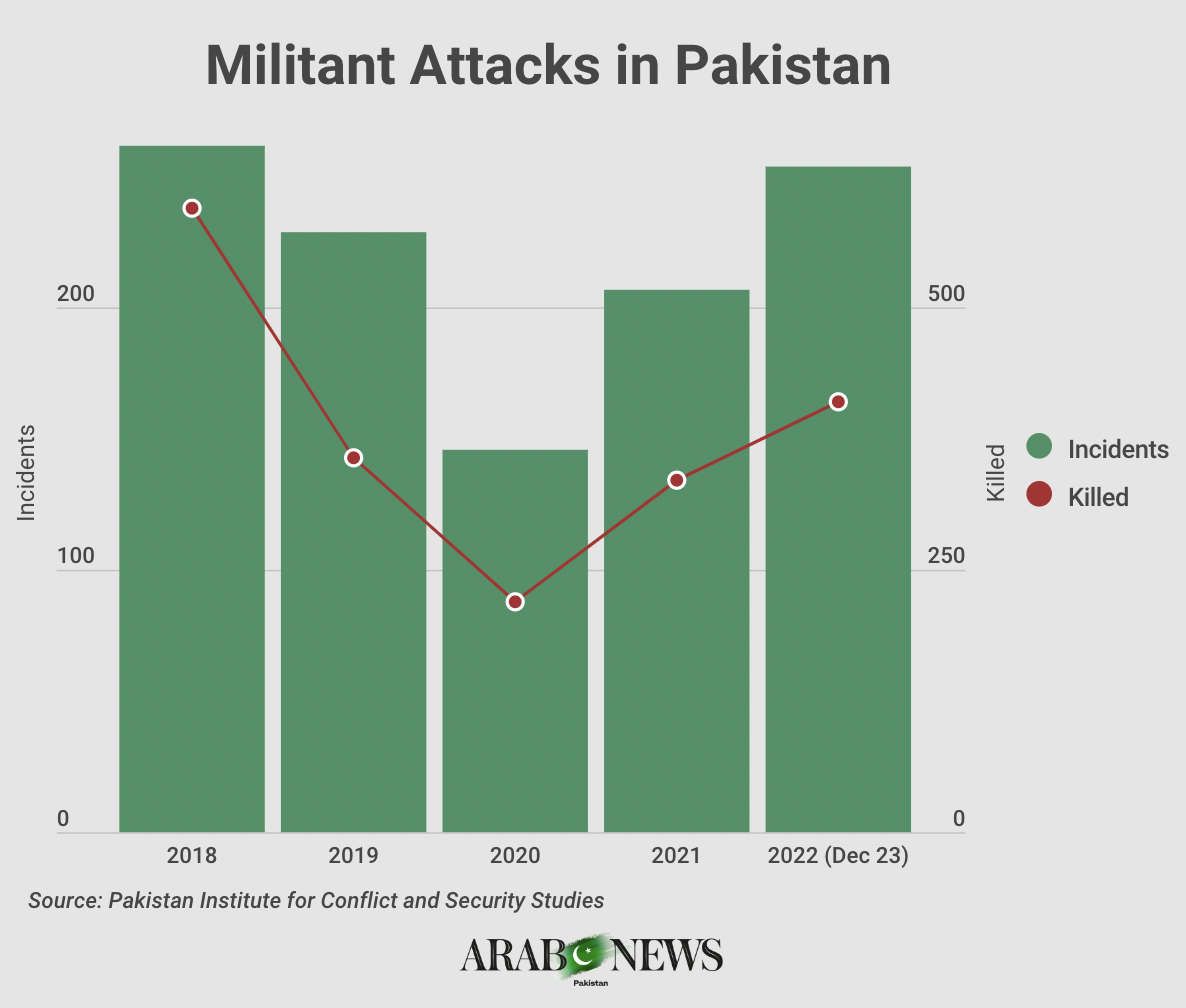
According to data compiled by the Pak Institute for Peace Studies (PIPS), an Islamabad-based think tank, the country endured 146 militant attacks in 2020 in which 220 people were killed and 547 injured. The number of such incidents spiked to 207 in 2021, making 335 people lose their lives while injuring 555 others.
The escalating trend continued in 2022 when 411 individuals were killed and 713 injured in 254 attacks. The data also include the December 23 suicide blast in Islamabad which resulted in the death of a taxi driver and a police official.
“The sharp increase in terror attacks in the last two years shows we have been losing the gains made against various militant groups through military operations,” Khawaja Khalid Farooq, former head of the National Counter Terrorism Authority (NACTA), told Arab News on Friday.
“The TTP and different Baloch separatist outfits have apparently joined hands to attack our security personnel both in Balochistan and Khyber Pakhtunkhwa provinces which should be a worrying sign,” he continued. “We need to act swiftly to eliminate them all to restore peace in the country.”
The monthly data compiled by PIPS from October to December, 2020, showed that 70 people were killed and 221 injured in 37 militant attacks. The number of violent incidents increased to 64 in 2021 with 83 deaths and 108 injuries.
Another surge was witnessed in the corresponding months of 2022, when 67 attacks were reported in which 75 killings were recorded and 136 people were said to be injured.
NACTA, which coordinates efforts of federal and provincial law enforcement agencies against violent extremism, did not respond to Arab News queries related to the rise in militant attacks or share the official data.
According to the Pakistan Institute for Conflict and Security Studies, a total of 18 suicide attacks have occurred in Islamabad since 2005 in which 165 people have been killed and 616 wounded.
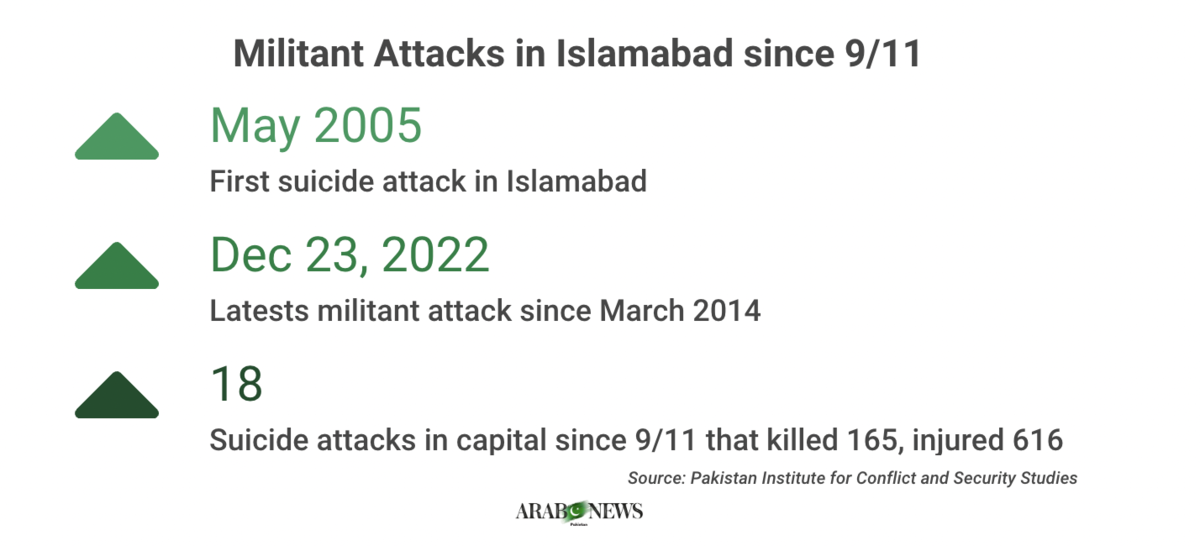
Prior to the suicide blast on December 23, the last such bombing in the city took place in March 2014 when two attackers detonated themselves at the Judicial Complex Islamabad. Data showed the first suicide attack in the federal capital after September 11, 2001, attacks in the United States took place in May 2005. Prior to 9/11, the only suicide bombing in Islamabad was an attack on the Egyptian embassy claimed by the Islamic Jihad in November 1995.
Pakistan has witnessed a total of 504 suicide attacks since 9/11 that killed 6,748 people and injured 15,111, according to PIPS.
In November 2021, the TTP agreed to have a temporary cease-fire while negotiations with the government before prolonging it “indefinitely” in mid-2022. The negotiations between the two sides were facilitated by the Afghan Taliban, though they failed to yield positive results.
Security analysts said the government should initiate bilateral negotiations with the Afghan Taliban to ensure their country was not used to launch militant attacks in Pakistan.
“Pakistan reached a cease-fire deal with the TTP on the insistence of Afghan Taliban,” Muhammad Amir Rana, a security analyst and PIPS director, told Arab News. “However, it proved counterproductive and made it possible for the TTP to regroup and reinforce itself and launch a fresh wave of attacks.”
He said the TTP leadership, along with the militant network’s infrastructure, was based in Afghanistan, adding the administration in Islamabad should seek assurances from the Afghan government not to let militants infiltrate Pakistan’s tribal districts.
“We have to talk directly to the Afghan government instead of involving jirgas or using other channels to fetch a robust commitment from them to dismantle the TTP support network,” he continued, adding that Pakistan was capable of dealing with the militants internally.
Journalist and security expert Hassan Khan said Pakistan ignored the militancy issue during the lull period which helped the recent resurgence of radical groups.
“Pakistan released a large number of TTP militants from its prisons during the peace talks, including some elders who had gone back to their respective territories where they regrouped themselves against the state,” he told Arab News.
“The situation could get worse if the political leaders failed to take ownership of the situation and formulate a national consensus policy to eliminate militants,” he added.


