Nearly 1,700 journalists killed over past 20 years: RSF

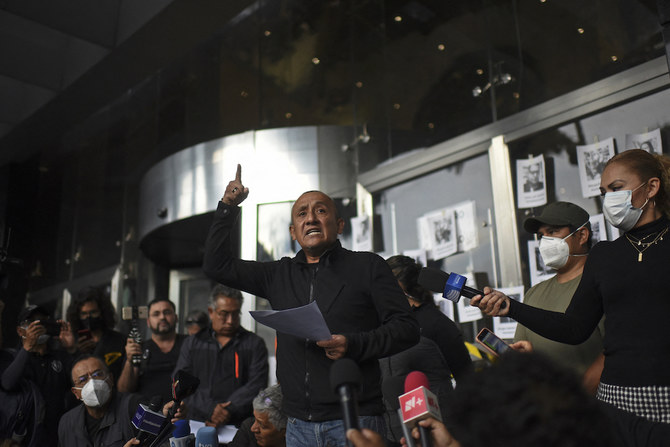
Mexican journalist Rodolfo Montes delivers a speech during a demonstration held by Mexican journalists to protest against the murder of their colleague Fredid Roman in Mexico City, on August 24, 2022. (AFP)
Short Url
Updated 30 December 2022
Follow

Nearly 1,700 journalists killed over past 20 years: RSF

  • So far this year 58 journalists have been killed doing their jobs, up from 51 in 2021
  • Ukraine is currently the most dangerous country in Europe for the media

PARIS: Nearly 1,700 journalists have been killed worldwide over the past 20 years, an average of more than 80 a year, according to an analysis published by Reporters Without Borders.
The two decades between 2003 and 2022 were “especially deadly decades for those in the service of the right to inform,” said the Paris-based media rights campaigners.
“Behind the figures, there are the faces, personalities, talent and commitment of those who have paid with their lives for their information gathering, their search for the truth and their passion for journalism,” RSF secretary-general Christophe Deloire said.
Iraq and Syria were the most dangerous countries to work as a journalist, accounting for “a combined total of 578 journalists killed in the past 20 years, or more than a third of the worldwide total,” RSF said.
They are followed by Mexico (125 killed), the Philippines (107), Pakistan (93), Afghanistan (81) and Somalia (78).
The “darkest years” were 2012 and 2013, “due in large measure to the war in Syria.” There were 144 killings in 2012 and 142 the year after, the report said.
This peak was “followed by a gradual fall and then historically low figures from 2019 onwards.”
But deaths increased again in 2022, in part because of the war in Ukraine. So far this year, 58 journalists have been killed doing their jobs, up from 51 in 2021.
Eight journalists have been killed in Ukraine since Russia invaded in February. This compares to a total of 12 media deaths there over the preceding 19 years.
Ukraine is currently the most dangerous country in Europe for the media, after Russia itself, where 25 journalists have been killed over the past 20 years.
“Since Vladimir Putin took over, Russia has seen systematic attacks on press freedom — including deadly ones — as RSF has repeatedly reported.
“They include Anna Politkovskaya’s high-profile murder on 7 October 2006,” the rights group said.
Elsewhere in Europe, Turkiye was ranked third most dangerous, followed by France “as a result of the massacre at the satirical weekly Charlie Hebdo in Paris in 2015.”
Reporters run the greatest risks worldwide in areas where armed conflict has occurred.
But, RSF stressed, “countries where no war is officially taking place are not necessarily safe for reporters and some of them are near the top of the list of those where killings have occurred.
“In fact, more journalists have been killed in ‘zones at peace’ than in ‘zones at war’ during the past two decades, in most cases because they were investigating organized crime and corruption.”
The Americas accounted for almost half of journalist murders, many in Mexico, Brazil, Colombia and Honduras.
“America is nowadays clearly the world’s most dangerous continent for the media,” RSF said.


Grok faces more scrutiny over deepfakes as Irish regulator opens EU privacy investigation

Updated 59 min 35 sec ago
Follow

Grok faces more scrutiny over deepfakes as Irish regulator opens EU privacy investigation

  • The regulator says Grok has created and shared sexualized images of real people, including children. Researchers say some examples appear to involve minors
  • X also faces other probes in Europe over illegal content and user safety

LONDON: Elon Musk’s social media platform X faces a European Union privacy investigation after its Grok AI chatbot started spitting out nonconsensual deepfake images, Ireland’s data privacy regulator said Tuesday.
Ireland’s Data Protection Commission said it notified X on Monday that it was opening the inquiry under the 27-nation EU’s strict data privacy regulations, adding to the scrutiny X is facing in Europe and other parts of the world over Grok’s behavior.
Grok sparked a global backlash last month after it started granting requests from X users to undress people with its AI image generation and editing capabilities, including putting females in transparent bikinis or revealing clothing. Researchers said some images appeared to include children. The company later introduced some restrictions on Grok, though authorities in Europe weren’t satisfied.
The Irish watchdog said its investigation focuses on the apparent creation and posting on X of “potentially harmful” nonconsensual intimate or sexualized images containing or involving personal data from Europeans, including children.
X did not respond to a request for comment.
Grok was built by Musk’s artificial intelligence company xAI and is available through X, where its responses to user requests are publicly visible.
The watchdog said the investigation will seek to determine whether X complied with the EU data privacy rules known as GDPR, or the General Data Protection Regulation. Under the rules, the Irish regulator takes the lead on enforcing the bloc’s privacy rules because X’s European headquarters is in Dublin. Violations can result in hefty fines.
The regulator “has been engaging” with X since media reports started circulating weeks earlier about “the alleged ability of X users to prompt the @Grok account on X to generate sexualized images of real people, including children,” Deputy Commissioner Graham Doyle said in a press statement.
Spain’s government has ordered prosecutors to investigate X, Meta and TikTok for alleged crimes related to the creation and proliferation of AI-generated child sex abuse material on their platforms, Spanish Prime Minister Pedro Sánchez said on Tuesday.
“These platforms are attacking the mental health, dignity and rights of our sons and daughters,” Sánchez wrote on X.
Spain announced earlier this month that it was pursuing a ban on access to social media platforms for under-16s.
Earlier this month, French prosecutors raided X’s Paris offices and summoned Musk for questioning. Meanwhile, the data privacy and media regulators in Britain, which has left the EU, have opened their own investigations into X.
The platform is already facing a separate EU investigation from Brussels over whether it has been complying with the bloc’s digital rulebook for protecting social media users that requires platforms to curb the spread of illegal content such as child sexual abuse material.