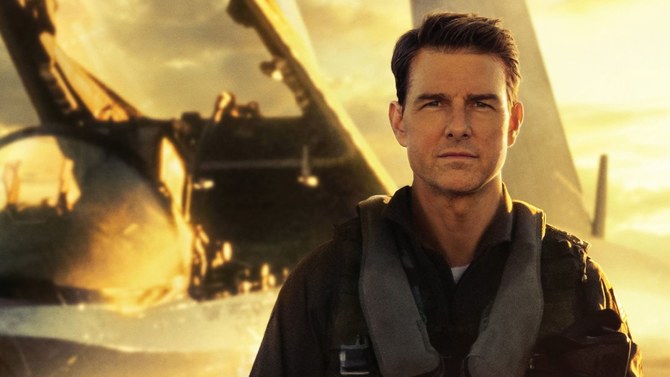

‘Top Gun: Maverick’
Director: Joseph Kosinski
Starring: Tom Cruise, Jennifer Connelly, Miles Teller
Movies are so rarely great art, the long-tenured film critic Pauline Kael once wrote, that if we cannot appreciate great trash, viewers have very little to be interested in. Accepting that as true, there was no greater — nor bigger, bolder, or more breathtaking — trash to be found at the cinema this year than “Top Gun: Maverick.” Nor was there a film that united the world quite like it. The characters won’t stick with you, nor will the story or the scant themes, but the exhilarating feeling of watching its unparalleled third act on the biggest screen possible, a propulsive and emotional testament to the power of practical effects — not to mention the magnetism of Tom Cruise, our greatest living movie star — are among the highest highs in the history of the art form.
‘Avatar: The Way of Water’
Director: James Cameron
Starring: Sam Worthington, Zoe Saldana, Sigourney Weaver
It’s going to sound corny, but James Cameron, the visionary filmmaker behind “Terminator,” “Titanic” and “Aliens,” wants to change the world with the “Avatar” franchise. The first was a scathing treatise on extraction colonialism, endless war and environmental catastrophe hidden underneath a beautifully animated children’s movie about blue people from another planet. The second is no different, this time shifting its empathy to the creatures of the sea. Most magic of all, the films are so entertaining, so well crafted and acted, with such inspired storytelling throughout, you never feel lectured to. Instead, you go home wondering how a silent space whale named Payakan ended up becoming the year’s best film character. Drop your cynicism at the door, “Avatar” is transcendent storytelling.
‘Barbarian’
Director: Zach Cregger
Starring: Bill Skarsgård, Georgina Campbell, Justin Long
What “Psycho” once did for showers, hit horror film “Barbarian” has done for the AirBnB. It begins with a woman arriving late at night at the house she’s booked to find a man already staying inside. He, too, has a booking — his from a competing app. Let’s both stay the night, they decide. What’s the worst that could happen? While things don’t work out for the two lodgers as they expect, this is a film that’s best left with as little said as possible, full of some of the scariest moments — as well as some of the funniest — found in a film in recent memory, often simultaneously. Jordan Peele may be the best comedian-turned-horror director, Zach Cregger, formerly a sketch comedy goof himself, has given him a run for his money right out the gate.
‘The Banshees of Inisherin’
Director: Martin McDonagh
Starring: Colin Farrell, Brendan Gleeson, Barry Keoghan
After the success of “Three Billboards Outside Ebbing, Missouri,” British-Irish writer-director Martin McDonagh has gone back to his roots with his latest film, reuniting with his “In Bruges” (2008) stars Farrell and Gleeson with a comedic drama that finds one man (Gleeson) in the throes of an existential crisis and his kind-hearted best friend (Farrell) watching his life fall apart in its wake. While the performances make the film sing — with Farrell once again proving that he is truly one of the best actors of his generation and rising star Keoghan showing why the best directors in the world keep hiring him — this is a story that lingers in the mind long after, as its achingly relatable characters navigate feelings they don’t fully understand.
‘Hit The Road’
Director: Panah Panahi
Starring: Hassan Madjooni, Pantea Panahiha, Rayan Sarlak
Describing “Hit the Road” — the debut feature from the Iranian filmmaker Panah Panahi, son of the renowned filmmaker Jafar Panahi — without making it sound like another dark and depressing window into the lives of the unfortunate is tough. After all, it follows a son fleeing from Iran to Turkey with his family driving him to the border as their terminally ill dog sits awaiting death in the car with them, and serious conversations about the hardest aspects of their lives. In context though, Panahi’s gentle touch, offbeat sense of humor and wistful spirit transform “Hit the Road” into something transcendent, complete with long dance sequences, absurd asides and a crescendo of hallucinatory imagery that follows its heart-wrenching conclusion.
‘Triangle of Sadness’
Director: Ruben Ostlund
Starring: Harris Dickinson, Dolly De Leon, Woody Harrelson
Money is power—at least in the world we’ve built for ourselves. But when the trappings of modern society are stripped away after an ultra-luxury cruise ship sinks, leaving a mix of its wealthiest guests stranded on an island alongside the working-class crew, power begins to assert itself very differently. The latest laugh-out-loud farce from Sweden’s most merciless contemporary satirist is a spiritual sequel to his 2014 film “Force Majeure,” in which a father’s masculine image falls apart after running away from his family during a moment of crisis. This time, not only is the spotlight shined on the absurdities of male and female roles in society, but on society itself, and the ways in which we use the trappings of the modern world to obscure our true selves.
‘Bullet Train’
Director: David Leitch
Starring: Brad Pitt, Joey King, Aaron Taylor-Johnson
Has there ever been a greater chasm between critics and audiences than in this current moment? Take “Bullet Train.” On Twitter you’ll find critics and movie snobs lining up to dismiss the film as an empty star vehicle, a sub-Tarantino pastiche, or worse. Ask anyone in the real world and you’ll get a decidedly different response. “Bullet Train” is a film that evokes the madcap soul of action comedies from the late 90s and early 2000s — a time when video store clerks excitedly recommended films that flew under the radar, ones with well-drawn characters, off-the-wall performances, kinetic action sequences and plots full of twists and turns — ones you would tell your friends about, too. Let Twitter cynics have their jokes. In five years, they’ll be pretending they were David Leitch fans all along.
‘The Woman King’
Director: Gina Prince-Bythewood
Starring: Viola Davis, Thuso Mbedu, Lashana Lynch
Long before Wakanda, there was Dahomey, a prosperous kingdom on the African continent whose might spanned centuries, powered by remarkable female warriors who ignited the spirit of their countrymen. That it took until 2022 to tell their story is a crime. That the creative powers of Viola Davis, Prince-Bythewood and their collaborators were able to will it into the big-budget epic it always should have been feels like a miracle. Though it boasts a career-best performance from Davis, long considered one of our fines actors, this is far from a one-woman show, with a bevy of great performers all of whom give humanity and depth to characters who are not simply one-dimensional heroes as they grapple with the evils they have committed to serve a better future.
‘Bones and All’
Director: Luca Guadagnino
Starring: Timothée Chalamet, Taylor Russell, Mark Rylance
What if I told you that the most romantic film of the year followed two teenage cannibals as they traverse the country, unable to quell their desire for both each other and their victims? If I haven’t lost you yet, you’ll find much to sink your teeth into in “Bones and All,” the latest from the Italian filmmaker behind “A Bigger Splash” (2015) and 2018’s remake of “Suspiria.” While Chalamet is once again expertly put to use as a scared boy pretending he’s ready to be a man, it's Russell who steals the show with a deeply felt performance of a girl searching for the people who have abandoned her, unsure who she can trust. See it twice; your repulsion should fade after the initial shock, leaving this film’s heart to beat louder than any movie’s in recent memory.