

Balochistan government bans large gatherings in Gwadar as policeman killed amid protests

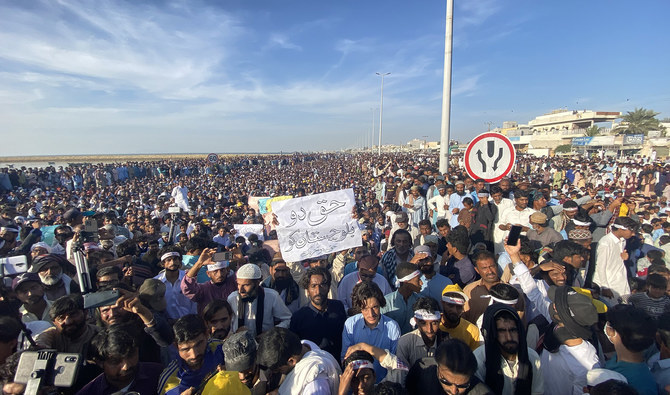
Thousands of demonstrators gather at Marine Drive in Gwadar, Pakistan, on December 10, 2021, to protest illegal trawling, token system at the Pak-Iran border and security checkpoints in their city. (AN Photo/File)
Short Url
Updated 29 December 2022
Follow

Balochistan government bans large gatherings in Gwadar as policeman killed amid protests

  • The decision was taken after a police constable was killed on Tuesday in a clash with people seeking basic rights
  • The residents of Gwardar have been protesting for these rights even as their city is central to China’s corridor project

ISLAMABAD: The provincial administration of Balochistan imposed a ban on large gatherings in Pakistan’s southwestern port city of Gwadar on Wednesday after a policeman was killed in a clash with protesters day before who said they were seeking their basic rights.

Gwardar is central to a $60 billion China-Pakistan Economic Corridor (CPEC) where workers from Beijing have been involved in the development of the port on the Arabian Sea. According to the residents of the area, the Chinese investment in their city has done little to improve their lives, particularly with regards to water scarcity and employment opportunities.

Protests against the lack of basic facilities first started in November 2021 under the banner of “Give Gwadar its Rights” but dissipated after the government negotiated with demonstrators and promised to meet their demands. Around two months ago, these protests broke out again and remained peaceful but on Monday, police arrested at least 18 demonstrators they said were trying to block the Gwadar Expressway and moving toward the port.

The Balochistan Police also said a constable was killed on Tuesday when protesters fired directly at uniformed personnel in Gwadar.

“The Government of Balochistan, in exercise of powers conferred under Sub-Section (6) of Section 144 [Code of Criminal Procedure] 1898, is pleased to impose complete ban on ‘display/use of weapons, gatherings (sit-in and processions/rallies) of five or more than five persons’ in District Gwadar with immediate effect for a period of one month,” said an official notification issued by the province’s home department.

Balochistan’s home minister Meer Zia Ullah Langau maintained in a Twitter post that local forces had tried to peacefully deal with the protest in the city, though the writ of the state had been challenged.

“Every democratic process will be supported but within the constitution,” he added.

Protest leader Maulana Hidayat-ur-Rehman previously accused the state of using force to end what he said was a peaceful protest in Gwadar. He said an operation had been launched against the innocent people of Gwadar.

“The provincial government is oblivious to the situation in Gwadar. If the state is doing the right thing, why did they suspend Internet and mobile services in Gwadar,” he asked in a video statement.

Rehman also vowed to carry on his struggle for the rights of the people of Gwadar.


Rating firm S&P says it won’t rush Iran war downgrades, sees risks for countries like Pakistan

Updated 12 March 2026
Follow

Rating firm S&P says it won’t rush Iran war downgrades, sees risks for countries like Pakistan

  • Agency says it is monitoring indebted energy importers as higher oil prices strain finances
  • Gulf economies seen better placed to weather shock, though Bahrain flagged as vulnerable

LONDON: S&P Global ‌said it would not make any knee-jerk sovereign rating cuts following the outbreak of war in the ​Middle East, but warned on Thursday that soaring oil and gas prices were putting a number of already cash-strapped countries at risk.

The firm’s top analysts said in a webinar that the conflict, which has involved US and Israeli strikes ‌against Iran and Iranian ‌strikes against Israel, ​US ‌bases ⁠and Gulf ​states, ⁠was now moving from a low- to moderate-risk scenario.

Most Gulf countries had enough fiscal buffers, however, to weather the crisis for a while, with more lowly rated Bahrain the only clear exception.

Qatar’s banking sector could ⁠also struggle if there were significant ‌deposit outflows in ‌reaction to the conflict, although there ​was no evidence ‌of such strains at the moment, they ‌said.

“We don’t want to jump the gun and just say things are bad,” S&P’s head global sovereign analyst, Roberto Sifon-Arevalo, said.

The longer the crisis ‌was prolonged, though, “the more difficult it is going to be,” he ⁠added.

Sifon-Arevalo ⁠said Asia was the second-most exposed region, due to many of its countries being significant Gulf oil and gas importers.

India, Thailand and Indonesia have relatively lower reserves of oil, while the region also had already heavily indebted countries such as Pakistan, Bangladesh and Sri Lanka whose finances would be further hurt by rising energy prices.

“We ​are closely monitoring ​these (countries) to see how the credit stories evolve,” Sifon-Arevalo said.