


CAIRO: The Actors’ Syndicate in Egypt has opened a special nursing home for the nation’s elderly actors who have fallen on hard times.
Soft Power Home was recently opened in the Sixth of October region, close to the pyramids of Giza. Some of the former stars had lost their sight, were homeless and had no pension or source of income.
Ashraf Zaki, head of the Actor’s Syndicate, said in exclusive statement to Arab News: “First of all, I want to thank Egyptian President Abdel Fattah El-Sisi for agreeing to transfer the land on which the house was built from usufruct to ownership, which gives the house more security and greater support.
“For the project, I also extend special thanks to the Ruler of Sharjah, His Highness Sheikh Sultan Al-Qasimi, for funding the project, especially since he considers Egypt his second country.”
Zaki added: “The project was a dream 11 years ago, specifically with the rise of artists who had fallen out of the limelight needing shelter … there were tragic images of some actors on the streets.”
“Over the past years, we have been surprised by this recurring scene, and we have been moving individually, asking for donations to save artist after artist, but we thought that the matter should be institutional, so we contacted the Egyptian Ministry of Solidarity to provide a place for us to build a home for the elderly, and financing.
“And we were surprised by (the) quick response from Sheikh Sultan Al-Qasimi, Ruler of Sharjah in the United Arab Emirates, and he donated the full amount required to build the house,” Zaki said.
“The house is located in the 6th of October City in a very healthy area, and it consists of three floors … about 60 beds, and it also includes a swimming pool and a gymnasium,” Zaki said.
“The name was suggested by the scriptwriter Amr Mahmoud Yassin, the son of the late great artist Mahmoud Yassin. We also named one of the halls of the house after the late artist Hisham Selim, for his efforts in the project, but he died before it was completed and (could celebrate) with us,” he added.
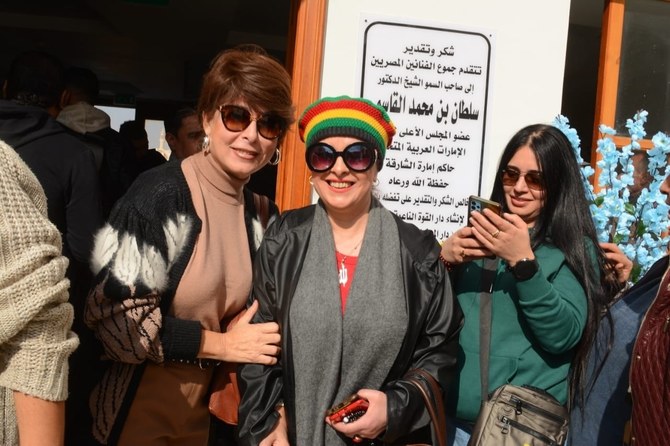
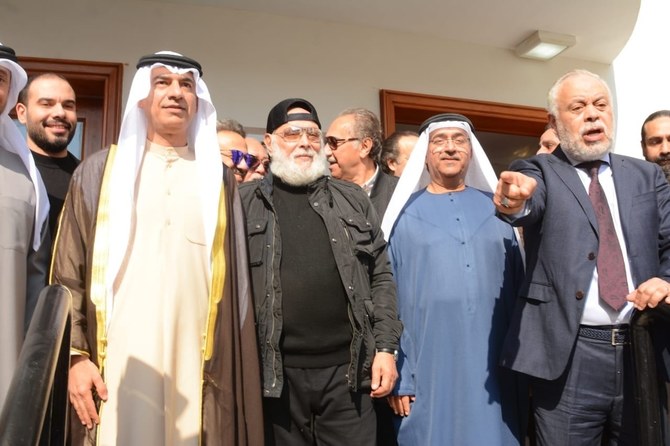
The opening of the home saw artists Ashraf Abdel Ghafour and Muhammad Abu Dawoud honored. Among the actors present were Ghafour, Sabreen, Bushra, Abeer Sabry, Anoushka, Rania Farid Shawqi, Sami Maghawry, Amr Mahmoud Yassin, Ehab Fahmy, Hanan Shawky, Afaf Donia Abdel Aziz, Safaa Al-Toukhi, Sabri Fawaz, Salwa Muhammad Ali, Ashraf Fahmy and Ahmed Salama.
Soft Power Home has been adorned with the photographs of several stars including Abdel Halim Hafez, Nadia Lotfy, Yahya Shaheen, Ali Al-Kassar, Mary Mounib, Omar Sharif, Sana Jamil, Abdel Moneim Madbouly, Saeed Abdel Al-Ghani and Mahmoud Al-Meligy.
The artist Ashraf Abdel Ghafour said during the opening: “My tongue is unable to express its joy at the completion of this (home) … I and the artist Samiha Ayoub went to present the project to Sheikh Sultan Al-Qasimi and he agreed without hesitation to finance the project, and for that I thank him very much.”
Artist Salah Abdullah praised the opening of the nursing home saying it was “a wonderful syndicate event … Thank you to our brother and friend, our captain, Ashraf Zaki, and thanks are due to the former captain, the great artist Ashraf Abdul Ghafoor and to all of the current board of directors for their great efforts to accomplish this great project,” he said in a Facebook post.