

‘Cries of children were unbearable’: Rescued Rohingya refugees recall ordeal at sea

1 / 2
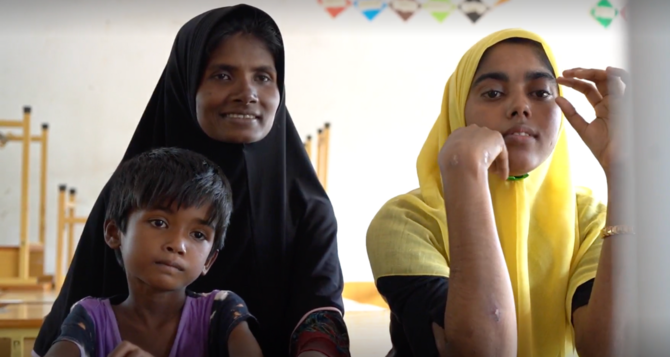
Umme Salima, Hatemon Nesa, and Rahena pose for a photo. (AN photo)
2 / 2
Hatemon Nesa, middle, speaks to her mother, Anwar Begum, in Cox’s Bazar, Bangladesh during a video call facilitated by Arab News. (AN photo)
Short Url
Updated 29 December 2022
Follow

‘Cries of children were unbearable’: Rescued Rohingya refugees recall ordeal at sea

  • Arab News team reconnects refugees with family after they reach Indonesia
  • Indonesian fishermen helped rescue 174 Rohingya adrift at sea for weeks

JAKARTA/DHAKA: When Hatemon Nesa boarded a wooden ship in Cox’s Bazar in late November, she left a Rohingya refugee camp in Bangladesh in the hope of finding a better life for her young daughters.

She set out on her journey with her five-year-old, leaving the older daughter with family members at the camp. She believed that the voyage would be successful and that they would soon be reunited in another country.

But the boat engines broke down about a week later and she, her daughter and another 172 refugees, mostly women and children, were left drifting in the Andaman Sea for weeks, with no food or water.

No regional country intervened despite UN calls for rescue last week. They were finally brought to safety by fishermen when their boat entered Indonesian waters.

On Wednesday, efforts of an Arab News team helped reconnect Nesa with her family, who had not been able to reach her for weeks and feared the worst.  

“Allah almighty saved our lives,” Nesa said in a video call from a shelter in Indonesia’s northern Aceh province, as she spoke to her brother and mother who remained in Cox’s Bazar.

“We were starving while floating on the boat ... I couldn't eat anything. If I held a water bottle in hand, it would have been stolen. I could drink water only when there was rain.”

Nesa and her daughter, Umme Salima, were among the refugees who reached the coastal village of Muara Tiga in Aceh’s Pidie district on Monday.

The International Organization for Migration said they were in “very poor health condition” and many were suffering severe dehydration and malnutrition.

“The rice and lentil you fed me, with that energy I traveled up to Indonesia,” Nesa told her mother as both burst into tears during the call.

Whenever there was another ship in sight, she and other refugees on the boat would scream for help. But for weeks their cries fell on deaf ears.

“We shouted so much and waved our hands like anything. At one point it felt like our hands would fall off our bodies,” Nesa said.

Opinion

This section contains relevant reference points, placed in (Opinion field)

Her relative, Rahena, 19, who was also on the boat, recalled how they were floating for days. “The cries of children due to hunger were unbearable,” she said, adding that at least 20 people onboard had died.

No help came when their boat entered Malaysian waters earlier this month. Neither did any come when it crossed into Indian waters, despite Nesa’s brother Mohammed Rezuwan Khan, a Rohingya activist in Cox’s Bazar, appealing for rescue. 

As the drifting Rohingya entered Indonesian territory, authorities repeatedly said they could not locate their boat. Local villagers then caught sight of them and organized help.

“From what I’ve seen, the eagerness of the public (to help) is extraordinary,” Nasruddin, coordinator from Geutanyoe Foundation, an Aceh-based humanitarian organization, told Arab News. “This is something that we need to appreciate and commend.”

It was not the first time that Indonesian fishermen would join to help the refugees, taking them to safety and providing necessary assistance.

Nasruddin said around 600 Rohingya have reached Aceh since March this year.

Nesa and her little daughter’s journey is not over as Indonesia is not a party to the 1951 Refugee Convention, meaning they cannot claim asylum. For the time being, however, they are safe and again in touch with their family.

“With the help of Arab News I got hold of my sister again and established communications with her after landing in Indonesia,” her brother said. “I want to convey my heartfelt thanks.”


China positions itself as force for global stability at its annual Congress

Updated 3 sec ago
Follow

China positions itself as force for global stability at its annual Congress

BEIJING: While much of the world’s attention is on the Iran war, that hasn’t stopped China from moving ahead with national priorities with global repercussions.
Not that China doesn’t care about the war and its impact on energy supplies and geopolitics. But for the world’s second largest economy, its growing rivalry with the United States revolves around a different battle: the development of the cutting-edge technologies shaping the 21st century.
That message came through in a five-year plan formally endorsed Thursday by the National People’s Congress at the end of its annual meeting, the nation’s biggest political event of the year. If anything, China is doubling down on a push to transform its economy and be at the forefront of technology. State media described China’s determination to stay the course on economic development as a force for stability in an uncertain world.
“A stable and developing China injects more stability and certainty into a world fraught with change and turbulence,” the official People’s Daily newspaper said in a front-page column on Wednesday. Other state-media echoed that view.
The commentaries and official statements didn’t mention US President Donald Trump, whose tariffs and use of military force from Venezuela to Iran are shaking up the global order that has governed international relations in the post-World War II era. China publicly defends that system, while calling for making it more equitable to reflect the interests of developing countries as well as rich ones.
Trump is due to visit Beijing in three weeks to hold talks with his counterpart, Chinese leader Xi Jinping.
The National People’s Congress also rubber-stamped three laws, including one governing ethnic minorities, at its closing session. The votes are ceremonial and nearly unanimous, designed to show unity behind the ruling Communist Party’s vision for the nation. The five-year plan was approved with 2,758 votes in favor, one against, and two abstentions.
“We are forging ahead at full speed in building a great country,” Foreign Minister Wang Yi said at an annual news conference during the Congress.
Banking on tech for growth
Many economists believe that China needs to do more to put more money into the hands of consumers to boost domestic spending and reduce its dependence on export-led growth.
China’s leaders agree in concept, but the five-year plan puts technology front and center, confirming it remains the top priority. Analysts expect any steps to boost consumption to happen only gradually, such as expanding social security and health care benefits, while government funds are poured into artificial intelligence, robotics and other areas.
Chinese Premier Li Qiang announced an economic growth target of 4.5 percent to 5 percent for 2026 at the start of the Congress, a level that gives the government more leeway to focus on the longer-term goals of the five-year plan rather than meeting a higher target this year.
Staying conservative on climate
The five-year plan doesn’t pledge to reduce carbon emissions overall, but only to reduce “emissions intensity” — how much pollutants are emitted relative to the size of the economy. That means emissions could still grow as the economy does.
The target for a reduction in intensity was set at 17 percent, a level that could allow emissions to rise 3 percent or more, analysts said. “International good practice is to move away from intensity targets toward absolute emission reduction targets,” said Niklas Hohne of the NewClimate Institute in Germany.
China has a history of setting conservative targets and its rapid expansion in solar and other clean energies may drive emissions down anyway. The country is the world’s No. 1 emitter of greenhouse gases, but leaders have long argued that the size of its population and economy must be considered when evaluating its pollution levels.
Regulating ethnic groups
A sweeping ethnic minorities law endorsed by the Congress solidifies what critics say is a government policy of assimilation, emphasizing the creation of “a common consciousness of the Chinese nation.”
The government said it is meant to foster a stronger sense of community and shared economic development among its ethnic groups. The law encapsulates an approach under Xi that has promoted unity over ethnic cultures and their languages.
“It puts a death nail in the party’s original promise of meaningful autonomy,” said James Leibold, a professor at Australia’s LaTrobe University who has studied China’s changing policies toward its ethnic minorities.
Seeking a “right to rest” for workers
Formal proposals and other suggestions to reduce work hours in a variety of ways were among those that got the most attention on social media during this year’s Congress.
Many focused on a “right to rest,” including calls to give employees the right not to respond to work messages after hours. Many Chinese workers get only five days of paid vacation a year. Yu Miaojie, an economist and deputy to the Congress, proposed raising the minimum statutory annual leave from five to 10 days.
The popularity of the proposals reflects concern about the intense workplace competition in China. Giving workers more leisure time is also seen as a way to boost consumption by giving them more free time to spend.