PARIS: At least 100 Iranians arrested in more than 100 days of nationwide protests face charges punishable by death, Oslo-based group Iran Human Rights (IHR) said Tuesday.
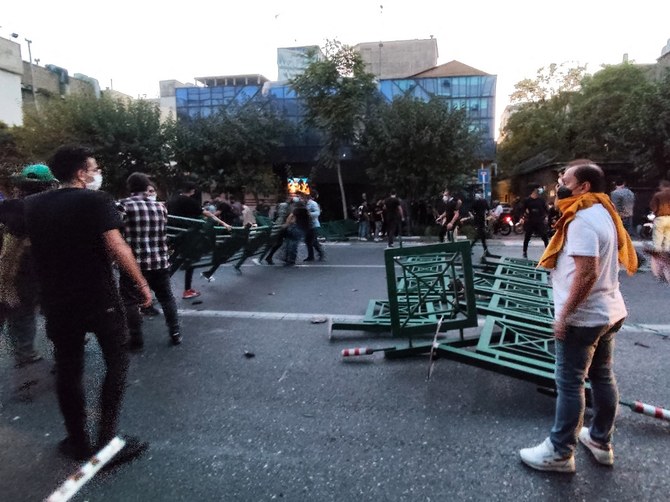
Protests have gripped Iran since the September 16 death in custody of Iranian-Kurdish Mahsa Amini, 22, after her arrest in Tehran for an alleged breach of the country’s strict dress code for women.
Earlier this month, Iran executed two men in connection with the protests, an escalation of the authorities’ crackdown that activists say is meant to instill public fear.
In a report Tuesday, IHR identified 100 detainees who face potential capital punishment, including at least 11 already sentenced to death.
Five detainees on the IHR list are women.
The report said many of them have limited access to legal representation.
“By issuing death sentences and executing some of them, they (the authorities) want to make people go home,” said IHR director Mahmood Amiry-Moghaddam.
“It has some effect,” he told AFP, but “what we’ve observed in general is more anger against the authorities.”
“Their strategy of spreading fear through executions has failed.”
In an updated death toll issued Tuesday, IHR said 476 protesters have been killed so far.
Iran’s top security body in early December gave a toll of more than 200 people killed, including security officers.
At least 14,000 people have been arrested since the nationwide unrest began, the United Nations said last month.
Majidreza Rahnavard, 23, was hanged in public from a crane on December 12 after being sentenced by a court in Mashhad for killing two members of the security forces with a knife.
Four days earlier, Mohsen Shekari, also 23, had been executed for wounding a member of the security forces.
The judiciary has said that nine others have been handed death sentences over the protests, of whom two have been allowed retrials.
The father of death row inmate Mohammad Ghodablou has issued a plea on social media calling for his son’s release, saying “he made a big mistake.”
“Mohammad has so far had no criminal record,” the father said in a video circulated this week, claiming he suffers from a mental disorder.
Ghodablou, 22, was charged in Tehran with “corruption on earth” for “attacking police with a car, which resulted in the death of one officer and the injury of five others.”
The judiciary’s Mizan Online news website reported Monday that Ghodablou had undergone psychiatric evaluation that concluded he “was aware of the nature of his crime.”
US-based Human Rights Activists News Agency (HRANA) noted in a report issued Monday a rise of 88 percent in executions in 2022 compared to last year and an eight-percent rise in death sentences, the vast majority of them for murder or drug offenses.
According to London-based rights group Amnesty International, Iran is second only to China in its use of the death penalty, with at least 314 people executed in 2021.

Dozens of Iran protesters risk death penalty: Rights group
https://arab.news/2kr67
Dozens of Iran protesters risk death penalty: Rights group
- In a report Tuesday, IHR identified 100 detainees who face potential capital punishment
- The report said many of them have limited access to legal representation
Trump says Iran government change ‘best thing that could happen’
- US president's comments come after he ordered a second aircraft carrier to head to the Middle East
FORT BRAGG, United States: US President Donald Trump said a change of government in Iran would be the “best thing that could happen,” as he ordered a second aircraft carrier to head to the Middle East.
“Seems like that would be the best thing that could happen,” Trump told reporters at the Fort Bragg military base in North Carolina when a journalist asked if he wanted “regime change” in Iran.
“For 47 years, they’ve been talking and talking and talking. In the meantime, we’ve lost a lot of lives while they talk,” he told reporters.
Trump declined to say who he would want to take over in Iran from supreme leader Ayatollah Ali Khamenei, but he added that “there are people.”
He has previously backed off full-throated calls for a change of government in Iran, warning that it could cause chaos, although he has made threats toward Khamenei in the past.
Speaking earlier at the White House, Trump said that the USS Gerald R. Ford — the world’s largest warship — would be “leaving very soon” for the Middle East to up the pressure on Iran.
“In case we don’t make a deal, we’ll need it,” Trump said.
The giant vessel is currently in the Caribbean following the US overthrow of Venezuela’s Nicolas Maduro. Another carrier, the USS Abraham Lincoln, is one of 12 US ships already in the Middle East.
When Iran began its crackdown on protests last month — which rights groups say killed thousands — Trump initially said that the United States was “locked and loaded” to help demonstrators.
But he has recently focused his military threats on Tehran’s nuclear program, which US forces struck last July during Israel’s unprecedented 12-day war with Iran.
The protests have subsided for now but US-based Reza Pahlavi, the son of Iran’s last shah, urged international intervention to support the Iranian people.
“We are asking for a humanitarian intervention to prevent more innocent lives being killed in the process,” he told the Munich Security Conference.
It followed a call by the opposition leader, who has not returned to his country since before the revolution, for Iranians at home and abroad to continue demonstrations this weekend.
Iran and the United States, who have had no diplomatic relations since shortly after the revolution, held talks on the nuclear issue last week in Oman. No dates have been set for new talks yet.
The West fears the program is aimed at making a bomb, which Tehran denies.
The head of the UN nuclear watchdog, Rafael Grossi, said Friday that reaching an accord with Iran on inspections of its processing facilities was possible but “terribly difficult.”
Trump said after talks with Israeli Prime Minister Benjamin Netanyahu earlier this week that he wanted to continue talks with Iran, defying pressure from his key ally for a tougher stance.
The Israeli prime minister himself expressed skepticism at the quality of any agreement if it didn’t also cover Iran’s ballistic missiles and support for regional proxies.
According to the US-based Human Rights Activists News Agency, 7,008 people, mostly protesters, were killed in the recent crackdown, although rights groups warn the toll is likely far higher.
More than 53,000 people have also been arrested, it added.
The Norway-based Iran Human Rights (IHR) NGO said “hundreds” of people were facing charges linked to the protests that could see them sentenced to death.
Figures working within the Iranian system have also been arrested, with three politicians detained this week from the so-called reformist wing of Iranian politics supportive of President Masoud Pezeshkian.
The three — Azar Mansouri, Javad Emam and Ebrahim Asgharzadeh — were released on bail Thursday and Friday, their lawyer Hojjat Kermani told the ISNA news agency.


