



ISLAMABAD: The chairman of Pakistan’s National Disaster Management Authority (NDMA), Lt. Gen. Inam Haider Malik, called a meeting on Monday to review the country’s pandemic response efforts, instructing authorities to review new coronavirus variants in the region and devise precautions accordingly.
Pakistan’s current COVID-19 positivity rate stands at 0.53 percent and 95 percent of the country’s eligible population has been inoculated with a first, and 90 percent with a second, dose of coronavirus vaccines.
Neighbouring India’s government has already asked the country’s states to keep a sharp lookout for any new variants of the coronavirus and urged people to wear masks in crowded areas, citing an increase in COVID-19 cases in China and other parts of the globe.
China has registered a surge in infections after ending strict restrictions, while data from the World Health Organization shows infections have risen in countries including Japan, South Korea and the United States in recent days.
“National Institute of Health (NIH) team was called on for updated monitoring of regional trends of new variant of coronavirus and trajectories development for Pakistan without creating undue alarm,” the NDMA said in a statement.
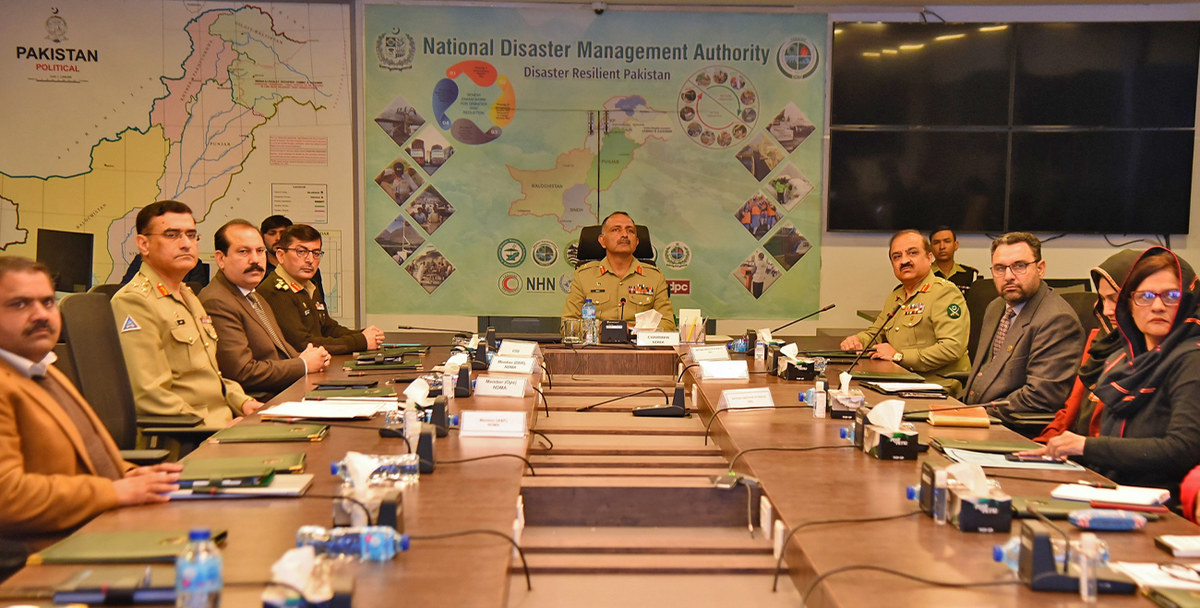
Pakistan’s National Disaster Management Authority (NDMA), Lt. Gen. Inam Haider Malik (center), presides over a special session of the National Emergency Operation Centre in Islamabad, Pakistan on December 26, 2022. (Photo courtesy: NCOC)
While the chairman of the authority expressed confidence in Pakistan’s current strategies and state of preparedness, “the situation will be continuously monitored by National Command & Operation Center (NCOC) and preparedness, preventative protocols and vaccination administration system will be strengthened to tackle spike in concern,” the NDMA added.
The NCOC, which was set up in 2020 as the national pandemic response body, presented detailed statistics on COVID-19 management, vaccination administration data and low risk of new variants in Pakistan.
The chairman instructed the National Institute of Health (NIH) “to issue precautionary COVID variant risk advisory for public and relevant stakeholders based on scientific analysis of data at global & regional level and carry out selective mock drills for COVID emergency.”
NIH was also directed to review stocks of vaccines and arrangements in hospitals to deal with coronavirus cases.
There have been 1,544,131 infections and 30,426 coronavirus-related deaths reported in Pakistan since the pandemic began. Pakistan has administered at least 278,150,849 doses of COVID vaccines so far.


