

Haaland can score 800 goals, says Man City teammate De Bruyne

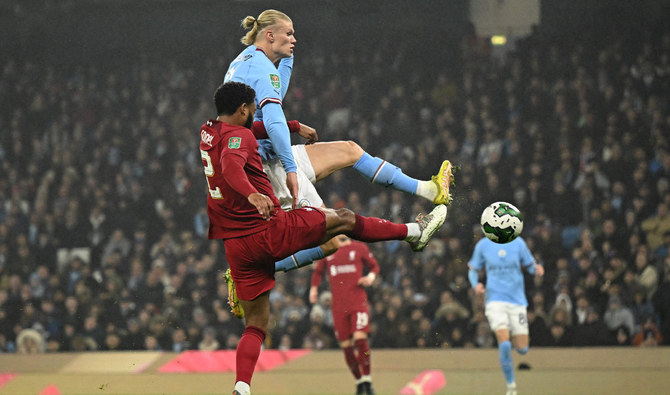
Manchester City's Norwegian striker Erling Haaland (R) scores the opening goal during their English League Cup fourth round football match against Liverpool at the Etihad stadium on Dec. 22, 2022. (AFP)
Short Url
Updated 26 December 2022
Follow

Haaland can score 800 goals, says Man City teammate De Bruyne

  • The Belgian international has played with a host of top strikers in his career and is well-placed when it comes to 22-year-old Haaland’s place in the pecking order

LONDON: Kevin De Bruyne believes Manchester City teammate Erling Haaland can go on and score 800 goals before his career ends.

Haaland, who will return to the city of his birth when the champions resume their Premier League title defense at Leeds on Wednesday, has scored 24 goals in just 19 appearances since his summer move from Borussia Dortmund.

“He already has about 200 goals, so he can probably go to 600, 700 or 800 if he stays fit and does the things that he does,” said De Bruyne.

The Belgian international has played with a host of top strikers in his career and is well-placed when it comes to 22-year-old Haaland’s place in the pecking order.

De Bruyne enjoyed a fruitful relationship with the club’s record goalscorer Sergio Aguero before the Argentinian left the Etihad Stadium in 2021.

He has also combined with Romelu Lukaku on international duty, former City teammate Gabriel Jesus and new World Cup-winner Julian Alvarez, a current fellow City player.

“It is very hard to compare because they are all totally different,” said De Bruyne.

“They have all scored 300 or 400 goals. Erling is so obsessed with goals he can maybe go beyond that.”

He added: “He is still a young boy enjoying his life and he takes his football very seriously. He loves scoring goals, so I think that is the most unique thing he has.”


Cricket’s increasingly concentrated power and influence

Updated 4 sec ago
Follow

Cricket’s increasingly concentrated power and influence

  • There seems to be a belief amongst those who wield power that India’s domestic market will never slow down and continue to sustain the sport globally

There appears to have been some mischief-making in the corridors of power which determine cricket broadcasting rights. At least this is the case as far as the all-important Indian market is concerned.

Rumors have been expressed in respected media channels that the current four-year deal between JioStar and the International Cricket Council is in jeopardy.

JioStar is the result of a merger in 2024 between Viacom18 and Disney Star, which had negotiated the original deal, signed in 2022. This was valued at $2.9 billion. The precise rumor was that JioStar does not wish to honor the last two years of the deal.

Such was the impact of the rumor that the ICC and JioStar released a joint statement on Dec. 11 which said that the media reports “do not reflect the position of either organization.

“The existing agreement between the ICC and JioStar remains fully in force, and JioStar continues as the ICC’s official media rights partner in India. Any suggestion that JioStar has withdrawn from the agreement is incorrect. JioStar is fully committed to honor its contractual obligations in letter and spirit.”

It can be argued that evidence of that commitment was demonstrated by the recent unveiling of a teaser advertisement for the men’s Twenty20 World Cup in early 2026, jointly hosted by India and Sri Lanka. The event ought to be a bonanza for advertisers, sponsors and marketers.

So, why, at this point, would rumors circulate about honoring the current media rights model? One possibility is that there is lingering suspicion that the $2.9-billion deal with Disney Star was over the odds.

It is understood that, at the bidding stage, Sony Pictures Networks had been the second-highest bidder at around half of the final sum and that Jio had bid significantly less than that figure.

It is difficult to keep track of the changing ownership patterns of companies which have held ICC media rights. Star Sports, the precursor of Disney Star, started its long-standing commercial relationship with the ICC in 2007, whilst its partnership with the Board of Control for Cricket in India began in 2011.

Indian Premier League broadcasting rights were secured in 2018. It seems that Star had become the preferred supplier and, perhaps, this led to an overreach in 2023 in order to ensure that this position was retained.

What seemed like an ever-growing market received a shock to its system in August. The Indian parliament passed the Promotion and Regulation of Online Gaming Bill. As discussed in my column of Sept. 11, the motivations for the bill are honorable.

It seeks to address the risks of addiction and financial ruin, along with the accompanying harm to mental health and possible suicide risk caused by compulsive playing, as well as opportunities for money laundering and threats to national security by illegal messaging.

The impact on real-money gaming platforms has been severe. They had become a vital cog in the engine driving televised cricket in India and beyond. Dream11, India’s largest fantasy sports platform, had featured on Team India’s shirt front, for both men and women, since 2023.

This prominent sponsorship disappeared with immediate effect and its business model had to pivot from paid contests to free-to-play. One piece of regulatory legislation exposed the inherent risk which cricket faces in basing a part of its financial underpinning on any sector which may be subject to significant governmental intervention.

Of course, none of this is new. Tobacco companies were once prominent sponsors of the game. When this was banned, cricket’s national boards moved onto other sectors, such as financial services. Sponsorship is not the main source of income for cricket — television is, largely from India.

It is well known that the ICC receives 80 percent of its income from India and that other countries rely on tours by the Indian team to generate domestic income. This level of dependency is not only risky but makes most of the rest of cricket vulnerable to what happens in India.

JioStar is owned by Reliance Industries, an industrial conglomerate which controls significant parts of India’s energy, telecommunications, retail and financial sectors. It also owns the Mumbai Indians in the IPL, MI Cape Town in South Africa, MI Emirates in ILT20, MI New York and MI London in The Hundred.

In the latter case, this represents a re-brand of The Oval Invincibles. Despite having a 49 percent stake in the franchise, its influence has been sufficient to effect the re-branding.

Reliance and its owners, the Ambani family, are heavily invested in cricket. A former senior executive of Disney Star and JioStar, Sanjog Gupta, is now chief executive of the ICC and will be very familiar with the terms of the current rights deal.

Jay Shah, former secretary of the BCCI and the current ICC chair is the son of India’s interior minister. The ICC and the BCCI are linked, more than ever before, by common interests and deeply personal connections at the governance levels of both cricket, politics and financial capital.

Whether the rumors about JioStar’s stance on the current rights deal is correct or not, it is known that the ICC has been preparing member boards for the prospect that funding distribution to them in the next cycle from 2028 could be 30 percent lower than in the current cycle.

JioStar has established such a powerful market position, akin to a monopoly, that the rumored default on the current deal may represent the opening salvos on negotiations for the next cycle.

In an ideal world, cricket’s governing body should not be beholden to a single broadcaster. Diversification of revenue streams across multiple broadcasters and streaming platforms in multiple countries would reduce the risk and dependency.

It seems unlikely to happen, as it requires the ICC leadership to decouple itself from the BCCI and India. A basic textbook on corporate strategy would not recommend that a global sport’s financial viability should be dependent on one country and a single powerful broadcaster.

However, that is the position in which cricket finds itself. There seems to be a belief amongst those who wield power in cricket that India’s domestic market will never slow down and continue to sustain the sport globally.

Add to that the continued growth and maturity of franchise leagues, with a high proportion of teams owned by Indian companies and individuals, the notion of anyone else having their hands on the levers of power is risible.

Little evidence exists to suggest that India’s dominance of cricket is not going to remain in place for some time to come. There is no obvious prospect of that position being used to institute structural and governance reform that addresses possible conflicts of interest and restricts power and influence.

In 1887, Lord Acton famously said: “Power tends to corrupt and absolute power corrupts absolutely.” Applied to cricket, this does not imply that financial corruption exists.

However, it should serve as a reminder that absolute power can corrupt the best of natures. On this issue, global cricket governance stands at a crossroads.