

Top UN, NGO officials in Afghanistan to meet over Taliban ban on women staff

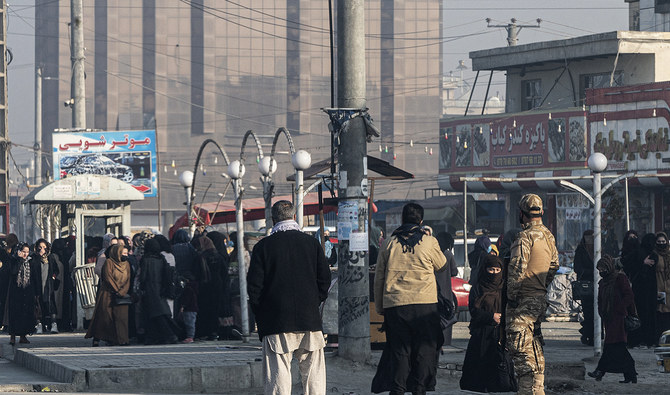
Afghan female university students stop by Taliban security personnel stand next to a private university in Kabul on December 21, 2022. (Photo courtesy: AFP)
Short Url
Updated 25 December 2022
Follow

Top UN, NGO officials in Afghanistan to meet over Taliban ban on women staff

  • NGO officials say the meeting will discuss whether to suspend all aid work following the latest Taliban directive
  • The UN and other international NGOs are instrumental in coordinating distribution of aid across Afghanistan

KABUL: Top officials from the United Nations and dozens of NGOs operating in Afghanistan are meeting Sunday to discuss the way ahead after the Taliban authorities ordered all NGOs to stop women employees from working, aid officials said.

The hard-line Islamists on Saturday threatened to suspend the operating licenses of NGOs if they failed to implement the order.

The Ministry of Economy, which issues these licenses, said it had received “serious complaints” that women working in NGOs were not observing a proper Islamic dress code.

“A meeting of Humanitarian Country Team (HCT) is scheduled later today to consult and discuss how to tackle this issue,” Tapiwa Gomo, public information officer for the UN Office for the Coordination of Humanitarian Affairs, told AFP.

The HCT comprises top UN officials and representatives of dozens of Afghan and international NGOs who coordinate distribution of aid across the country.

The meeting will discuss whether to suspend all aid work following the latest Taliban directive, some NGO officials said.

The United Nations, which said it would seek an explanation from the Taliban about the order, condemned the ministry’s directive.

It said the order excluding women “systematically from all aspects of public and political life takes the country backward, jeopardizing efforts for any meaningful peace or stability in the country.”

US Secretary of State Antony Blinken said the ban would be “devastating” to Afghans as it would “disrupt vital and life-saving assistance to millions.”

The ban comes at a time when millions across the country depend on humanitarian aid provided by international donors through a vast network of NGOs.

Afghanistan’s economic crisis has only worsened since the Taliban seized power in August last year, which led to Washington freezing billions of dollars of its assets and foreign donors stopping aid.

The ministry said women working in NGOs were not observing “the Islamic hijab and other rules and regulations pertaining to the work of females in national and international organizations.”

It remained unclear whether the directive impacted foreign women staff at NGOs.

Dozens of organizations work across remote areas of Afghanistan and many of their employees are women, with several warning a ban on women staff would stymie their work.

The latest restriction comes less than a week after the Taliban authorities banned women from attending universities, prompting global outrage and protests in some Afghan cities.

Since returning to power in August last year, the Taliban have already barred teenage girls from secondary school.

Women have also been pushed out of many government jobs, prevented from traveling without a male relative and ordered to cover up outside of the home, ideally with a burqa.

They are also not allowed to enter parks or gardens.


Four more US deportees arrive in Eswatini: lawyer, official

Updated 5 sec ago
Follow

Four more US deportees arrive in Eswatini: lawyer, official

  • Two of the newly arrived deportees are from Somalia, one from Tanzania and one from Sudan
  • The four arrived at the maximum-security Matsapha Correctional Center

MBABANE, Eswatini: Four more men deported from the United States under Washington’s scheme to expel undocumented migrants have arrived in the southern African kingdom of Eswatini, a lawyer and a prison official said Thursday.
The tiny country took in 15 men last year as part of US deals with several African nations for them to accept migrants under a third-country deportation program that has been widely criticized by rights groups.
Two of the newly arrived deportees are from Somalia, one from Tanzania and one from Sudan, US-based migration lawyer Alma David, who represents some of the other detainees, told AFP.
The four arrived at the maximum-security Matsapha Correctional Center, outside the capital, late Wednesday, an officer said on condition of anonymity.
“They are in perfect health,” the officer told AFP. “They are currently being oriented by the social welfare and health departments.”
The facility was preparing to receive around 140 more deportees, the official said.
According to a document revealed by Human Rights Watch in September and seen by AFP, Eswatini agreed to take 160 deportees in exchange for funds to build its border and migration management capacity.
Eswatini, Africa’s last absolute monarchy, confirmed in November that it had received around $5.1 million from the United States to accept the deportees.
Equatorial Guinea, Ghana, Rwanda and South Sudan have also accepted US deportees. Cameroon reportedly received 17 African nationals deported from the United States this year.
Eswatini authorities say they are only holding the deportees while arrangements are finalized for their repatriation.
One of the men sent to Eswatini, a 62-year-old Jamaican who had reportedly completed a murder sentence in the United States, was sent back to the Caribbean island nation in September.
Lawyers and civil society groups in Eswatini have gone to court to challenge the legality of the detentions, arguing that the deportees are being held “indefinitely” without charges.