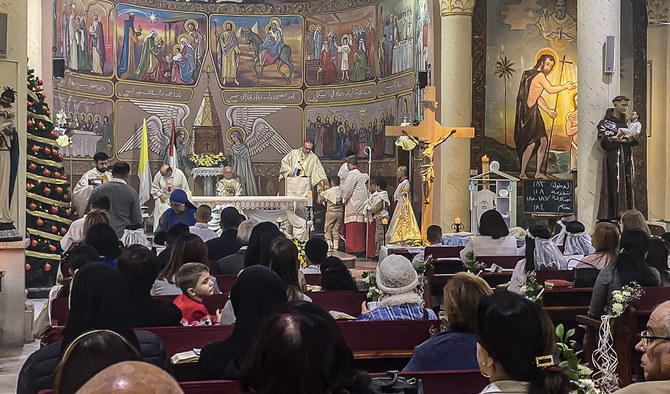
GAZA CITY, PALESTINE: In Gaza City, the small but tight-knit Catholic Christian community gathered at the Holy Family Church for Christmas mass earlier this month, presided over by Archbishop Pierbattista Pizzaballa, the Latin Patriarch of Jerusalem.
As Israel has prevented many Christians in Gaza from traveling to Bethlehem to attend midnight mass at the Church of the Nativity, they celebrated the holiday early.
“For years, I have been coming to Gaza to celebrate with the Christian community, to get close to them and support them,” Pizzaballa told Arab News.
The Patriarch spent three days in Gaza City, during which he visited the educational and medical institutions of the Latin Patriarchate.
“Not all Christians in Gaza have been granted permits, so it is necessary to share Christmas with them. I feel so warm here in Gaza,” he said.
Israel initially agreed to issue 645 permits to Palestinian Christians, submitted by the Palestinian General Authority for Civil Affairs. The Israeli government decided earlier to grant Christians in Gaza 500 permits, not including children, to visit Bethlehem and Jerusalem during Christmas.
The Israeli Gisha organization, which specializes in freedom of movement for Palestinians, said that as of Dec. 6, a total of 996 requests for permits had been submitted, of which 781 were for individuals above the age of 16. Of those, 514 were approved, in addition to 131 permits for children.
Some Christians in Gaza bemoan their inability to gather all family members in one place to celebrate Christmas due to restrictions on movement.
“Christmas is a joy for us as Christians, and an opportunity for the whole family to gather on this occasion, but the current circumstances prevent us from gathering together,” Gaza resident Sana’a Tarazi told Arab News.
“Part of the family lives in the West Bank and another part in Europe.”
Christmas trees decorate the entrance of Christian institutions and homes in Gaza, in addition to some Muslim homes. At a ceremony attended by thousands, the YMCA lit a Christmas tree in its yard as part of a series of activities for the holidays.
“The lighting of the Christmas tree spreads joy to our Christian community as well as to the general Palestinian community in Gaza,” Hati Farah, secretary general of the YMCA in Gaza, told Arab News.
“We need to celebrate and make the celebrants in Gaza feel the existence of activities that make them feel like a holiday. This is a special holiday for us as Christians, but it is a message of peace toward all religions.”
About 1,300 Christians live in the Gaza Strip, most of whom follow the Greek Orthodox Church and celebrate Christmas on Jan. 7, while a small Catholic community (which numbers about 133, according to the National Catholic Reporter) celebrates Christmas according to the Western calendar.
The Rosary Sisters School, one of four Christian schools in Gaza, has been beautifully decorated for the holidays. A tree covered in lights and colorful ornaments sits in the schoolyard, and decorations and lights hang in the center of the main building and on the doors of classrooms.
“Christmas is a special occasion. We celebrate it every year and everyone here in the school, staff and students, is very happy with these decorations,” Sister Nabila Saleh, principal of the Rosary Sisters School, told Arab News.
To mark the holiday season, Santa Claus visits Christian schools and other institutions to distribute sweets.
Although the Islamist group Hamas controls Gaza, and forbids the public observance of Christmas, it has allowed private celebrations in Christian homes and institutions.
An official delegation from Hamas congratulated Christian communities in Gaza and visited the churches of the Latin Monastery and the Greek Orthodox Church.
Dec. 25 and Jan. 7 are considered official holidays in the West Bank and Gaza Strip in all public and private institutions.
Christmas trees are available in some shops, as well as decorations, which are bought by Christians and Muslims alike. “Most of my customers for Christmas decorations are Muslims,” shop owner Mahmoud Al-Hajj told Arab News.
“My children love the Christmas tree and the lights on it,” one customer told Arab News. “We are Muslims, but this time is a time of joy and I want my children to feel it as it is the case in many countries of the world.
“I have Christian friends in my workplace. We celebrate Christmas together, as well as Eid Al-Fitr, and Eid Al-Adha. We are one people.”


In Gaza, Christian and Muslim Palestinians celebrate Christmas together
https://arab.news/zq3ev
In Gaza, Christian and Muslim Palestinians celebrate Christmas together

- About 1,300 Christians, both Greek Orthodox and Latin Catholic, live in the Gaza Strip
- Early Christmas mass this year was presided over by Archbishop Pierbattista Pizzaballa

Tunisia’s famed blue-and-white village threatened after record rains
- The one-time home of French philosopher Michel Foucault and writer Andre Gide, the village is protected under Tunisian preservation law, pending a UNESCO decision on its bid for World Heritage status
SIDI BOU SAID, Tunisia: Perched on a hill overlooking Carthage, Tunisia’s famed blue-and-white village of Sidi Bou Said now faces the threat of landslides, after record rainfall tore through parts of its slopes.
Last week, Tunisia saw its heaviest downpour in more than 70 years. The storm killed at least five people, with others still missing.
Narrow streets of this village north of Tunis — famed for its pink bougainvillea and studded wooden doors — were cut off by fallen trees, rocks and thick clay. Even more worryingly for residents, parts of the hillside have broken loose.
“The situation is delicate” and “requires urgent intervention,” Mounir Riabi, the regional director of civil defense in Tunis, recently told AFP.
“Some homes are threatened by imminent danger,” he said.
Authorities have banned heavy vehicles from driving into the village and ordered some businesses and institutions to close, such as the Ennejma Ezzahra museum.
- Scared -
Fifty-year-old Maya, who did not give her full name, said she was forced to leave her century-old family villa after the storm.
“Everything happened very fast,” she recalled. “I was with my mother and, suddenly, extremely violent torrents poured down.”
“I saw a mass of mud rushing toward the house, then the electricity cut off. I was really scared.”
Her Moorish-style villa sustained significant damage.
One worker on site, Said Ben Farhat, said waterlogged earth sliding from the hillside destroyed part of a kitchen wall.
“Another rainstorm and it will be a catastrophe,” he said.
Shop owners said the ban on heavy vehicles was another blow to their businesses, as they usually rely on tourist buses to bring in traffic.
When President Kais Saied visited the village on Wednesday, vendors were heard shouting: “We want to work.”
One trader, Mohamed Fedi, told AFP afterwards there were “no more customers.”
“We have closed shop,” he said, adding that the shops provide a livelihood to some 200 families.
- Highly unstable -
Beyond its famous architecture, the village also bears historical and spiritual significance.
The village was named after a 12th-century Sufi saint, Abu Said Al-Baji, who had established a religious center there. His shrine still sits atop the hill.
The one-time home of French philosopher Michel Foucault and writer Andre Gide, the village is protected under Tunisian preservation law, pending a UNESCO decision on its bid for World Heritage status.
Experts say solutions to help preserve Sidi Bou Said could include restricting new development, building more retaining walls and improving drainage to prevent runoff from accumulating.
Chokri Yaich, a geologist speaking to Tunisian radio Mosaique FM, said climate change has made protecting the hill increasingly urgent, warning of more storms like last week’s.
The hill’s clay-rich soil loses up to two thirds of its cohesion when saturated with water, making it highly unstable, Yaich explained.
He also pointed to marine erosion and the growing weight of urbanization, saying that construction had increased by about 40 percent over the past three decades.
For now, authorities have yet to announce a protection plan, leaving home and shop owners anxious, as the weather remains unpredictable.


