

Pakistan’s diplomatic mission in UAE celebrates religious diversity ahead of Christmas

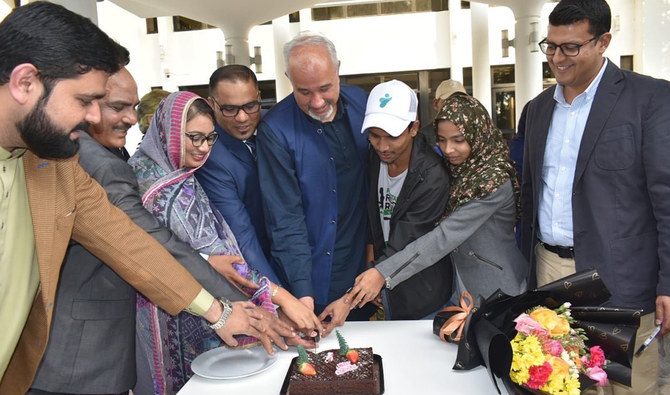
This handout photograph taken on December 23, 2022 and released by Pakistan Embassy in UAE shows the country's Ambassador Faisal Niaz Tirmiz (c) cutting a Christmas cake with the Pakistani Christian community residing in Abu Dhabi. (Photo courtesy: Twitter/PakinUAE)
Short Url
Updated 24 December 2022
Follow

Pakistan’s diplomatic mission in UAE celebrates religious diversity ahead of Christmas

  • The country’s envoy to the Arab state tells a gathering the government believes in religious freedom in line with Jinnah’s vision
  • Ambassador Faisal Tirmizi recalls the contribution of Pakistan’s non-Muslim community in the country’s progress and development

ISLAMABAD: Pakistan’s top diplomat in the United Arab Emirates (UAE) said on Saturday his country’s constitution emphasized religious freedom and protection of all communities while addressing a ceremony at the embassy in Abu Dhabi.

Ambassador Faisal Niaz Tirmizi noted his country’s outlook in this regard was inspired by the vision of its founder, Muhammad Ali Jinnah, who told the constituent assembly in August 1947 that Pakistani citizens would be free to go to their places of worship.

“The government’s policies are geared toward empowering minority communities to play their role in national life as equal citizens,” he was quoted as saying by the Associated Press of Pakistan (APP) news agency.

Tirmizi added the government was working to foster interfaith harmony among its people.

The event arranged by the embassy brought together a number of Pakistani Christian community members in the Arab country.

Special prayers were also held at the occasion, as some of the speakers pointed out that December 25 had special significance for Pakistan since it also marked Jinnah’s birth anniversary.

The Pakistani ambassador recalled the contribution of Justice AR Cornelius, Col. SK Tressler, FE Chaudhry and other successful members of Pakistan’s non-Muslim community while praising their contributions to the country’s progress and development.


Pakistan high court pauses tree-cutting in Islamabad until Feb. 2

Updated 10 sec ago
Follow

Pakistan high court pauses tree-cutting in Islamabad until Feb. 2

  • Islamabad High Court asks CDA to ‘explain and justify’ tree-cutting at next hearing
  • CDA officials say 29,000 trees were cut due to allergies, deny felling in green belts

ISLAMABAD: The Islamabad High Court has ordered an immediate halt to tree-cutting in the federal capital until Feb. 2, seeking justification from civic authorities over the legality of a large-scale felling drive that has seen thousands of trees removed in recent months.

The interim order, issued by a single-judge bench led by Justice Khadim Hussain Soomro, came during proceedings on a petition challenging the Capital Development Authority’s (CDA) tree-cutting operations in Islamabad’s Shakarparian area and H-8 sector.

At the outset of the hearing, the petitioner’s counsel argued that trees were being felled in violation of the Pakistan Environmental Protection Act 1997, the Islamabad Wildlife Ordinance 1979 and the city’s master plan.

“Respondents shall not cut trees till the next date of hearing,” Justice Soomro said in the court order released on Friday while referring to CDA officials.

“Respondents are directed to come fully prepared and to file paragraph-wise comments before the next date of hearing, along with a comprehensive report explaining the justification and legal basis for the cutting of trees,” he added.

According to the court order, the petitioner maintained that the CDA had not made any public disclosure regarding the legal basis for the operation and that the felling was causing environmental harm.

The petition sought access to the official record of tree-cutting activities and called for the penalization of CDA officials responsible for the act under relevant criminal and environmental laws.

It also urged the court to impose a moratorium on infrastructure projects in Islamabad, order large-scale replanting as compensation and constitute a judicial commission headed by a retired Supreme Court judge to probe the alleged violations.

CDA officials acknowledge around 29,000 paper mulberry trees have been cut in the capital in recent months, arguing that the species triggers seasonal allergies such as sneezing, itchy eyes and nasal congestion.

They also maintain that no trees have been removed from designated green belts and that the number of replacement trees planted exceeds those felled.

Designed in the 1960s by Greek architect Constantinos Doxiadis, Islamabad was conceived as a low-density city with green belts and protected natural zones at its core.

Critics, however, say the recent felling has extended beyond paper mulberry trees and question whether authorities are adhering to the city’s master plan and the legal protections governing forested and green areas.

The court has adjourned its hearing until Feb. 2, 2026.