Iran's Supreme Court has accepted the death sentence appeal of one protestor but confirmed that of another, the country's judiciary said on Saturday.
The Court had initially said it had accepted the appeals of both protestors, but in a subsequent statement the judiciary's Mizan news agency said: "The public relations of the Supreme Court of Iran has corrected its news: 'The appeal of Mohammad Qabadloo has not been accepted/the ruling has been confirmed.
"Saman Seydi's appeal has been accepted by the Supreme Court."
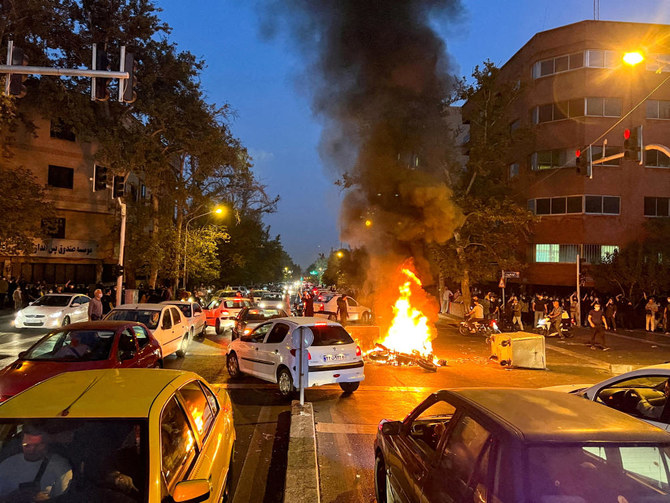
Nationwide unrest erupted in mid-September after the death in custody of 22-year-old Kurdish Iranian woman Mahsa Amini, who was arrested by morality police enforcing the Islamic Republic’s mandatory dress code laws.
Iran hanged two protesters earlier this month: Mohsen Shekari, 23, was accused of blocking a main road in September and wounding a member of the paramilitary Basij force with a knife. Majid Reza Rahnavard, 23, who was accused of stabbing to death two Basij members, was publicly hanged from a construction crane.
Amnesty International has said Iranian authorities are seeking the death penalty for at least 21 people in what it called “sham trials designed to intimidate those participating in the popular uprising that has rocked Iran.”
Qobadloo was charged with killing a police agent and injuring five others during the protests.
Yasin, a Kurd who raps about inequality, oppression and unemployment, was accused of attempting to kill security forces and singing revolutionary songs.
Rights group HRANA said that as of Friday 506 protesters had been killed, including 69 minors. It said 66 members of the security forces had also been killed. As many as 18,516 protesters are believed to have been arrested, it said.
A top state security body said early this month that 200 people, including members of security forces, had lost their lives in the unrest.

Iran Supreme Court accepts appeal of one protester’s death sentence
Short Url
https://arab.news/cab3j
Iran Supreme Court accepts appeal of one protester’s death sentence
- Iranian authorities seeking the death penalty for at least 21 people in so-called ‘sham trials’
Slain son of former Libya ruler Qaddafi to be buried near capital
TRIPOLI: The slain son of former Libyan ruler Muammar Qaddafi will be buried in a town south of the capital that remains loyal to the family, relatives said Thursday.
Seif Al-Islam Qaddafi, once seen by some as Libya’s heir apparent, was shot dead on Tuesday in the northwestern city of Zintan.
The burial will be held on Friday in the town of Bani Walid some 175 kilometers south of Tripoli, two of his brothers said.
“The date and location of his burial have been decided by mutual agreement among the family,” half-brother Mohamed Qaddafi said in a Facebook post.
Mohamed said the plan reflected “our respect” for the town, which has remained loyal to the elder Qaddafi years after he was toppled and killed in the 2011 Arab Spring uprisings.
Each year, the town of about 100,000 celebrates the anniversary of a 1969 coup that brought Muammar to power, parading through the streets holding the ex-leader’s portrait.
Saadi Qaddafi, a younger brother, said his dead sibling will be “buried among the Werfalla,” an influential local tribe, in a grave next to his brother Khamis Qaddafi, who died during the 2011 unrest.
Marcel Ceccaldi, a French lawyer who had been representing Seif Al-Islam, told AFP he was killed by an unidentified “four-man commando” who stormed his house on Tuesday.
Seif Al-Islam had long been widely seen as his father’s heir. Under the elder Qaddafi’s iron-fisted 40-year rule, he was described as the de facto prime minister, cultivating an image of moderation and reform despite holding no official position.
But that reputation soon collapsed when he promised “rivers of blood” in retaliation for the 2011 uprising.
He was arrested that year on a warrant issued by the International Criminal Court for alleged crimes against humanity, and a Tripoli court later sentenced him to death, although he was later granted amnesty.
In 2021 he announced he would run for president but the elections were indefinitely postponed.
He is survived by four out of six siblings: Mohamed, Saadi, Aicha and Hannibal, who was recently released from a Lebanese prison on bail.
Libya has struggled to recover from chaos that erupted after the 2011 uprising. It remains split between a UN-backed government based in Tripoli and an eastern administration backed by Khalifa Haftar.
Seif Al-Islam Qaddafi, once seen by some as Libya’s heir apparent, was shot dead on Tuesday in the northwestern city of Zintan.
The burial will be held on Friday in the town of Bani Walid some 175 kilometers south of Tripoli, two of his brothers said.
“The date and location of his burial have been decided by mutual agreement among the family,” half-brother Mohamed Qaddafi said in a Facebook post.
Mohamed said the plan reflected “our respect” for the town, which has remained loyal to the elder Qaddafi years after he was toppled and killed in the 2011 Arab Spring uprisings.
Each year, the town of about 100,000 celebrates the anniversary of a 1969 coup that brought Muammar to power, parading through the streets holding the ex-leader’s portrait.
Saadi Qaddafi, a younger brother, said his dead sibling will be “buried among the Werfalla,” an influential local tribe, in a grave next to his brother Khamis Qaddafi, who died during the 2011 unrest.
Marcel Ceccaldi, a French lawyer who had been representing Seif Al-Islam, told AFP he was killed by an unidentified “four-man commando” who stormed his house on Tuesday.
Seif Al-Islam had long been widely seen as his father’s heir. Under the elder Qaddafi’s iron-fisted 40-year rule, he was described as the de facto prime minister, cultivating an image of moderation and reform despite holding no official position.
But that reputation soon collapsed when he promised “rivers of blood” in retaliation for the 2011 uprising.
He was arrested that year on a warrant issued by the International Criminal Court for alleged crimes against humanity, and a Tripoli court later sentenced him to death, although he was later granted amnesty.
In 2021 he announced he would run for president but the elections were indefinitely postponed.
He is survived by four out of six siblings: Mohamed, Saadi, Aicha and Hannibal, who was recently released from a Lebanese prison on bail.
Libya has struggled to recover from chaos that erupted after the 2011 uprising. It remains split between a UN-backed government based in Tripoli and an eastern administration backed by Khalifa Haftar.
© 2026 SAUDI RESEARCH & PUBLISHING COMPANY, All Rights Reserved And subject to Terms of Use Agreement.


