

Suicide blast kills policeman, civilian in Pakistan’s federal capital

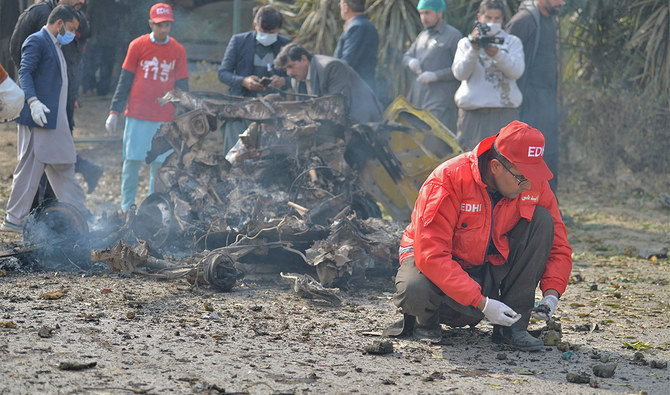
Policemen collect evidence at the suicide blast site in Islamabad on December 23, 2022. (AFP)
Short Url
Updated 23 December 2022
Follow

Suicide blast kills policeman, civilian in Pakistan’s federal capital

  • Eight people, including four policemen, are injured in the blast and two of them are said to be in critical condition
  • Driver or suicide bomber were wearing a shawl, which gave the impression a woman was also in the car, police say

ISLAMABAD: At least one policeman and a civilian were killed and eight others injured after a suicide bomber blew himself at a residential neighborhood of Pakistan’s federal capital, Islamabad, during the snap checking of vehicle, officials said.

Pakistan has witnessed a surge in militant violence in recent weeks, though such incidents have mainly remained confined to the northwestern territories of the country bordering Afghanistan.

Officials in Islamabad have blamed a proscribed militant network, Tehreek-e-Taliban Pakistan (TTP), for such incidents while urging the interim Taliban administration in the neighboring country not to allow armed groups to use the Afghan soil against other states.

The TTP, whose top leaders are based in Afghanistan, also claimed responsibility for the suicide bombing in Islamabad. The group said it conducted the bombing in revenge for the killing of its senior commander Omar Khalid Khorasani in Afghanistan in August this year. 
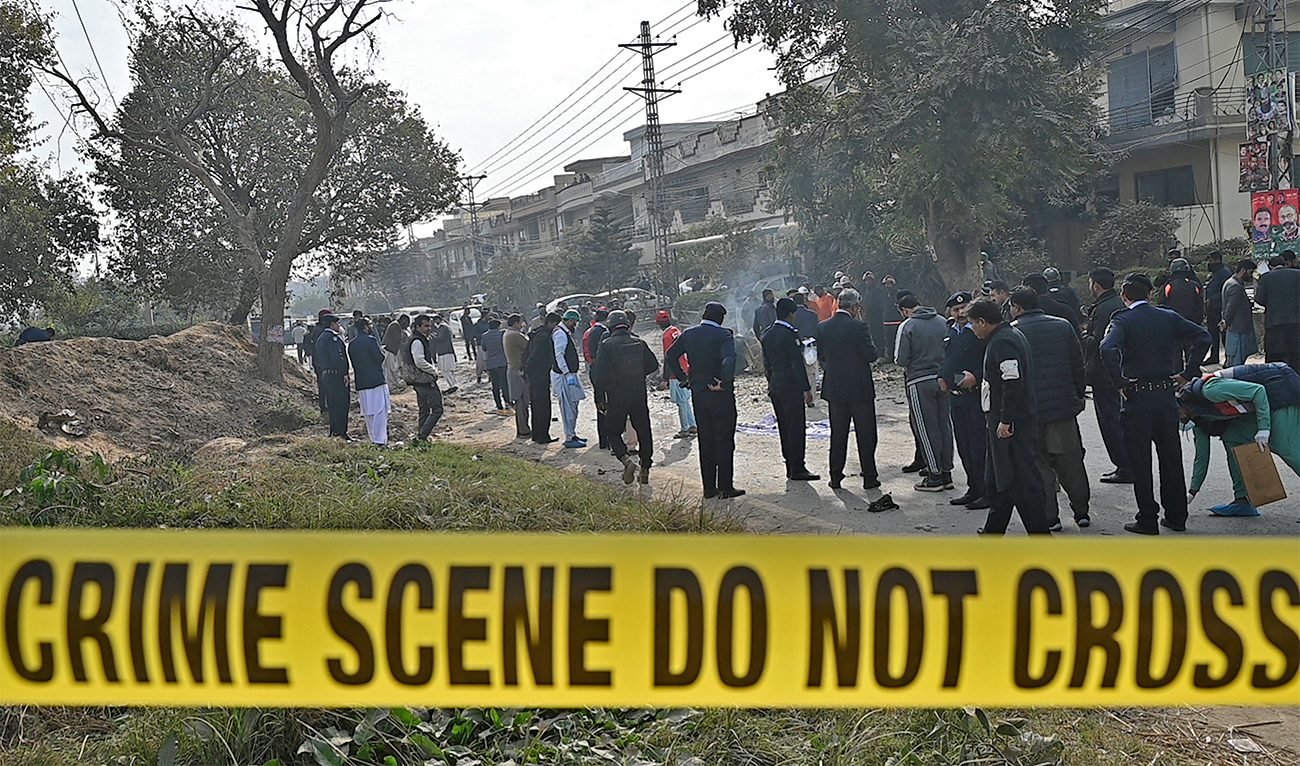


Policemen collect evidence at the suicide blast site in Islamabad on December 23, 2022. (AFP)

“Two dead people are brought to PIMS [Pakistan Institute of Medical Sciences] hospital, including a policeman identified as Adeel Hussain from the blast site,” Dr. Naveed Shaikh, a spokesperson for the medical facility, told Arab News.

He said two injured among the six brought to the hospital were in critical condition.

“All the injured are getting the best medical assistance,” he added.

The Islamabad police earlier said in a statement the security was on high alert in the federal capital and checking was going on when “a suspicious vehicle was stopped for snap checking and a suicide bomber in it blew himself up.”

“According to initial reports, a policeman has been martyred,” the statement confirmed. It informed that a heavy police contingent had also reached the crime scene soon after the incident. 

Deputy Commissioner Islamabad Irfan Nawaz Memon said in a statement that eight people, including four policemen, were injured in the blast.

An Islamabad Police spokesperson said the suicide bomber or the driver of the car had wrapped himself up in a shawl, causing investigators to initially think a woman had also been in the car. 

The interior ministry, meanwhile, said the car was prepared to hit a “high-value” target in the federal capital.

“Islamabad was saved from a big incident due to the vigilance of the police,” the ministry said.

Meanwhile, Prime Minister Shehbaz Sharif ordered a detailed report of the incident while paying tributes to the police personnel killed or injured in the blast.

“The nation salutes its valiant police personnel who stopped the terrorists by laying down their life,” he said, adding the battle against militant violence would continue until its end.

Sharif also urged the public to cooperate with the law enforcement agencies in their efforts to eliminate violent extremism.


Pakistan to promote mineral sector at Saudi forum this month with 13 companies

Updated 02 January 2026
Follow

Pakistan to promote mineral sector at Saudi forum this month with 13 companies

  • Delegation will take part in the Future Minerals Forum in Riyadh from Jan. 13-15
  • Petroleum minister will lead Pakistan, participate in a 90-minute country session

ISLAMABAD: Around 13 Pakistani state-owned and private companies will attend the Future Minerals Forum (FMF) in Saudi Arabia from Jan. 13 to 15, an official statement said on Friday, as the country seeks to ramp up global engagement to develop its mineral resources.

The FMF is an international conference and investment platform for the mining sector, hosted by mineral-rich countries to attract global investors, companies and governments.

Petroleum Minister Ali Pervaiz Malik confirmed Pakistan’s participation in a meeting with the Saudi envoy, Nawaf bin Said Al-Malki.

Pakistan hosts one of the world’s largest copper-gold zones. The Reko Diq mine in southwestern Balochistan, with an estimated 5.9 billion tons of ore, is partly owned by Barrick Gold, which calls it one of the world’s largest underdeveloped copper-gold deposits. Its development is expected to boost Pakistan’s struggling economy.

“Upon an invitation of the Government of the Kingdom of Saudi Arabia, the Federal Minister informed the Ambassador that Pakistan will fully participate in the upcoming Future Minerals Forum (FMF), scheduled to be held in Riyadh later this month,” Pakistan’s Press Information Department (PID) said in an official statement.

The Pakistani minister will lead his country’s delegation at the FMF and take part in a 90-minute country showcase session titled “Unleashing Potential: Accelerating Pakistan’s Mineral Revolution” along with local and foreign investors.

Pakistan will also establish a dedicated pavilion to highlight the vast potential of its rich geological landscape to the global mineral community.

The Saudi envoy welcomed Pakistan’s decision to participate in the forum and discussed enhancing bilateral cooperation in the minerals and energy sectors during the meeting.

According to the statement, he highlighted the potential for cooperation between Saudi Arabia and Pakistan in the minerals and energy sectors, expressing confidence that the FMF would provide a platform to expand collaboration.
Pakistan’s mineral sector, despite its rich reserves of salt, copper, gold and coal, contributes only 3.2 percent to the country’s GDP and just 0.1 percent to global mineral exports.

However, many countries, including the United States, have shown interest in Pakistan’s underdeveloped mineral sector, particularly in copper, gold and other critical resources.

In October, Pakistan dispatched its first-ever shipment of rare earth and critical minerals to the United States, according to a Chicago-based US public relations firm’s report.