

'Revisit this decision': World reacts to Taliban-led Afghanistan suspending university access for women

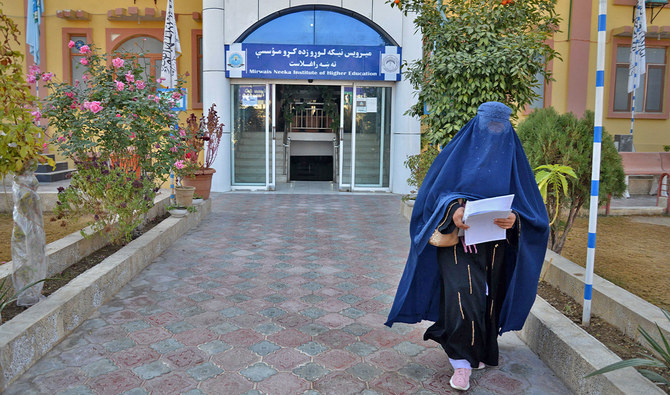
A female university Student walks in front of a university in Kandahar Province of Afghanistan on December 21, 2022. (AFP)
Short Url
Updated 21 December 2022
Follow

'Revisit this decision': World reacts to Taliban-led Afghanistan suspending university access for women

  • The move has drawn condemnation from foreign governments
  • Will complicate efforts by Taliban to gain international recognition

Afghanistan’s Taliban-run government on Tuesday suspended university access for female students, drawing condemnation from foreign governments and complicating efforts by the Taliban administration to gain international recognition.

Following are reactions from the United Nations, foreign governments and rights groups.

STEPHANE DUJARRIC, United Nations spokesperson:

“It’s another very troubling move and it’s difficult to imagine how the country can develop, deal with all of the challenges that it has, without active participation of women and the education of women.”

ANTONY BLINKEN, United States Secretary of State:

“Deeply dismayed by the announcement from the Taliban denying women the right to a university education. Afghan women deserve better. Afghanistan deserves better.”

“The Taliban have just definitively set back their objective of being accepted by the international community.”


An Afghan female student stands in front of the entrance gate of Kabul University in Kabul, Afghanistan, on December 21, 2022. (REUTERS)

QATAR FOREIGN MINISTRY:

“The State of Qatar expresses deep concern and disappointment with the Afghan caretaker government’s decision to suspend girls’ and women’s studies in Afghan universities.

“As a Muslim country in which women enjoy all their rights, especially education, the State of Qatar calls on the Afghan caretaker government to review its decision in line with the teachings of the Islamic religion concerning women’s rights.”

ANNALENA BAERBOCK, German Foreign Minister:

“By destroying the future of girls and women in Afghanistan, the Taliban decided to destroy their own country’s future. I will put the issue on the agenda of the G7 tomorrow. The Taliban may try to make women invisible, but won’t succeed — the world is watching.”

BARBARA WOODWARD, Britain’s United Nations Ambassador:

“(It is) another egregious curtailment of women’s rights and a deep and profound disappointment for every single female student. It is also another step by the Taliban away from a self-reliant and prosperous Afghanistan.”

MELANIE JOLY, Canadian Foreign Minister:

“The Taliban announced that they are suspending female students from attending universities, denying them the prospect of a better life. Equal access to all levels of education is a right to which every woman and every girl is entitled. We condemn this outrageous violation.”

PAKISTANI FOREIGN MINISTRY:

“We strongly believe that every man and woman has the inherent right to education in accordance with the injunctions of Islam. We strongly urge the Afghan authorities to revisit this decision.”

AGNES CALLAMARD, Secretary General, Amnesty International:

“It is hate, another expression of violence to maintain and preserve the power of men over women, to keep women in a small airless space. This is what Taliban is making of Afghanistan. A prison for women.”


Bangladesh halts controversial relocation of Rohingya refugees to remote island

Updated 29 December 2025
Follow

Bangladesh halts controversial relocation of Rohingya refugees to remote island

  • Administration of ousted PM Sheikh Hasina spent about $350m on the project
  • Rohingya refuse to move to island and 10,000 have fled, top refugee official says

DHAKA: When Bangladesh launched a multi-million-dollar project to relocate Rohingya refugees to a remote island, it promised a better life. Five years on, the controversial plan has stalled, as authorities find it is unsustainable and refugees flee back to overcrowded mainland camps.

The Bhasan Char island emerged naturally from river sediments some 20 years ago. It lies in the Bay of Bengal, over 60 km from Bangladesh’s mainland.

Never inhabited, the 40 sq. km area was developed to accommodate 100,000 Rohingya refugees from the cramped camps of the coastal Cox’s Bazar district.

Relocation to the island started in early December 2020, despite protests from the UN and humanitarian organizations, which warned that it was vulnerable to cyclones and flooding, and that its isolation restricted access to emergency services.

Over 1,600 people were then moved to Bhasan Char by the Bangladesh Navy, followed by another 1,800 the same month. During 25 such transfers, more than 38,000 refugees were resettled on the island by October 2024.

The relocation project was spearheaded by the government of former Prime Minister Sheikh Hasina, who was ousted last year. The new administration has since suspended it indefinitely.

“The Bangladesh government will not conduct any further relocation of the Rohingya to Bhasan Char island. The main reason is that the country’s present government considers the project not viable,” Mizanur Rahman, refugee relief and repatriation commissioner in Cox’s Bazar, told Arab News on Sunday.

The government’s decision was prompted by data from UN agencies, which showed that operations on Bhasan Char involved 30 percent higher costs compared with the mainland camps in Cox’s Bazar, Rahman said.

“On the other hand, the Rohingya are not voluntarily coming forward for relocation to the island. Many of those previously relocated have fled ... Around 29,000 are currently living on the island, while about 10,000 have returned to Cox’s Bazar on their own.”

A mostly Muslim ethnic minority, the Rohingya have lived for centuries in Myanmar’s western Rakhine state but were stripped of their citizenship in the 1980s and have faced systemic persecution ever since.

In 2017 alone, some 750,000 of them crossed to neighboring Bangladesh, fleeing a deadly crackdown by Myanmar’s military. Today, about 1.3 million of them shelter in 33 camps in the coastal Cox’s Bazar district, making it the world’s largest refugee settlement.

Bhasan Char, where the Bangladeshi government spent an estimated $350 million to construct concrete residential buildings, cyclone shelters, roads, freshwater systems, and other infrastructure, offered better living conditions than the squalid camps.

But there was no regular transport service to the island, its inhabitants were not allowed to travel freely, and livelihood opportunities were few and dependent on aid coming from the mainland.

Rahman said: “Considering all aspects, we can say that Rohingya relocation to Bhasan Char is currently halted. Following the fall of Sheikh Hasina’s regime, only one batch of Rohingya was relocated to the island.

“The relocation was conducted with government funding, but the government is no longer allowing any funds for this purpose.”

“The Bangladeshi government has spent around $350 million on it from its own funds ... It seems the project has not turned out to be successful.”