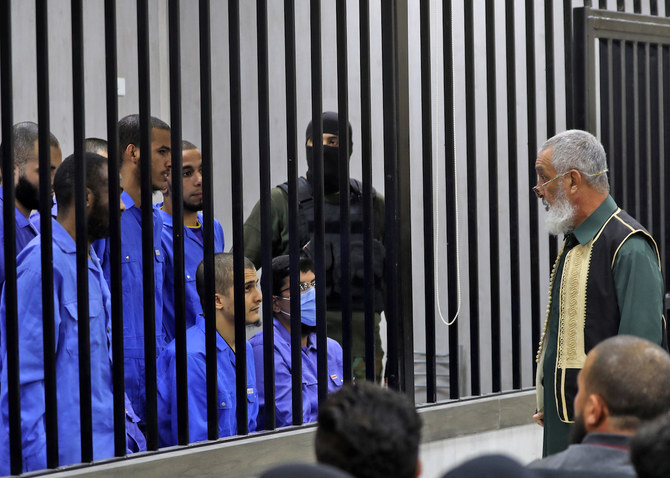
BENGHAZI: A Libyan court sentenced 17 former members of the Daesh group to death, a statement from the country’s Tripoli-based top prosecutor said on Monday.
The death sentences were given out to those convicted of participating in the killing of 53 people in the western city of Sabratha and destruction of public property, according to the statement. Another 16 militants were given prison sentences, two of them for life. The court did not specify when the sentences would be carried out.
Libya remains split between two rival administrations after years of civil war. The divide between authorities in the capital of Tripoli and eastern Libya has led to the deterioration of government institutions and services, and widespread lawlessness.
Islamic extremists expanded their reach in Libya after the 2011 uprising toppled and later killed longtime ruler Muammar Qaddafi. IS was driven from its main stronghold, the coastal city of Sirte, in 2016 and fled inland. The militants also maintain a presence in other pockets such as western Sabratha, not far from the country’s border with Tunisia.
In February 2016, the United States carried out an airstrike on an IS training camp near Sabratha, killing at least 40 people, as part of its effort to eradicate the Islamic State.


Libyan court sentences 17 former Daesh members to death
https://arab.news/2mfqf
Libyan court sentences 17 former Daesh members to death

- Death sentences were for those convicted of participating in the killing of 53 people, destruction of public property


Algeria inaugurates strategic railway to giant Sahara mine
- The mine is expected to produce 4 million tons per year during the initial phase, with production projected to triple to 12 million tons per year by 2030
- The project is financed by the Algerian state and partly built by a Chinese consortium
ALGEIRS: Algerian President Abdelmadjid Tebboune on Sunday inaugurated a nearly 1,000-kilometer (621-mile) desert railway to transport iron ore from a giant mine, a project he called one of the biggest in the country’s history.
The line will bring iron ore from the Gara Djebilet deposit in the south to the city of Bechar located 950 kilometers north, to be taken to a steel production plant near Oran further north.
The project is financed by the Algerian state and partly built by a Chinese consortium.
During the inauguration, Tebboune described it as “one of the largest strategic projects in the history of independent Algeria.”
This project aims to increase Algeria’s iron ore extraction capacity, as the country aspires to become one of Africa’s leading steel producers.
The iron ore deposit is also seen as a key driver of Algeria’s economic diversification as it seeks to reduce its reliance on hydrocarbons, according to experts.
President Tebboune attended an inauguration ceremony in Bechar, welcoming the first passenger train from Tindouf in southern Algeria and sending toward the north a first charge of iron ore, according to footage broadcast on national television.
The mine is expected to produce 4 million tons per year during the initial phase, with production projected to triple to 12 million tons per year by 2030, according to estimates by the state-owned Feraal Group, which manages the site.
It is then expected to reach 50 million tons per year in the long term, it said.
The start of operations at the mine will allow Algeria to drastically reduce its iron ore imports and save $1.2 billion per year, according to Algerian media.


