

Archaeology Magazine features old Buddhist temple in Pakistan among ‘Top 10 Discoveries of 2022’

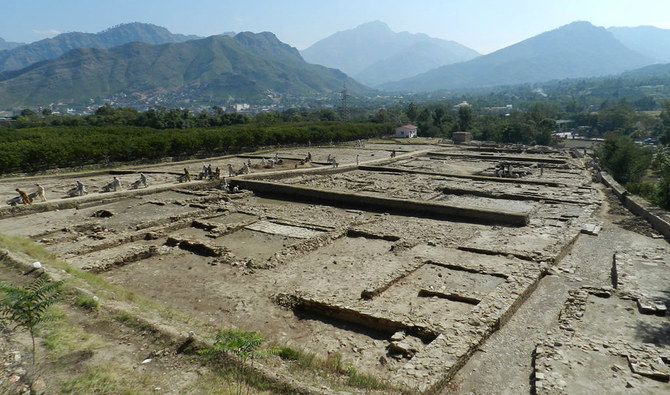
This file photo shows workers laboring on one of the world’s oldest known Buddhist temples at Barikot in the Swat Valley. (Photo courtesy: The Italian Archeological Mission - Pakistan)
Short Url
Updated 19 December 2022
Follow

Archaeology Magazine features old Buddhist temple in Pakistan among ‘Top 10 Discoveries of 2022’

  • Archaeologists discovered Buddhist temple in December 2021 in northwestern Pakistan’s Barikot town
  • As per estimates, temple dates back to end of second century B.C. when area was hub of Buddhist teachings

ISLAMABAD: An old Buddhist temple discovered last year in Pakistan’s Barikot town has been featured in the Top 10 Discoveries of 2022 by the renowned Archaeology Magazine.

Barikot is a town located in Pakistan’s northwestern Khyber Pakhtunkhwa (KP) province. It serves as an entrance town to the picturesque Swat Valley in KP province, where thousands of tourists flock to each year to vacation in the mountains.

The Gandhara region makes up part of present-day northern Pakistan and northeast Afghanistan. The area is famous for its Gandhara style of art which is heavily influenced by the classical Greek and Hellenistic traditions.

This region in northwestern Pakistan was a crossroads for the exchange of goods and culture among the civilizations of the Middle East, Central Asia and India from the sixth century B.C.

In its Top 10 Discoveries of 2022 section, Archaeology Magazine featured the old temple, discovered by archaeologist Luca Maria Olivieri of Ca’ Foscari University and his team in December last year, saying that the monument dated back to at least as early as the end of the second century B.C.

“This makes it the oldest known Buddhist temple in the region and places its construction firmly during the period when Barikot is known to have been a center of Buddhist teaching and a sacred pilgrimage site,” the magazine said.

Olivieri told the magazine that he did not expect there to be Buddhist monuments in the city at such an early stage. “Until now, we have not excavated any evidence of Buddhist presence in Barikot dating to before the end of the first century A.D.,” he added.

The remnants excavated from the site include a 10-foot-high apsidal structure on which a circular shrine was later made. The building also contains an iconic cone-shaped Buddhist stupa.

“Olivieri’s team was surprised by the building’s shape, which is well known from Buddhist structures in India at this time but is very rare in Gandhara,” the magazine wrote. “The team has also found Buddhist sculptures and inscriptions.”


Pakistan warns India-Canada uranium deal could widen nuclear imbalance in South Asia

Updated 5 sec ago
Follow

Pakistan warns India-Canada uranium deal could widen nuclear imbalance in South Asia

  • Islamabad says assured uranium supplies could free India’s domestic reserves for military use
  • Foreign office calls for non-discriminatory nuclear cooperation framework for non-NPT states

ISLAMABAD: Pakistan on Thursday voiced concern over a uranium supply agreement and nuclear technology cooperation between India and Canada, warning the arrangement could expand India’s nuclear arsenal and undermine the global non-proliferation framework.

The statement came after Ottawa and New Delhi concluded a long-term deal covering uranium supplies and potential cooperation in advanced nuclear technologies, including small modular reactors.

The agreement was announced earlier this week as part of efforts by the two countries to deepen energy and economic ties. Canada has previously supplied uranium to India under a civilian nuclear cooperation framework first agreed in 2010 and implemented in 2013, with commercial supply contracts signed in subsequent years.

“Assured external uranium supplies effectively release India’s domestic reserves for military use, enabling the expansion of its fissile material stockpiles, accelerating the growth of its nuclear arsenal, and deepening existing asymmetries in South Asia’s strategic balance,” foreign office spokesperson Tahir Andrabi said in a statement while responding to media queries.

“The arrangement also undermines Canada’s commitment to the international non-proliferation regime and its corresponding obligations under that framework,” he added.

Andrabi said the agreement represents another country-specific exception in civilian nuclear cooperation, noting that India’s 1974 nuclear test — conducted using plutonium produced in a Canadian-supplied research reactor — led to the creation of the Nuclear Suppliers Group (NSG).

“A state whose actions necessitated the establishment of global export controls is now being granted preferential access under selective arrangements,” he added.

The foreign office spokesperson said India has not placed all of its civilian nuclear facilities under International Atomic Energy Agency safeguards and has not made binding commitments under the new arrangement to do so.

He also pointed out it was unclear what concrete non-proliferation assurances accompanied the agreement.

“Pakistan reiterates that civil nuclear cooperation must be governed by a non-discriminatory, criteria-based approach applicable equally to states that are not parties to the Nuclear Non-Proliferation Treaty (NPT),” Andrabi said.

“Selective exceptions diminish the credibility of the global non-proliferation framework and risk further destabilizing regional and global peace & security.”