

Archaeology Magazine features old Buddhist temple in Pakistan among ‘Top 10 Discoveries of 2022’

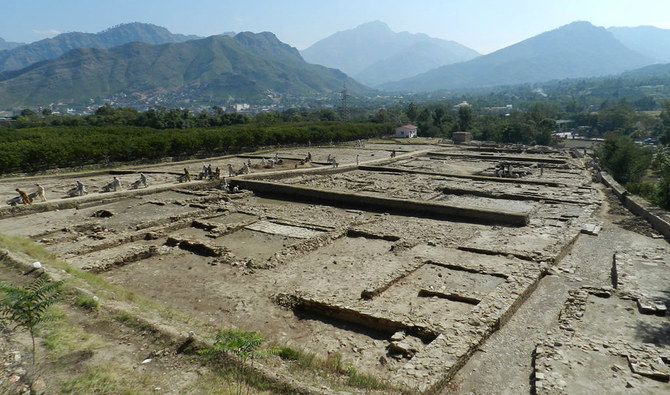
This file photo shows workers laboring on one of the world’s oldest known Buddhist temples at Barikot in the Swat Valley. (Photo courtesy: The Italian Archeological Mission - Pakistan)
Short Url
Updated 19 December 2022
Follow

Archaeology Magazine features old Buddhist temple in Pakistan among ‘Top 10 Discoveries of 2022’

  • Archaeologists discovered Buddhist temple in December 2021 in northwestern Pakistan’s Barikot town
  • As per estimates, temple dates back to end of second century B.C. when area was hub of Buddhist teachings

ISLAMABAD: An old Buddhist temple discovered last year in Pakistan’s Barikot town has been featured in the Top 10 Discoveries of 2022 by the renowned Archaeology Magazine.

Barikot is a town located in Pakistan’s northwestern Khyber Pakhtunkhwa (KP) province. It serves as an entrance town to the picturesque Swat Valley in KP province, where thousands of tourists flock to each year to vacation in the mountains.

The Gandhara region makes up part of present-day northern Pakistan and northeast Afghanistan. The area is famous for its Gandhara style of art which is heavily influenced by the classical Greek and Hellenistic traditions.

This region in northwestern Pakistan was a crossroads for the exchange of goods and culture among the civilizations of the Middle East, Central Asia and India from the sixth century B.C.

In its Top 10 Discoveries of 2022 section, Archaeology Magazine featured the old temple, discovered by archaeologist Luca Maria Olivieri of Ca’ Foscari University and his team in December last year, saying that the monument dated back to at least as early as the end of the second century B.C.

“This makes it the oldest known Buddhist temple in the region and places its construction firmly during the period when Barikot is known to have been a center of Buddhist teaching and a sacred pilgrimage site,” the magazine said.

Olivieri told the magazine that he did not expect there to be Buddhist monuments in the city at such an early stage. “Until now, we have not excavated any evidence of Buddhist presence in Barikot dating to before the end of the first century A.D.,” he added.

The remnants excavated from the site include a 10-foot-high apsidal structure on which a circular shrine was later made. The building also contains an iconic cone-shaped Buddhist stupa.

“Olivieri’s team was surprised by the building’s shape, which is well known from Buddhist structures in India at this time but is very rare in Gandhara,” the magazine wrote. “The team has also found Buddhist sculptures and inscriptions.”


Pakistan’s top military commander stresses agility in modern warfare during visit to frontline garrisons

Updated 4 sec ago
Follow

Pakistan’s top military commander stresses agility in modern warfare during visit to frontline garrisons

  • Field Marshal Asim Munir reviews field drills and simulator training in Gujranwala and Sialkot, praising high readiness levels
  • Field Marshal Asim Munir reviews field drills and simulator training in Gujranwala and Sialkot, praising high readiness levels

ISLAMABAD: Pakistan’s Chief of Defense Forces Field Marshal Asim Munir said on Saturday modern warfare requires agility, precision and situational awareness as he visited the Gujranwala and Sialkot Garrisons, where he interacted with officers and soldiers and observed their combat readiness.

The two cities sit close to the border with India, giving them strategic importance, particularly after a brief but intense military clash between the nuclear-armed rivals in May.

The conflict was sparked when India launched missile strikes on Pakistani cities, saying it was targeting “terror infrastructure” after blaming Islamabad for a gun attack on tourists in Indian-administered Kashmir, though Pakistan had denied involvement and demanded an impartial international probe.

Both sides exchanged missiles and artillery fire and deployed fighter aircraft and drones during four days of hostilities before a US-brokered ceasefire halted the escalation.

“The Field Marshal witnessed field training exercise and advanced simulator training facility, lauding the formation’s high professional standards and overall state of readiness,” the military’s media wing, Inter-Services Public Relations (ISPR), said in a statement.

“Emphasizing the significance of technological adaptability, he noted that modern warfare demands agility, precision, situational awareness and swift decision-making,” it added.

A video released by ISPR showed Munir watching a military demonstration involving tanks and drones.

During his interaction with troops, Munir praised their morale and commitment to national defense.

He said the Pakistan Army remained fully focused on internal and external challenges, including “hostile hybrid campaigns, extremist ideologies, and divisive elements seeking to undermine national stability.”