

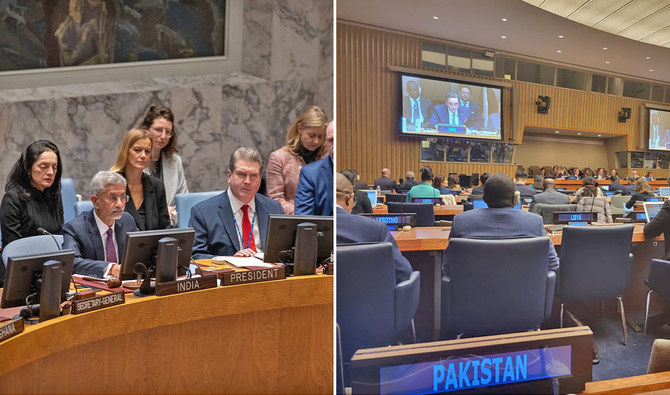
India, Pakistan envoys trade heated accusations of ‘terrorism’

India’s external affairs minister, Subrahmanyam Jaishankar (left), and Pakistan's foreign minister Bilawal Bhutto-Zardari address different meetings at UN headquarters in New York, Pakistan, on December 15, 2022. (@DrSJaishankar and @PakistanUN_NY)
Short Url
Updated 16 December 2022
Follow

India, Pakistan envoys trade heated accusations of ‘terrorism’

  • India’s foreign minister says ‘world today sees [Pakistan] as epicenter of terrorism’
  • Bhutto-Zardari says Pakistan lost far more lives to ‘terrorism’ than India

UNITED NATIONS: After the UN Security Council adopted a statement Thursday warning of the increasing dangers of ‘terrorism’, envoys from India and Pakistan heatedly traded accusations blaming each other for militant attacks.

India’s external affairs minister, Subrahmanyam Jaishankar, never named Pakistan in his speech to the Security Council. But answering questions afterward from reporters, he recalled former US Secretary of State Hillary Clinton saying during a visit to Pakistan a decade ago “that if you keep snakes in your backyard, you can’t expect them to bite only your neighbors, eventually they will bite the people who keep them in the backyard.”

“Pakistan is not good at taking good advice,” Jaishankar said. “The world today sees them as the epicenter of terrorism.”

Earlier, he told the council that “India faced the horrors of cross-border terrorism long before the world took serious not of it” and has “fought terrorism resolutely, bravely and with a zero-tolerance approach.”

He said that the Sept. 11, 2001, ‘terrorist’ attack on the United States that killed nearly 3,000 people and the Nov. 26, 2008, attack that killed 166 people in Mumbai, India, must never happen again.

The 10 Mumbai attackers were members of Lashkar-e-Taiba, a Pakistan-based militant group, and Indian investigators later said their actions were directed by phone by handlers in Pakistan.

Pakistani Foreign Minister Bilawal Bhutto-Zardari was asked to respond to Jaishankar’s claim that the world sees Pakistan as “the epicenter of terrorism” at a news conference soon after.

He said that Pakistan as a nation has been the victim of ‘terrorism’ and that he as an individual is a victim of ‘terrorism’ — his mother, Benazir Bhutto, the first woman elected to lead a Muslim majority country in 1988, was assassinated by a suicide bomber who rushed her motorcade as she campaigned for president in 2007.

Bhutto-Zardari said fighting against militancy has been a cause “that is incredibly personal to me.”

“As a Muslim, as a Pakistani, as a victim of terrorism, I believe it is time that we move away from some of the Islamophobic narrative framing of this issue that took place after the awful attacks of Sept. 11, 2001, because what we witnessed from that date up until now is that terrorism, of course, knows no religion, knows no boundaries,” he said.

He said that Pakistan has lost far more lives to ‘terrorism’ than India, but that the Indians continue to say “Muslim and terrorist together,” whether in Pakistan or in India.

Bhutto-Zardari said Jaishankar should remember “that Osama bin Laden is dead, but the butcher of Gujarat lives and he is the prime minister of India.”

He was referring to Indian Prime Minister Narendra Modi, a Hindu nationalist who was accused of not doing enough to prevent the killings of nearly 1,000 Muslims during riots in 2002 in India’s western state of Gujarat, where he was the top elected official.

Before being asked about Jaishankar’s “epidemic” claim, Bhutto-Zardari told reporters that “it is about time that India and Pakistan and the international community work together ... to ensure that the financing, support, and facilitation of these (terrorist) groups come to an end.”


Planning minister says Pakistan to set up advanced technology centers to support economic growth

Updated 13 sec ago
Follow

Planning minister says Pakistan to set up advanced technology centers to support economic growth

  • Ahsan Iqbal says planned centers to focus on artificial intelligence, quantum computing and nanotechnology
  • He also cites satellite technology as key tool for climate monitoring, early warning and disaster management

ISLAMABAD: Pakistan plans to set up technology Centers of Excellence, including facilities focused on quantum computing and nanotechnology, as it seeks to benefit from rapid advances in artificial intelligence and emerging technologies, state media reported on Friday.

The announcement was made by Planning and Development Minister Ahsan Iqbal, who said the government aims to position Pakistan to compete in future technologies that are expected to drive economic growth and reshape global industries.

Quantum computing, which uses the principles of quantum mechanics to process information far more quickly than conventional computers, has applications ranging from complex data analysis and cryptography to climate modeling and materials science. Nanotechnology focuses on engineering materials at the molecular level and is widely used in energy storage, medicine and electronics.

Addressing a ceremony in Islamabad, Iqbal said countries that master artificial intelligence, robotics, quantum computing and space technologies would lead the global economy in the coming decades.

“During the address, the minister said Pakistan’s efforts to align itself with rapid advancements in artificial intelligence, robotics, space innovation and emerging technologies reflect the country’s ambition to participate confidently in shaping the future,” Radio Pakistan reported.

“Ahsan Iqbal further announced that the government plans to establish three Centers of Excellence, including a National Center for Quantum Computing and a National Center for Nanotechnology, aimed at upgrading the national economy,” it added.

He informed the ceremony that measures were underway to develop a new Silicon Valley in Pakistan “to promote cross-fertilization of ideas and innovation by bringing talent, research and industry together under one roof.”

The minister also highlighted the role of technology in tackling climate challenges, noting that satellite systems are increasingly used worldwide for disaster management, early warning systems and climate monitoring.

Pakistan, one of the world’s most climate-vulnerable countries, can benefit from satellite technology to track weather patterns, manage floods and improve disaster preparedness, he said, adding that more than 9,000 satellites currently orbit the Earth and are transforming how economies and governments operate.

Iqbal said the planned centers would support Pakistan’s broader “Uraan Pakistan” vision, which focuses on exports, digital development, energy and infrastructure, environmental resilience and social equity, Radio Pakistan reported.